Women Just 3% of Master's Graduates and None at PhD Level, Prof. Akech Warns
Women account for just 3% of master's graduates in South Sudan and none at PhD level, according to figures highlighted by Prof. Akech and reported by Eye Radio — a pipeline problem that begins long before postgraduate study.
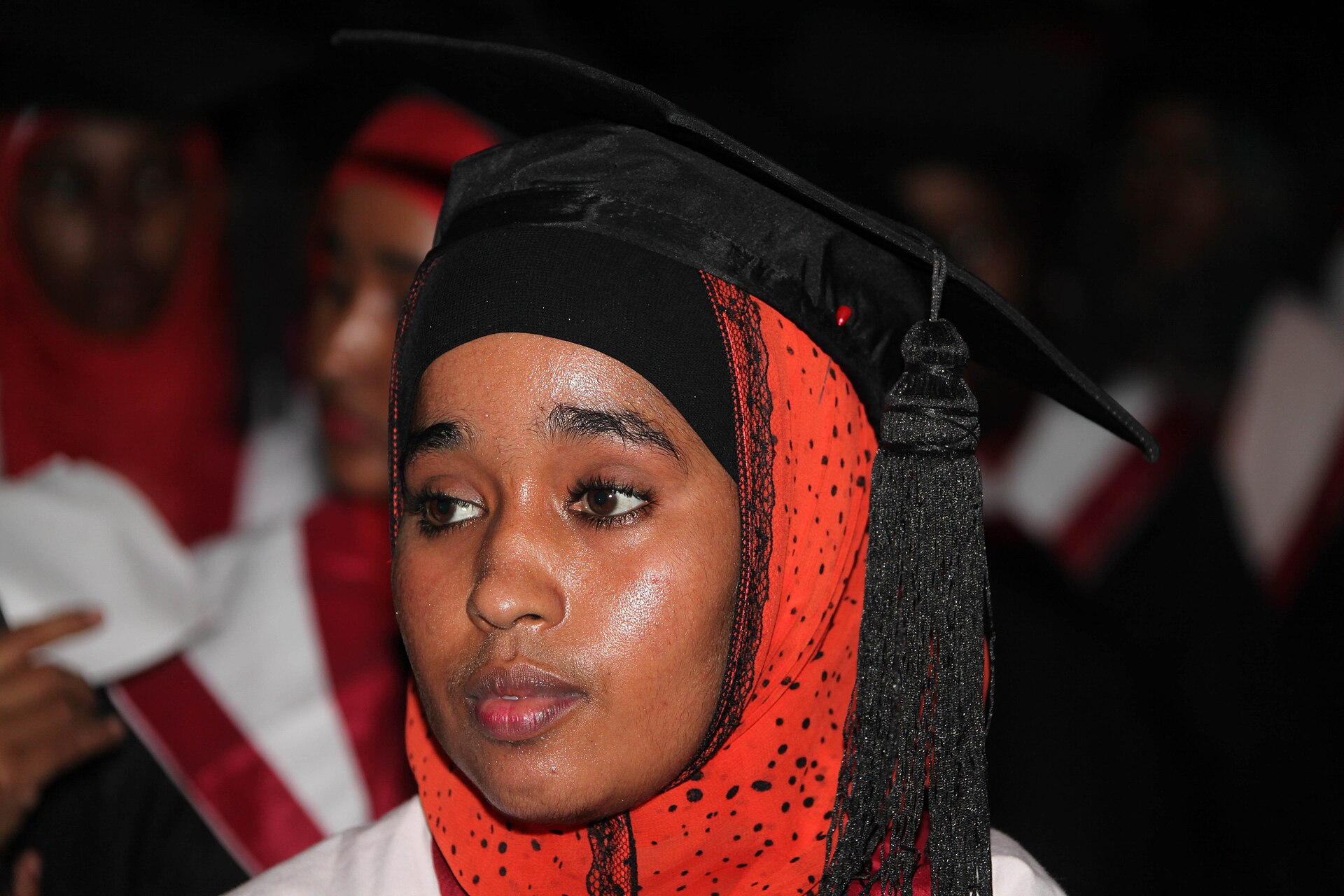
Graduates at a university graduation ceremony in Mogadishu, Somalia, in a file photograph of East African university graduations. (Wikimedia Commons, CC0)
Women account for just 3% of master's graduates in South Sudan and none at PhD level, according to figures highlighted by Prof. Akech and reported by Eye Radio — a pipeline problem that begins long before postgraduate study.
JUBA — Women account for just 3% of master's graduates in South Sudan, and none at PhD level, according to Prof. Akech, in figures reported by Eye Radio. Put plainly, for every hundred master's degrees completed, ninety-seven go to men — and at the highest level of scholarship, the doctorate, the reported number of women graduates is zero.
Figures like these describe the end of a long pipeline, and the leaks begin early. A woman completing a master's degree has already survived every point at which girls and women leave education in disproportionate numbers: primary school, the transition to secondary school, completion of secondary school, admission to a first degree, and the years of undergraduate study. Each stage narrows the cohort, so that by the time postgraduate study begins, the pool of eligible women has already been reduced many times over.

The barriers are well understood in general terms, even where precise statistics are scarce. School fees compete within households, and boys' education is still too often prioritised when money runs short. Early marriage and childbearing interrupt studies at exactly the ages when postgraduate work would begin. Unpaid care work falls overwhelmingly on women, and a master's degree demands precisely what caring responsibilities consume: time, money and the freedom to travel or study away from home.
There is also the question of what a young woman sees ahead of her. Universities where few senior academics are women offer few visible examples of the path from first degree to doctorate to professor. Mentorship matters in postgraduate education — supervisors open doors to funding, conferences and publication — and where women are scarce at the top of institutions, the informal guidance that carries students upward is scarcer for women too.
The cost is national, not only personal. A country rebuilding its health service, courts, schools and economy needs researchers, specialists and university teachers drawn from its whole population. When half the population produces 3% of master's graduates and no doctoral graduates, expertise that South Sudan urgently needs simply never comes into existence, and decisions in every field are taken with women's knowledge and experience largely absent from the room.
The 3% figure also invites a comparison every reader can make. Women are roughly half of South Sudan's population and a large share of its primary school classrooms, yet their presence thins at every subsequent level until, at the summit of the system, it disappears entirely. That pattern is the signature of cumulative disadvantage rather than of ability: no serious observer argues that talent is distributed ninety-seven to three. Where the pipeline narrows this predictably, the explanation lies in the obstacles placed along it, and so does the remedy.
Changing a figure like 3% is slow work, but it is not mysterious work: keeping girls in secondary school, funding women through first degrees, providing scholarships and childcare that make postgraduate study possible for mothers, and appointing qualified women to senior academic posts so the next cohort can see the destination. Prof. Akech's figures, as reported by Eye Radio, give the country a baseline. The measure of the response will be whether, in years to come, the same count produces a different number. (Source: Eye Radio)
Source: Juba Global News Network, reporting Eye Radio coverage.