US Releases Massive Oil Reserves as Prices Soar Amid Gulf Chaos
By Juba Global News Network | JubaGlobal.com
March 12, 2026
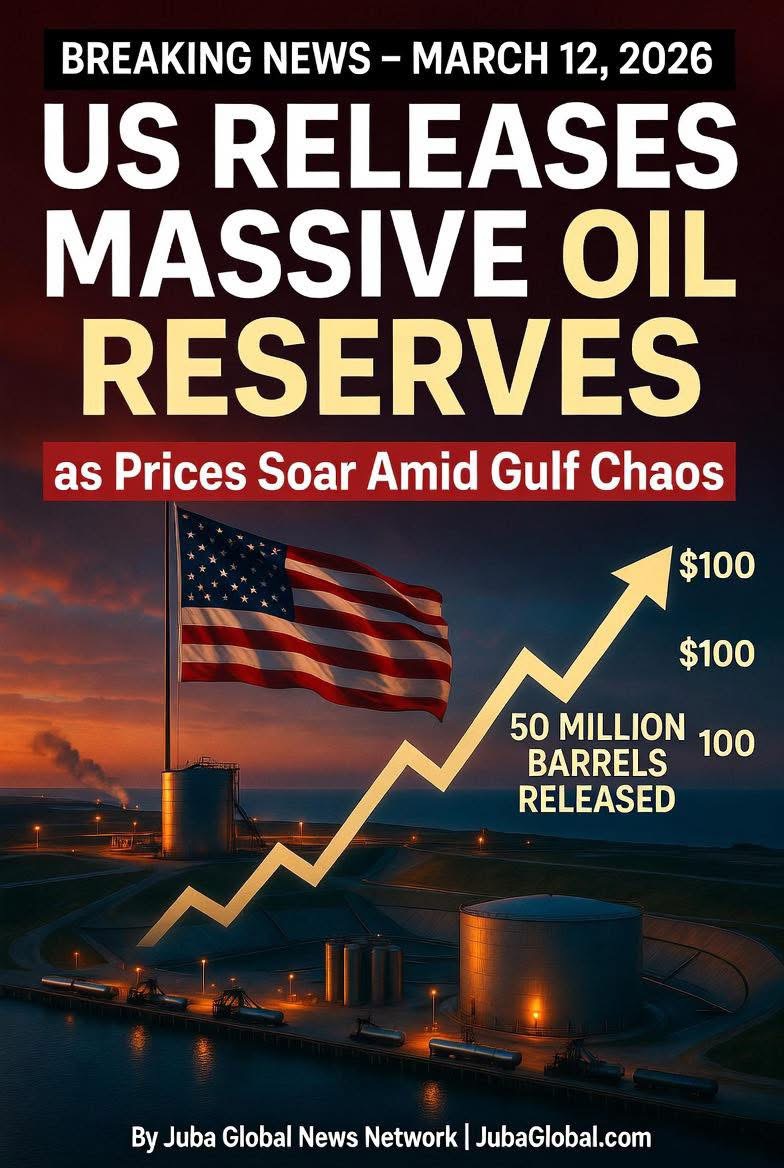
WASHINGTON / HOUSTON — In an emergency move to blunt the economic fallout from Iran’s blockade of the Strait of Hormuz, the United States and more than 30 allied nations have begun releasing tens of millions of barrels from strategic petroleum reserves, the largest coordinated drawdown since the 2022 Russia-Ukraine energy shock.
The White House announced the decision late Tuesday evening after Brent crude futures briefly surged past $119 per barrel earlier in the day. Energy Secretary Chris Wright confirmed that the U.S. Strategic Petroleum Reserve (SPR) will release up to 50 million barrels over the next 30 days, with additional contributions from Japan, South Korea, Germany, France, India and other partners bringing the total coordinated release above 120 million barrels.
“This is not panic — this is prudence,” Wright told reporters at the Department of Energy. “We will not allow Iran to hold the global economy hostage. American drivers, airlines, and factories will not pay the price for Tehran’s aggression.”
The Scale of the Intervention
The SPR, which sits in underground salt caverns along the Gulf Coast of Texas and Louisiana, currently holds roughly 370 million barrels after years of replenishment under the Trump administration. The 50-million-barrel release represents the largest single draw since President Biden’s historic 180-million-barrel release in 2022 — but this time it is explicitly tied to a shooting war.
Pentagon and Energy Department officials say the oil will be released in phased tranches starting immediately, with tankers already loading at the Bryan Mound and Big Hill sites in Texas. Allied nations are following suit: Japan is tapping 15 million barrels, South Korea 10 million, and European countries another 30 million combined.
“This is the largest collective reserve release in history,” said Dr. Meghan O’Sullivan, former U.S. deputy national security advisor for energy and now at Harvard’s Belfer Center. “The message to Iran is clear: your attempt to weaponise oil will be met with overwhelming supply response.”
Why Prices Are Still Climbing
Despite the massive injection, markets refused to calm. Brent crude closed Wednesday at $98.47 — still up 28% since the war began — while West Texas Intermediate settled at $94.12. Analysts say the physical disruption in the Gulf is simply too severe for reserves alone to fix.
More than 40 tankers have been diverted or delayed since Iranian forces began mining and attacking vessels in the Strait of Hormuz. Daily oil flows through the chokepoint have dropped by an estimated 4.2 million barrels per day, according to Kpler tracking data. Insurance rates for Gulf voyages have quadrupled, and several major shipping companies have declared “force majeure.”
OPEC+ emergency meeting scheduled for next week is already under pressure. Saudi Arabia and the UAE have pledged to increase production by 500,000 barrels per day each, but analysts doubt they can sustain that without damaging long-term fields.
Pain at the Pump Reaches American Families
In the United States, the national average gasoline price jumped to $3.67 per gallon Wednesday morning — the highest since October 2024. In California, prices in some counties topped $4.85, while truck stops along Interstate 80 reported diesel at $4.12.
Trucking companies have already announced fuel surcharges. Delta and United Airlines added $30–$60 to round-trip domestic fares effective immediately. Farmers in the Midwest are watching diesel costs rise just weeks before spring planting.
“I fill up twice a week for my commute and it’s already costing me an extra $40 a month,” said Maria Gonzalez, a nurse in Phoenix, Arizona. “If this keeps up, I don’t know how we’re going to make rent.”
Global Economic Warning Lights Flash Red
The International Energy Agency (IEA) issued its strongest alert yet, warning that sustained disruption could shave 0.8% off global GDP growth this year. China, the world’s largest oil importer, has quietly begun drawing from its own strategic reserves while ramping up purchases from Russia via discounted pipelines.
European leaders met virtually Wednesday night to coordinate further releases and accelerate LNG imports from the United States and Qatar. German Economy Minister Robert Habeck warned: “We are facing the most serious energy security crisis since 1973.”
Stock markets reacted sharply. The Dow Jones fell more than 600 points in early trading before partially recovering on news of the reserve release. Oil majors ExxonMobil, Chevron and Shell saw shares surge 7–11% as investors bet on sustained high prices.
Trump Administration’s Dual Message
President Donald Trump took to Truth Social early Wednesday: “We are releasing massive amounts of oil from our reserves — something only I would do — and prices will come down FAST once we finish the job in Iran. America will never be energy weak again!”
At the same time, National Security Advisor Michael Waltz told Fox News the releases are “temporary and targeted” and stressed that “the real solution is victory over the Iranian regime, not endless reserve releases.”
Strategic Implications: A New Energy Battlefield
Military analysts note that Iran’s strategy of targeting commercial shipping — rather than direct confrontation with U.S. warships — is designed precisely to force reserve draws like this one. By making the world burn through emergency stocks, Tehran hopes to weaken Western staying power.
Pentagon officials confirmed that U.S. Navy escort operations for tankers have begun in the Arabian Sea, but they stopped short of announcing a full naval convoy system.
What Happens Next?
The SPR release is expected to provide a buffer of 4–6 weeks. Beyond that, the administration will face difficult choices: further drawdowns (risking national security stockpiles), forcing OPEC+ to flood the market, or escalating military operations to reopen the Strait by force.
Energy traders on the New York Mercantile Exchange are already pricing in $110+ oil by April if Hormuz attacks continue.
Juba Global News Network will track every barrel released, every price tick, and every diplomatic development. As one veteran oil trader in Houston put it: “We just bought ourselves time — but time is running out.”
This is a rapidly evolving story. Live oil price tracker, interactive reserve maps, and expert analysis updated hourly at JubaGlobal.com.