

Civilian Toll Rises: Iran Reports Over 1,348 Killed in US-Israeli Strikes
By Juba Global News Network | JubaGlobal.com March 12, 2026 TEHRAN / NEW YORK — Iran’s ambassador to the United Nations delivered a harrowing briefing Wedn
By Juba Global News Network | JubaGlobal.com
March 12, 2026
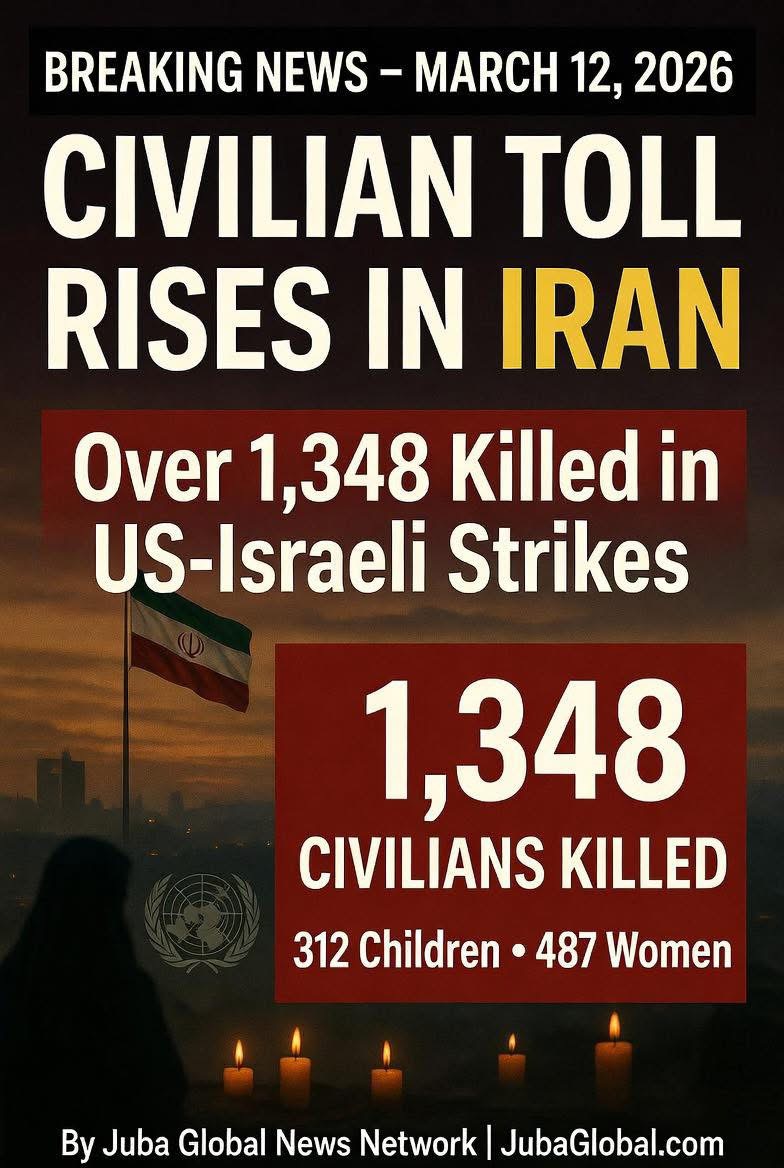
TEHRAN / NEW YORK — Iran’s ambassador to the United Nations delivered a harrowing briefing Wednesday morning, stating that more than 1,348 civilians have been killed and over 17,000 injured since the U.S.-Israeli military campaign against Iran began in late February, marking the deadliest phase of the conflict to date and triggering urgent international calls for a humanitarian ceasefire.
Ambassador Amir Saeid Iravani stood before the UN Security Council with a thick dossier of photographs, medical records and satellite imagery, declaring: “These are not collateral damage. These are deliberate strikes on homes, hospitals, schools and markets. The world is witnessing a humanitarian catastrophe unfolding in real time.”
Iranian state television aired the full session live, showing rows of flag-draped coffins in Tehran’s main cemetery and families weeping beside fresh graves. Health Ministry officials in Tehran released updated figures: 1,348 confirmed civilian deaths, including 312 children and 487 women, with another 17,426 people hospitalised for injuries ranging from shrapnel wounds to severe burns caused by strikes on energy infrastructure.
The Human Cost Behind the Headlines
The numbers are staggering. In the city of Isfahan alone, more than 200 civilians died when precision strikes hit a residential district adjacent to a suspected missile production site. Rescue workers described pulling entire families from collapsed apartment blocks. In Tabriz, a maternity hospital was damaged by a nearby blast, forcing premature babies onto generators and leaving three infants dead.
One survivor’s story has gone viral inside Iran. 28-year-old teacher Leila Hosseini lost her husband and two young daughters when their home in a southern suburb of Tehran was destroyed. In a tearful interview with Iranian state media, she said: “They told us the war was only against military targets. My children were sleeping. What threat did they pose?”
Hospitals across the country are operating at triple capacity. Shortages of antibiotics, painkillers and blood supplies have become critical after strikes damaged pharmaceutical factories and power grids, causing widespread blackouts that prevent refrigeration of medicines.
Iran Accuses US and Israel of War Crimes
Ambassador Iravani presented evidence claiming that at least 40% of the strikes occurred in civilian-dense areas with no visible military activity at the time of impact. He accused the United States and Israel of violating international humanitarian law and called for an immediate International Criminal Court investigation.
“These are not accidents,” he said. “The pattern is clear: destroy the economy, break the people’s will, and force surrender through suffering.”
Israeli Defence Forces spokesperson Rear Adm. Daniel Hagari rejected the claims outright, stating: “Every target is chosen with precision based on intelligence. We deeply regret any civilian harm, but Iran embeds its military assets among its own people. The blood is on Tehran’s hands.”
The U.S. State Department echoed that position, with spokesperson Tammy Bruce telling reporters: “Iran’s regime bears responsibility for putting its population at risk by using civilian areas as shields. We continue to minimise civilian casualties to the greatest extent possible.”
International Outcry and Diplomatic Pressure
The United Nations Secretary-General António Guterres called the reported death toll “deeply alarming” and demanded an immediate humanitarian pause. “Civilians are paying the highest price,” he said in a statement from New York. “This conflict must not be allowed to spiral into an even greater tragedy.”
China and Russia led calls for a Security Council resolution demanding a ceasefire and independent verification of casualty figures. French President Emmanuel Macron urged both sides to “return to diplomacy before the death toll becomes irreversible.” Even traditionally pro-Israel nations such as Germany and the United Kingdom expressed concern over the rising civilian numbers.
Human rights groups have joined the chorus. Amnesty International released satellite analysis showing damage to civilian infrastructure in 14 Iranian cities. “The scale of destruction suggests a strategy of collective punishment,” said the organisation’s Middle East director.
Inside Iran, the mood is one of defiant mourning. State-organised funerals have drawn hundreds of thousands, with crowds chanting anti-American and anti-Israeli slogans. President Masoud Pezeshkian used the casualty figures in his earlier speech setting peace conditions, saying: “We have paid in blood. Now the world must choose between justice and continued slaughter.”
The Broader Humanitarian Crisis
Beyond deaths and injuries, the war is creating a cascading crisis. More than 2.5 million Iranians have been internally displaced, according to the Iranian Red Crescent. Food prices have surged 60% in major cities as fuel shortages and damaged ports disrupt supply chains. Winter temperatures are dropping, yet millions lack reliable electricity for heating.
The International Committee of the Red Cross has warned that without safe corridors for aid, disease could soon claim more lives than the bombs. “We are seeing the early signs of a public health emergency,” said ICRC regional director Martin Schüepp.
Strategic Implications for the War
Military analysts say the high civilian toll is becoming a double-edged sword for the U.S.-Israeli coalition. While strikes have degraded Iran’s nuclear and missile capabilities, the mounting death toll is fuelling global pressure to halt operations and is hardening Iranian resolve.
“Every civilian death becomes a recruitment tool for the Revolutionary Guard,” noted Dr. Sanam Vakil of Chatham House. “The more Iran bleeds, the harder it becomes for Washington to claim victory without looking like the aggressor.”
Pentagon officials privately admit the casualty figures complicate messaging. Publicly, however, they insist the campaign remains “measured and necessary” to prevent Iran from acquiring nuclear weapons.
What Comes Next?
Iran’s UN envoy announced plans to present a formal resolution at the Security Council on Thursday demanding an immediate end to airstrikes and the establishment of a UN fact-finding mission. The Trump administration has signalled it will veto any such measure, calling it “one-sided.”
Meanwhile, Iranian officials say they will continue releasing updated casualty lists daily “until the world can no longer look away.”
For ordinary Iranians, the war has moved from distant headlines to daily survival. As one grieving father in Isfahan told local media while burying his son: “We are not soldiers. We are just people who want to live.”
Juba Global News Network will continue to monitor the humanitarian situation on the ground in Iran, bringing verified updates, survivor testimonies and expert analysis as the death toll rises.
This is a rapidly evolving story. Full casualty database, interactive maps of affected areas, and live UN coverage available now at JubaGlobal.com.
