

Israeli Strikes Hit Beirut Waterfront, Killing 8 in Latest Escalation
By Juba Global News Network | JubaGlobal.com March 12, 2026 BEIRUT / TEL AVIV — Israeli warplanes struck targets along Beirut’s southern waterfront and den
By Juba Global News Network | JubaGlobal.com
March 12, 2026
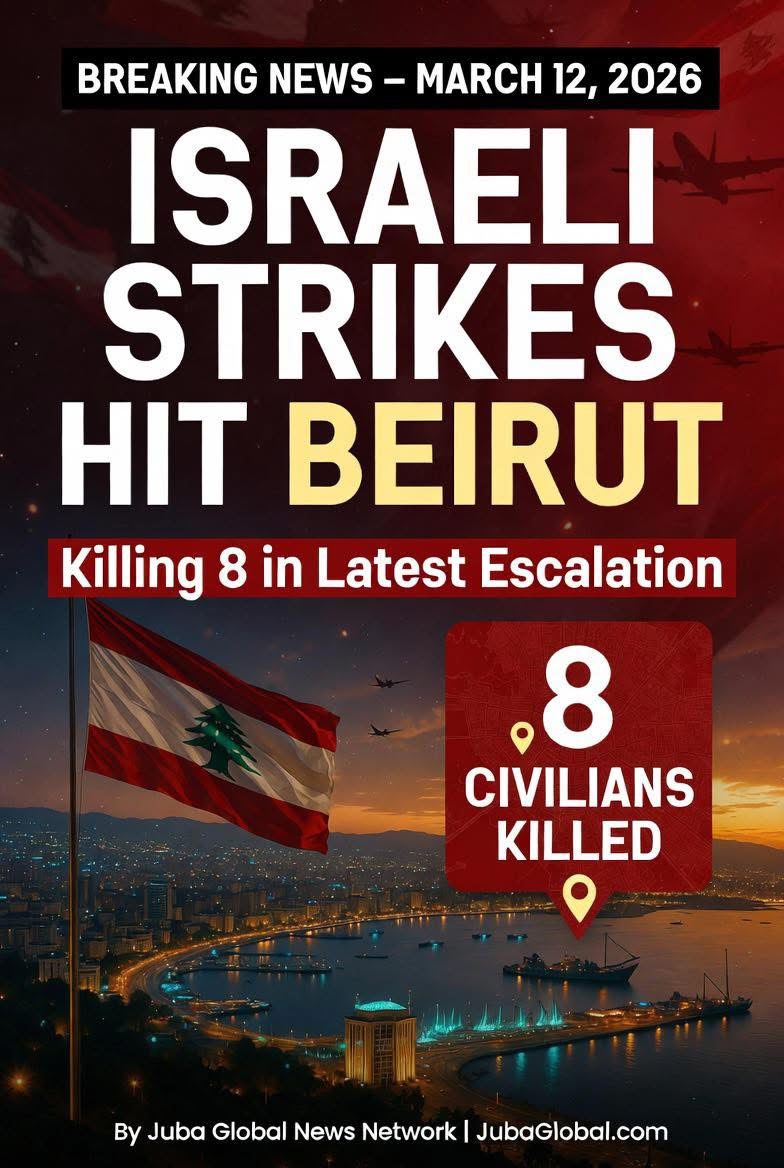
BEIRUT / TEL AVIV — Israeli warplanes struck targets along Beirut’s southern waterfront and densely populated suburbs late Tuesday night, killing at least eight civilians and wounding more than two dozen others in what Lebanese authorities described as the most serious escalation in the capital since the war with Iran began spreading across the region.
The Israeli Defence Forces (IDF) confirmed the operation, stating the strikes targeted “Hezbollah command centres and weapons storage facilities directly linked to Iranian supply lines.” Video released by the IDF showed precision-guided munitions hitting a warehouse near the Port of Beirut and a multi-storey building in the Dahieh district — a Hezbollah stronghold — triggering secondary explosions that lit up the night sky for several kilometres.
Lebanese civil defence teams worked through the night pulling bodies from the rubble. Among the dead were two women and three children, according to the Lebanese Red Cross. Rescue workers said at least 15 people remain missing. Hospitals in southern Beirut reported being overwhelmed, with doctors performing emergency surgeries under generator power after strikes damaged nearby power infrastructure.
Widening War: From Gaza to the Gulf to Lebanon
The Beirut strikes mark the latest chapter in a conflict that began as a targeted U.S.-Israeli campaign against Iran’s nuclear and military sites but has rapidly drawn in Iran’s regional proxies. Hezbollah, Tehran’s most powerful ally in the Arab world, has fired hundreds of rockets into northern Israel since early March, prompting Israel to expand its operations beyond Gaza and the West Bank.
Israeli Prime Minister Benjamin Netanyahu addressed the nation shortly after the strikes: “We will not tolerate Iranian rockets raining down on Tel Aviv or Haifa. Every Hezbollah target linked to Iran is now legitimate. We are fighting for our survival.” He added that the operation was “limited and precise” and warned that further strikes on Beirut could follow if rocket fire continues.
Hezbollah’s leadership responded with a vow of retaliation. In a statement read on Al-Manar television, the group said: “The blood of our martyrs in Beirut will be avenged with fire that reaches deep inside occupied Palestine.” Iranian state media praised Hezbollah’s “steadfast resistance” and accused Israel of “war crimes against Lebanese civilians.”
Civilian Toll and Humanitarian Crisis
Lebanese Prime Minister Najib Mikati called the strikes “a dangerous violation of Lebanese sovereignty” and demanded an immediate United Nations Security Council meeting. “Lebanon is paying the price for a war it did not start,” he said in an emergency address from the presidential palace.
The attacks have displaced thousands more families in Beirut’s southern suburbs. Roads leading north were jammed with cars carrying mattresses, children, and elderly relatives fleeing the fighting. The United Nations High Commissioner for Refugees (UNHCR) reported that more than 120,000 Lebanese have been internally displaced since the cross-border exchanges intensified, with many now sleeping in schools and public shelters.
Power outages across Beirut and Mount Lebanon have become near-constant after Israeli strikes damaged electricity substations linked to Iranian-supplied fuel shipments. Food prices have doubled in some markets, and pharmacies are running out of critical medicines as supply lines from the port remain disrupted.
International Alarm Grows
The international community reacted with growing concern. France, which maintains historic ties with Lebanon, urged “maximum restraint” and offered to mediate. Chinese Foreign Ministry spokesperson Lin Jian called the strikes “unacceptable” and warned that further escalation could “ignite a wider regional fire.”
Russia’s ambassador to the UN, Vassily Nebenzia, told the Security Council that “Israel’s actions risk dragging Lebanon into the same abyss as Iran.” The United States, while reaffirming support for Israel’s right to defend itself, privately urged Jerusalem to avoid hitting civilian-heavy areas of Beirut, according to diplomatic sources.
U.S. Secretary of State Marco Rubio spoke by phone with his Lebanese counterpart, emphasising that Washington does not want Lebanon to become “another battlefield in this conflict.” However, Pentagon officials confirmed that American intelligence continues to support Israeli targeting of Iranian weapons flows through Beirut’s port and airport.
Strategic Context: Hezbollah’s Iranian Lifeline
Military analysts say the waterfront strikes were aimed at disrupting Hezbollah’s rearmament. Israeli intelligence claims Iran has been smuggling advanced drones, anti-ship missiles, and precision-guided rockets through Beirut’s commercial port — the same facility that handles much of Lebanon’s legal and illicit trade.
Satellite imagery analysed by the Institute for the Study of War shows increased Iranian Revolutionary Guard activity at the port in recent weeks. “Hezbollah is Iran’s forward base in the Levant,” said retired Israeli Maj. Gen. Amos Yadlin. “If we don’t cut the supply line now, the next phase could be far more deadly for both sides.”
Hezbollah is estimated to possess over 150,000 rockets and missiles — many supplied or upgraded by Iran — giving it the capacity to overwhelm Israeli air defences if fully unleashed.
The Human Stories Behind the Headlines
Among the victims was 34-year-old teacher Fatima Khalil, who was killed while sheltering in her apartment building with her two young children. Neighbours described her as a community pillar who ran literacy classes for Syrian refugee children. Another victim, 19-year-old university student Ahmed Hassan, was delivering food to displaced families when shrapnel from the blast struck him.
Local journalist Rana Khoury, reporting live from the scene for Al-Jazeera, broke down on camera: “These are not military targets. These are homes, schools, and hospitals. The world cannot look away.”
What Comes Next?
Israeli officials have warned that operations in Beirut could intensify if Hezbollah does not stand down. Defence Minister Israel Katz told Channel 12 television: “We prefer diplomacy, but we are prepared for a full-scale campaign to neutralise the Iranian threat in Lebanon.”
Lebanese army units have been placed on high alert, and the government is considering a formal request for international peacekeeping forces along the southern border — a move that could draw in European or even U.S. troops.
For now, the people of Beirut are bracing for another sleepless night. Sirens wailed again shortly before dawn as Israeli drones were spotted overhead, keeping an entire city on edge.
Juba Global News Network will continue to bring live updates from Beirut, Jerusalem, Tehran, and Washington. As one exhausted Lebanese rescue worker said while carrying a child from the rubble: “Enough blood. Enough destruction. Someone must stop this madness before it consumes us all.”
This is a rapidly evolving story. Follow real-time developments, video footage, and expert analysis at JubaGlobal.com.
