Iraq Shuts Oil Ports After Deadly Tanker Attacks
By Juba Global News Network | JubaGlobal.com
March 12, 2026
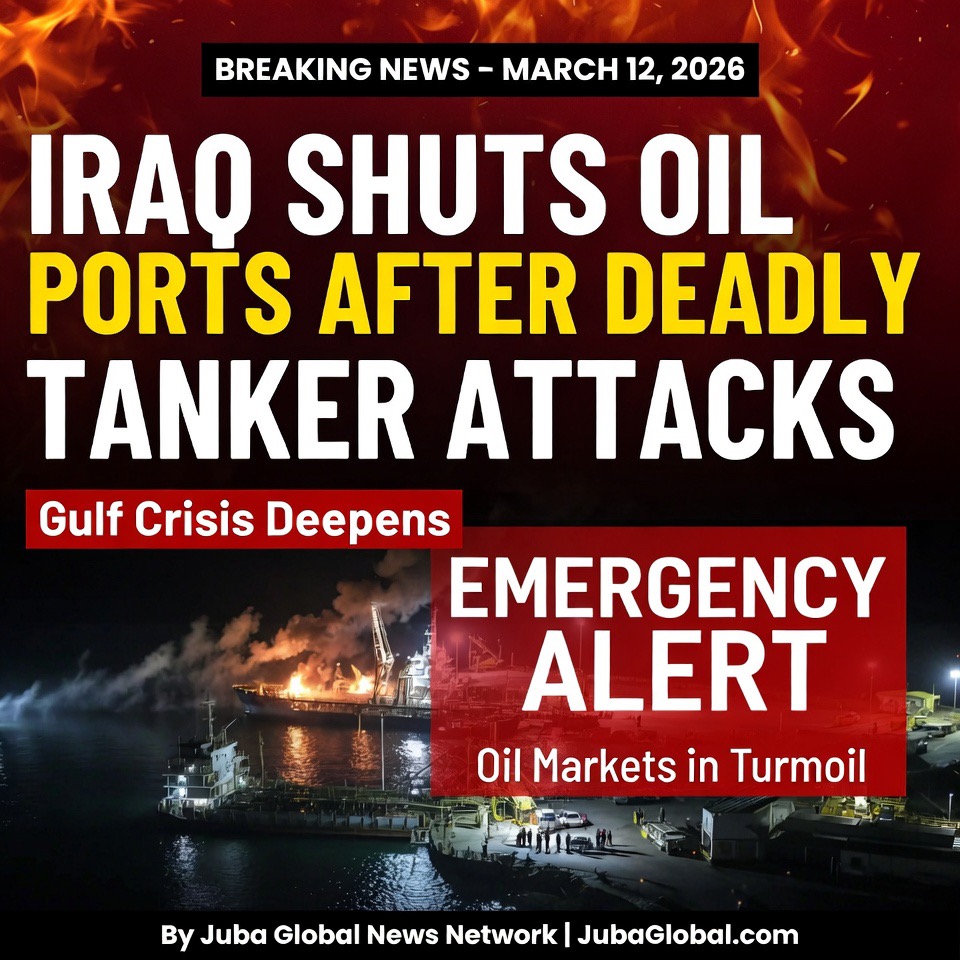
BASRA / BAGHDAD — Iraq has indefinitely suspended operations at its two largest southern oil export terminals — Al Basrah Oil Terminal (ABOT) and Khor al-Amaya Oil Terminal (KAAOT) — following a series of deadly Iranian attacks on commercial tankers in the northern Persian Gulf, dealing another severe blow to global oil supply chains already strained by the ongoing U.S.-Israel-Iran war.
The Iraqi Ministry of Oil announced the closure shortly after midnight local time, citing “unacceptable security risks to vessels, crews, and critical national infrastructure.” The decision effectively halts roughly 1.6–1.8 million barrels per day of Basra crude exports — about 90% of Iraq’s total seaborne oil shipments — at least until Baghdad and its international partners can guarantee safe passage for tankers loading at the offshore terminals.
Sequence of Attacks That Forced the Shutdown
The trigger came in rapid succession over the past 72 hours:
- Late Monday: An Iranian drone swarm struck two crude oil tankers anchored near the ABOT sea-line, killing four Filipino crew members and igniting fires on both vessels. One tanker was declared a total constructive loss; the other was towed to safety but remains heavily damaged.
- Tuesday morning: A second wave targeted a third tanker loading at Khor al-Amaya, killing two Indian seafarers and wounding seven others. Debris from the attack damaged loading arms and one of the terminal’s single-point moorings.
- Tuesday evening: A final strike hit an empty product tanker departing the area, causing no casualties but sending a clear message: no vessel — loaded or ballast — was safe.
Maritime security firms Dryad Global and Ambrey confirmed all three incidents occurred within Iraq’s declared exclusive economic zone, approximately 25–40 nautical miles southeast of the terminals. Iranian state media did not directly claim responsibility but broadcast footage of “precision naval operations” targeting “enemy-linked shipping” in the same timeframe and location.
Immediate Market and Economic Fallout
The announcement sent shockwaves through energy markets already reeling from Iranian attacks elsewhere in the Gulf. Brent crude futures jumped more than $4 in early Asian trading before paring gains to settle around $101.20 per barrel — still the highest sustained level since 2022.
Iraq is OPEC’s second-largest producer (behind Saudi Arabia) and a key supplier of medium-sour crude to Asian refiners, particularly in China and India. With ABOT and KAAOT offline, the country’s only remaining export route is the limited-capacity Ceyhan pipeline through Turkey, which handles roughly 400,000–500,000 barrels per day under normal conditions — nowhere near enough to offset the southern terminal closures.
Immediate consequences include:
- Force majeure declarations by Iraq’s State Oil Marketing Organization (SOMO) on March and April loadings.
- Spot market premiums for alternative medium-sour grades (Oman, Upper Zakum, Basrah Medium equivalents) surging 20–30%.
- Asian refiners scrambling to secure replacement barrels from West Africa, Latin America, and U.S. Gulf Coast — routes that add 10–20 days sailing time and higher freight costs.
- Further upward pressure on global bunker fuel and shipping insurance rates, already at multi-year highs.
Baghdad’s Dilemma and Security Measures
Iraqi Prime Minister Mohammed Shia al-Sudani convened an emergency cabinet session in Baghdad, where ministers of oil, defense, and foreign affairs described the attacks as “a direct assault on Iraqi sovereignty and the livelihood of the Iraqi people.” The government has formally protested to the United Nations and demanded that the U.S.-led coalition provide immediate naval escorts for commercial vessels calling at Iraqi ports.
The U.S. Navy’s Fifth Fleet, headquartered in Bahrain, confirmed it is “coordinating closely with Iraqi authorities” and has increased patrols in the northern Gulf. However, officials in Manama and Washington privately acknowledge that providing full-time convoy protection for every tanker would stretch already thin naval resources amid simultaneous threats across the wider Gulf and Red Sea.
Iran has accused Iraq of allowing its ports to be used as staging points for “hostile forces” supporting the U.S.-Israeli campaign — a charge Baghdad vehemently denies. Iraqi officials insist their neutrality in the conflict must be respected and that targeting Iraqi economic lifelines crosses a dangerous red line.
Broader Regional and Global Implications
The Iraqi shutdown compounds the cascading supply disruptions already underway:
- Iran’s own export terminals at Kharg Island and other facilities have seen reduced loadings due to repeated Israeli strikes.
- Saudi Arabia and the UAE are operating at or near maximum sustainable capacity but cannot fully replace lost Iraqi and Iranian barrels in the short term.
- Strategic petroleum reserve releases by more than 30 countries (led by the United States) are providing temporary relief but are not designed to offset multi-month physical disruptions.
Energy analysts at Kpler and Vortexa now forecast that if southern Iraqi terminals remain closed for more than three weeks, global oil inventories could draw down at rates not seen since the height of the 2020 pandemic recovery — potentially pushing Brent toward $110–$120 if attacks continue.
Voices from the Ground
In Basra, where oil revenues fund much of Iraq’s public sector salaries and reconstruction, the mood is grim. “We are caught between two fires,” said Ahmed al-Mansoori, a tanker loading supervisor who asked that his full name not be used for safety reasons. “Iran attacks the ships, America promises protection but can’t be everywhere, and ordinary Iraqis pay the price when salaries are delayed and electricity cuts deepen.”
International maritime unions have issued urgent warnings to seafarers, advising against accepting Gulf voyages without enhanced security guarantees. Families of the Filipino and Indian mariners killed in the attacks have begun public appeals for justice and repatriation of remains.
What Happens Next?
Iraq has indicated it will review the terminal status on a daily basis but offered no timeline for reopening. Diplomatic sources in Baghdad say reopening will likely require either a verifiable de-escalation in Iranian attacks or a robust multinational naval escort arrangement — both of which appear politically and logistically challenging in the current environment.
For now, every hour the terminals remain shuttered removes another 70,000–75,000 barrels from the market. In a world already short of spare production capacity, that arithmetic is unforgiving.
Juba Global News Network will continue live coverage from Basra, Baghdad, and the Gulf shipping lanes. Real-time export flow trackers, tanker movement maps, updated price charts, and crew safety advisories are available now at JubaGlobal.com.
This is a rapidly evolving story. Check back for any announcements on terminal reopenings, new attacks, or diplomatic breakthroughs that could restore safe passage for Iraqi crude.