Iran Targets Bahrain Facility, Sparking Massive Fire
By Juba Global News Network | JubaGlobal.com
March 12, 2026
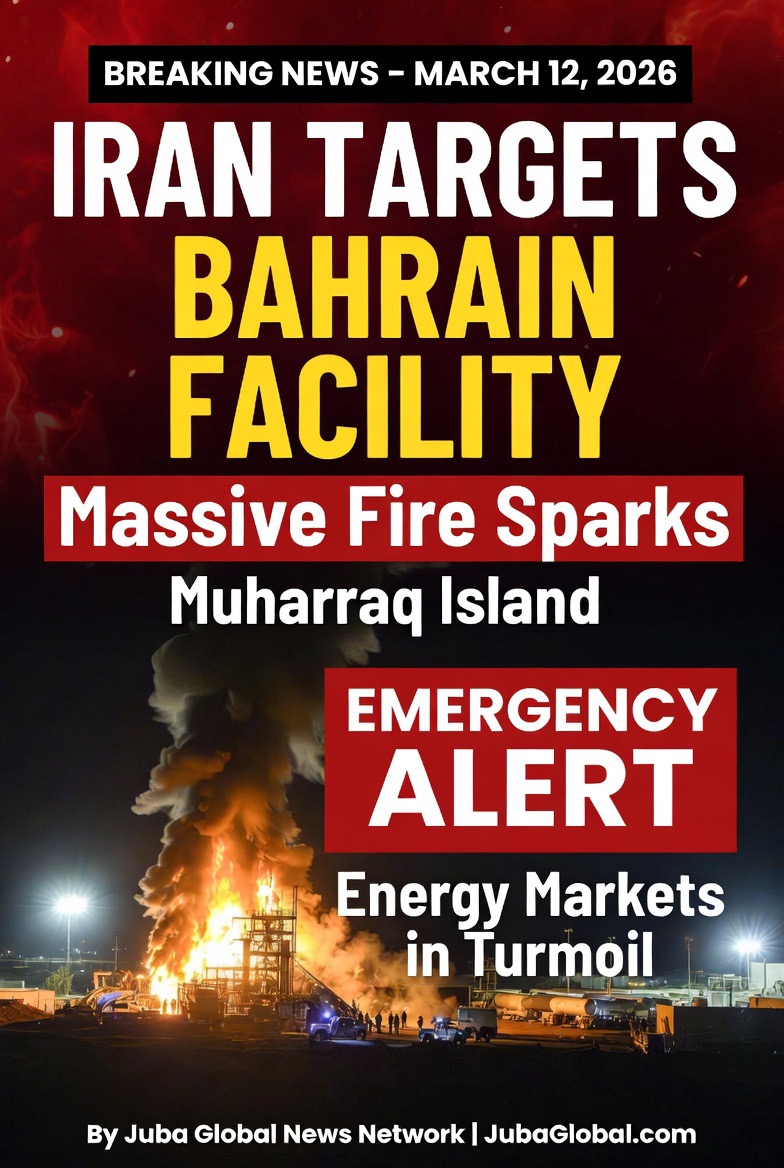
MANAMA / DUBAI — Iranian forces struck a major fuel storage and government facility on Bahrain’s Muharraq Island early Thursday, igniting a massive blaze that sent thick black smoke billowing across the northeastern part of the tiny Gulf kingdom and further rattling already jittery global energy markets.
Footage released by Bahrain’s National Communications Center and Interior Ministry showed towering flames engulfing large fuel tanks at the site, with emergency crews battling the inferno under floodlights as plumes of smoke rose hundreds of meters into the sky. Authorities urged nearby residents to stay indoors, close windows, and monitor air quality due to the heavy smoke, while firefighters worked to contain the fire and prevent it from spreading to adjacent jet fuel storage linked to Bahrain International Airport.
The attack — described by Bahraini officials as a direct Iranian missile or drone strike — comes amid Tehran’s escalating campaign to disrupt Gulf energy flows and retaliate against U.S.-Israeli airstrikes on Iranian soil. Iran’s Revolutionary Guard Corps has not officially claimed the latest hit but has repeatedly vowed that “not a single liter of oil” would leave the Persian Gulf while the conflict continues.
Immediate Impact and Escalation
Bahrain, home to the U.S. Navy’s Fifth Fleet headquarters, has been repeatedly targeted since the war began. Previous Iranian strikes in early March damaged residential areas in Manama, wounded dozens (including children), and hit energy sites including parts of the Bapco Energies refinery complex on Sitra Island. The Muharraq strike marks the most dramatic visual escalation yet, with dramatic videos showing the intense fire dominating social media and news feeds worldwide.
Bahraini authorities confirmed no immediate fatalities from the blaze but reported ongoing damage assessments. The facility serves both civilian aviation fuel needs and supports Bahrain’s limited domestic oil processing. While officials stated the fire was contained to specific tanks and did not immediately threaten the airport’s operations, the incident heightened fears of broader disruptions to regional fuel supply chains.
This latest attack compounds a pattern of Iranian strikes on Gulf energy infrastructure over the past two weeks:
- Multiple refineries and storage sites in Bahrain, Saudi Arabia, Kuwait, Qatar, and the UAE have been hit or threatened.
- QatarEnergy halted LNG production temporarily after earlier strikes.
- Saudi Aramco shut down parts of Ras Tanura after fires linked to intercepted Iranian drones.
- Iraq suspended operations at key southern oil ports following attacks on tankers and terminals.
Iranian officials have accused the U.S. and Israel of first targeting civilian-adjacent infrastructure (including a freshwater desalination plant on Qeshm Island), justifying their response as proportionate retaliation. Tehran denies deliberately hitting purely civilian targets but has made clear its intent to impose maximum economic pain on Gulf states hosting U.S. forces or supporting the anti-Iran campaign.
Energy Markets Reel
The strike sent oil prices spiking again, with Brent crude briefly touching $102 before settling around $99 amid the coordinated strategic reserve releases by the U.S. and allies. Traders warn that repeated hits on storage, refineries, and ports could force prolonged supply constraints even if the Strait of Hormuz remains technically open — insurance premiums are already prohibitively high, and many shippers have rerouted or halted Gulf voyages.
Bahrain’s small but strategic role in regional energy logistics amplifies the psychological impact. As host to the U.S. Fifth Fleet, any escalation there directly implicates American military presence and raises the specter of wider NATO-Gulf involvement.
Regional and International Response
Bahrain condemned the attack as “barbaric aggression against civilian infrastructure” and called for urgent UN Security Council action. Saudi Arabia, the UAE, and Kuwait issued joint statements expressing solidarity and warning that continued Iranian strikes would invite “severe consequences.”
The United States reiterated its commitment to defend Gulf partners. A Pentagon spokesperson confirmed heightened defensive postures around U.S. bases in Bahrain and warned that any further attacks on American assets or allies would be met with “decisive force.”
China, which condemned “indiscriminate” attacks in the Gulf earlier Wednesday, reiterated calls for de-escalation but stopped short of directly criticizing Iran in the latest incident.
Broader Strategic Picture
Military analysts view the Bahrain strike as part of Iran’s asymmetric strategy: avoid direct naval confrontation with superior U.S. forces while using drones, missiles, and proxies to impose asymmetric economic costs. By targeting energy choke points and storage, Tehran aims to drive up global prices, fracture coalition unity, and pressure Washington into negotiations or withdrawal.
Yet the approach carries risks — alienating Gulf neighbors who were previously neutral or cautious, and potentially inviting more aggressive U.S.-Israeli responses, including strikes deeper into Iranian territory or on IRGC naval assets.
As firefighters continued battling the Muharraq blaze into the afternoon, the incident served as a stark visual reminder: the war that began over Iran’s nuclear program has now engulfed the world’s most vital energy artery, with no clear off-ramp in sight.
Juba Global News Network is monitoring developments in real time. Live video feeds from Muharraq, updated oil price trackers, and expert analysis on the implications for global energy security are available now at JubaGlobal.com.
This is a rapidly evolving story. Check back for confirmed casualty figures, damage assessments, and any Iranian response to the latest escalation.