

China Condemns ‘Indiscriminate’ Attacks in Gulf Region
By Juba Global News Network | JubaGlobal.com March 12, 2026 BEIJING / ABU DHABI — China issued its strongest public condemnation yet of the ongoing U.S.-Is
By Juba Global News Network | JubaGlobal.com
March 12, 2026
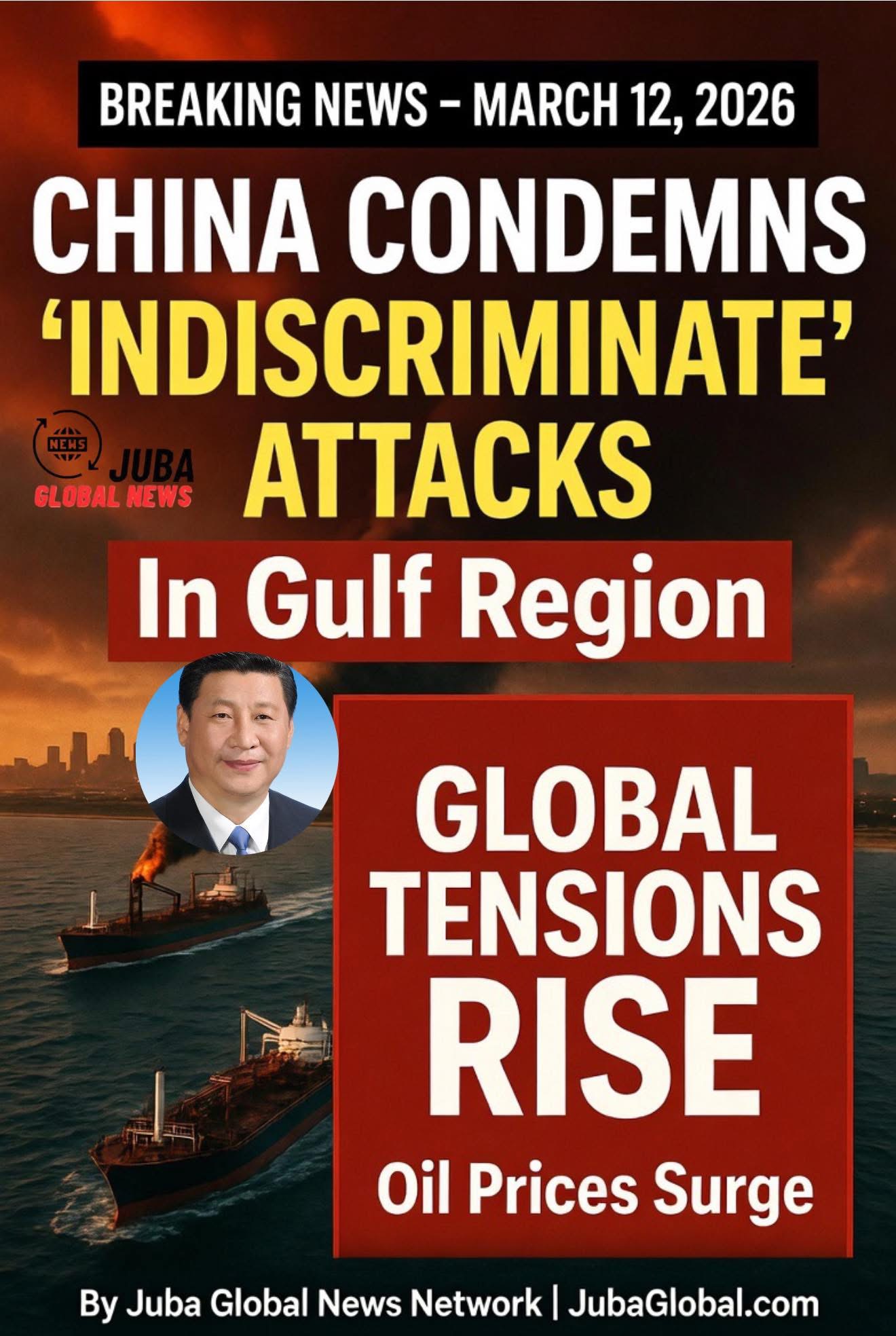
BEIJING / ABU DHABI — China issued its strongest public condemnation yet of the ongoing U.S.-Israeli military campaign against Iran, labeling recent strikes on Gulf energy infrastructure and civilian shipping as “indiscriminate” and warning that continued escalation risks turning the Persian Gulf into “a permanent zone of instability with global consequences.”
Foreign Ministry spokesperson Lin Jian delivered the statement during a regularly scheduled press briefing in Beijing Wednesday afternoon, just hours after Iranian forces claimed responsibility for a drone strike that ignited a massive fire at a key energy facility in Bahrain and as oil prices hovered near $100 per barrel amid disrupted tanker traffic through the Strait of Hormuz.
“China strongly opposes any actions that target civilian facilities and endanger international shipping lanes,” Lin said. “Attacks that cause civilian casualties, destroy energy infrastructure, and threaten the safety of merchant vessels are indiscriminate in nature and violate basic norms of international law. All parties must exercise maximum restraint and immediately cease actions that escalate the conflict.”
Beijing’s Sharpest Rebuke Since Conflict Began
The language marks a noticeable escalation in Beijing’s rhetoric since the U.S.-Israeli strikes on Iranian nuclear and military sites began in late February. Earlier statements had called for “de-escalation” and “dialogue,” but Wednesday’s briefing explicitly criticized the targeting of energy assets and civilian mariners — a direct reference to the string of attacks on commercial tankers and the Bahrain blaze that sent plumes of black smoke visible from Saudi Arabia.
China’s position is driven by three core interests:
- Energy Security — China remains the world’s largest importer of crude oil, with roughly 45% of its imports historically transiting the Strait of Hormuz. Even with diversified sourcing (Russia, Brazil, Middle East non-Gulf suppliers), prolonged disruption would spike domestic fuel costs and threaten industrial output.
- Belt and Road Initiative (BRI) — Multiple BRI projects, including ports in Pakistan, Oman, and the UAE, depend on stable Gulf waters.
- Geopolitical Balancing — Beijing has cultivated close economic and diplomatic ties with both Iran and Gulf Arab states. It does not want to be forced to choose sides in a widening regional war.
Lin reiterated China’s call for an immediate ceasefire and renewed nuclear negotiations, stating that “military means cannot resolve differences over Iran’s nuclear programme and will only create more problems.”
Diplomatic Moves Behind the Scenes
Chinese diplomats have been active on multiple fronts:
- Foreign Minister Wang Yi held separate phone calls with Iranian Foreign Minister Abbas Araghchi and Saudi Foreign Minister Faisal bin Farhan Al Saud on Tuesday, urging both to avoid actions that could “drag the entire region into irreversible confrontation.”
- China’s UN ambassador is preparing to co-sponsor a draft Security Council resolution (likely with Russia) calling for a 72-hour humanitarian pause and safe passage for commercial vessels through the Strait of Hormuz.
- State-owned energy giants Sinopec and CNPC have quietly increased spot purchases from non-Gulf suppliers and begun drawing down strategic reserves faster than usual.
Reaction from Washington and Tehran
The White House dismissed Beijing’s statement as “predictable posturing from a country that continues to buy Iranian oil in violation of sanctions.” National Security Council spokesperson John Kirby told reporters: “China talks about restraint while quietly enabling the very regime that’s attacking global shipping. Words are cheap when your tankers keep loading at Bandar Abbas.”
Iranian Foreign Ministry spokesperson Nasser Kanaani welcomed China’s position, calling it “principled and responsible” and noting that Beijing “understands the suffering caused by aggression disguised as self-defense.”
Gulf Arab states reacted cautiously. Saudi Arabia’s official news agency SPA carried a brief report on the Chinese statement without editorial comment, while the UAE — home to a massive Chinese trading community — issued no immediate response.
Broader Implications for Global Energy and Diplomacy
Analysts say China’s increasingly vocal stance could complicate U.S. efforts to maintain international unity behind the campaign. If Beijing pushes hard at the UN or accelerates alternative energy corridors (via Russia or Central Asia), the economic pressure on Iran might be partially offset.
Oil traders are watching closely. While the coordinated release of strategic reserves (led by the U.S.) has provided temporary relief, many market participants believe that sustained Chinese diplomatic and economic support for Tehran could prolong the disruption — and keep prices elevated well into Q2 2026.
“China is not going to war over the Gulf, but it can make the war much more expensive for the attackers,” said Dr. Yun Sun, director of the China Program at the Stimson Center. “Beijing’s red line is not Iran’s survival — it’s the free flow of oil and the credibility of international shipping.”
Looking Ahead
President Xi Jinping is scheduled to address the issue indirectly during a Politburo study session later this week, where energy security and great-power competition are expected to dominate the agenda. Meanwhile, Chinese embassies in Tehran, Riyadh, Abu Dhabi, and Washington have all issued travel advisories urging citizens to avoid non-essential movement in the Gulf region.
As the war enters its most economically disruptive phase, China’s shift from quiet diplomacy to public condemnation signals that Beijing no longer views the conflict as a distant Middle East affair — but as a direct threat to its own core national interests.
Juba Global News Network will continue tracking Beijing’s diplomatic maneuvering, energy market reactions, and any shifts in China’s public or private position as the U.S.-Israel-Iran war reshapes global geopolitics and energy flows.
This is a rapidly evolving story. Full transcript of the Foreign Ministry briefing, live oil-flow tracker through the Strait of Hormuz, and expert analysis updated in real time at JubaGlobal.com.
