Poverty and Exploitation Jeopardise Juba Schoolgirls' Dreams, Radio Tamazuj Feature Finds
At 19, Nancy Modo dreams of becoming a paediatrician — but after finishing Senior Four in Juba, financial hardship threatens to end her education, in a feature that traces what poverty does to schoolgirls' futures.
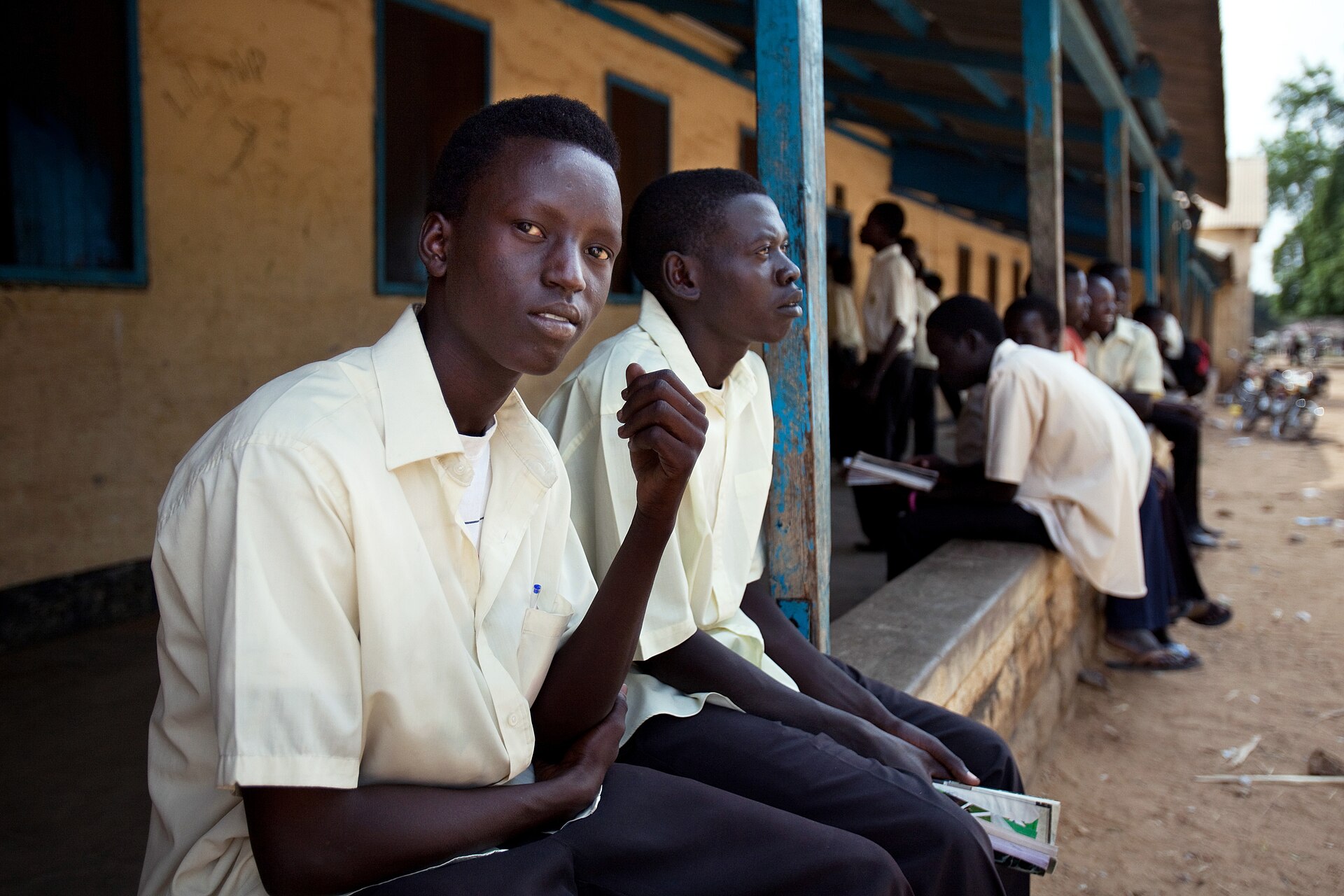
Students during a break at Supiri Secondary School in Juba, in a file photograph of the capital's school pupils. (Wikimedia Commons, CC BY-SA 3.0 IGO)
At 19, Nancy Modo dreams of becoming a paediatrician — but after finishing Senior Four in Juba, financial hardship threatens to end her education, in a feature that traces what poverty does to schoolgirls' futures.
JUBA — At 19, Nancy Modo dreams of becoming a paediatrician to save the lives of South Sudanese children. However, after completing Senior Four at New Apostolic Secondary School in Juba, she faces an uncertain future as financial hardship threatens to prevent her from continuing her education. Her story opens a Radio Tamazuj feature, published on 22 November, headlined "Poverty and exploitation jeopardize Juba schoolgirls' dreams" — a report on the forces that end girls' schooling in the capital even for those who, like Nancy, have already beaten long odds to finish secondary school.
Completing Senior Four is itself an achievement that most South Sudanese girls never reach. Girls' education in South Sudan is interrupted by poverty, child marriage, social norms and the cost of education, and thousands of girls stop their education early. A girl who finishes secondary school has survived every one of the points at which her classmates left: the fees that could not be paid, the household work that competed with homework, the pressure to marry, and the simple distance between home and school.
The cruellest feature of the pattern the feature describes is where it strikes Nancy: at the threshold. A completed secondary certificate is the key to nursing school, university admission and teacher training — the routes by which a schoolgirl becomes the paediatrician she dreams of being. But those routes charge fees too, and a family that has stretched to pay for secondary school often has nothing left for what comes next. The dream is not refused; it is priced, and the price arrives at exactly the moment the family's resources are exhausted.
Poverty does not act alone in the feature's account: its headline pairs poverty with exploitation. Girls whose schooling stalls for lack of money do not simply wait at home. They work — in markets, in homes, in the informal economy of a capital city — in circumstances where low pay, dependence on employers and the absence of protection expose them to exploitation, and where every year out of education makes return less likely. The longer the gap between Senior Four and any further training, the more completely the classroom door closes.
The national cost of that closing door is easiest to see in Nancy's chosen profession. South Sudan has too few doctors, and far too few paediatricians, for its children. Every girl whose medical ambition ends at a fees notice is a clinic unstaffed a decade from now. The same arithmetic applies across the professions girls name when they are asked: teachers, nurses, engineers, lawyers. A country cannot simultaneously lament its shortage of professionals and tolerate the loss, at eighteen and nineteen, of the very students who had already done the hardest part — finishing school.
There are interventions known to work, and they are unglamorous: scholarships and bursaries targeted at girls completing secondary school, school feeding that keeps younger girls enrolled, take-home rations that give families a material reason to keep daughters in class, and safe, affordable routes into nursing and teacher training for those whose families cannot pay. The World Food Programme's school feeding alone reaches hundreds of thousands of children in more than a thousand South Sudanese schools. What such programmes cannot do is follow a girl past the school gate — which is where Nancy's story says the support runs out.
Radio Tamazuj's feature gives that gap a name and a face. Nancy Modo did everything the system asked: she stayed, she studied, she finished, and she aimed her ambition at saving South Sudanese children's lives. Whether she gets the chance depends on whether anyone — a scholarship fund, a training college, a sponsor — meets her at the threshold where poverty currently stands. Her story is one girl's; the feature's point is that in Juba, it is the story of a generation of schoolgirls whose dreams are not failing for want of talent or effort, but for want of money and protection. (Source: Radio Tamazuj)
Source: Juba Global News Network, reporting Radio Tamazuj coverage.