
 Juba Global Editorial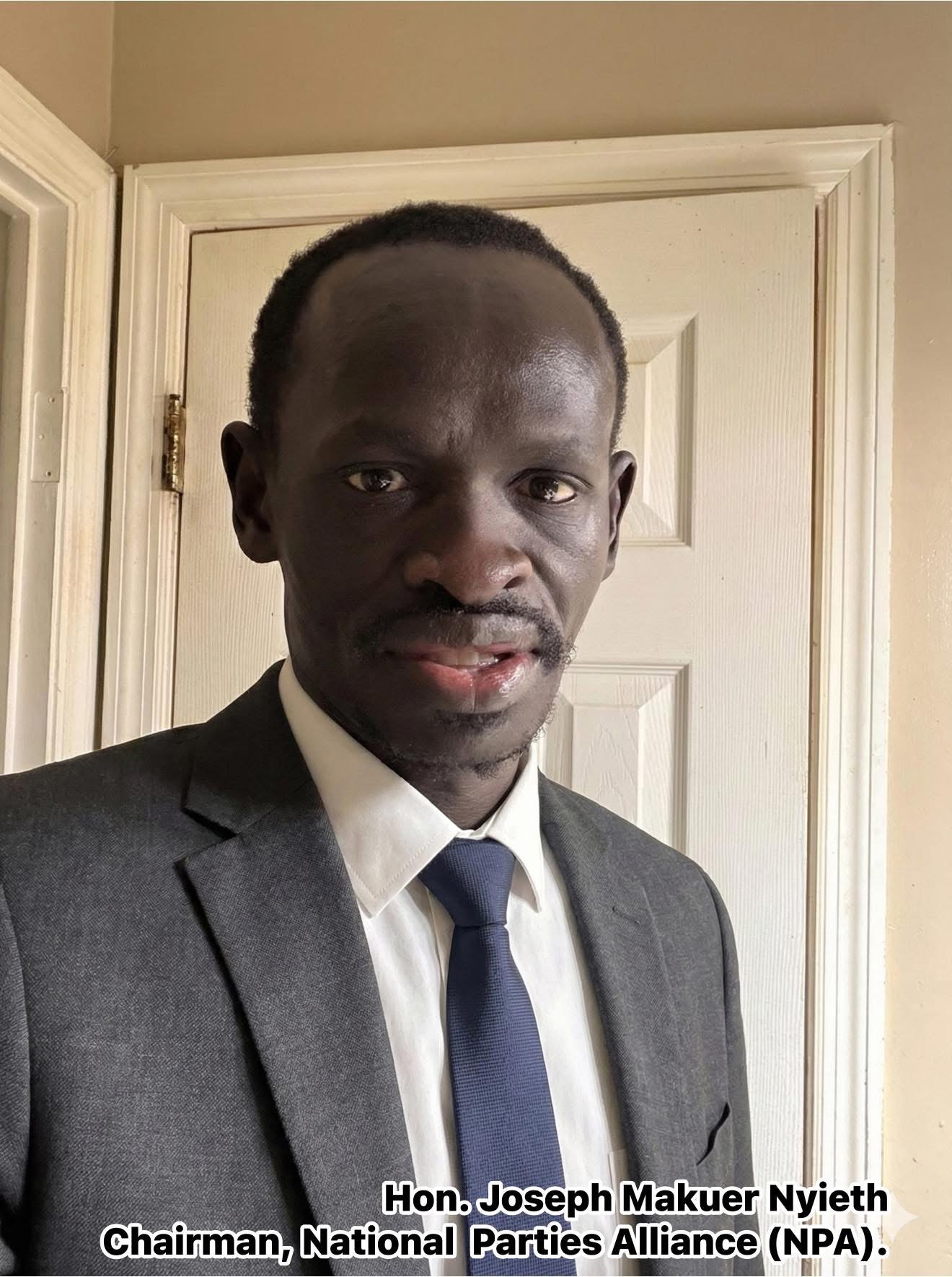
A Message to the People of South Sudan
By Dr. Joseph M. Nyieth
Chairman, National Parties Alliance (NPA)
Chairman, Patriotic People’s Party (PPP)
Chief Analyst, Juba Global News Network
My dear compatriots,
As we mark fifteen years since the birth of our beloved Republic — fifteen years since the flag of South Sudan was raised for the first time in Juba on that historic day of 9th July 2011 — I write to you not merely as a political leader, but as a son of this soil who has walked the same dusty roads, felt the same hopes, and shared the same disappointments that define our common journey as a people.
We achieved independence through the blood, sweat and sacrifice of generations. The martyrs who fell at Torit in 1955, at Malual-Chaat and Bor in 1983, and in countless battles across our land did not fight so that their children would inherit a nation governed by fear, corruption and institutional decay. They dreamed of a South Sudan where justice would flow like the Nile, where every citizen regardless of ethnicity or region would have equal access to opportunity, where the vast wealth of our land would translate into schools, hospitals, roads and dignified livelihoods for all.
Fifteen years later, we must ask ourselves with brutal honesty: have we honoured that dream?
The answer, painful as it is, is that we have fallen short. Our people face unemployment, unpaid salaries, a collapsing currency, soaring prices, inadequate healthcare, faltering education systems and persistent insecurity. Localised violence, cattle raiding, road ambushes and mass displacement continue to disrupt communities across the country. Eight million of our citizens — more than half of our population — face acute food insecurity. Aid agencies have warned repeatedly that we are at risk of slipping into full-scale famine.
These are not the fruits of freedom. These are the consequences of governance failures that have persisted for too long.
The State of Our Nation
Political scientists describe what has happened in South Sudan as a form of state capture — where public institutions, instead of serving the national interest, have been turned into instruments of elite enrichment and political survival. The social contract between the government and the governed has been broken. Trust has been eroded. Hope has been tested.
The ruling SPLM bears primary responsibility for this state of affairs, having governed since independence without delivering the peace dividend that our people were promised. But responsibility does not end there. Opposition parties, holdout groups and other political actors have also contributed to the cycle of instability through recurrent confrontation and failure to place national interest above partisan ambitions.
As Chairman of the National Parties Alliance and the Patriotic People’s Party, I say this not to point fingers alone, but to call for a fundamental reorientation of our political culture. We must move from a politics of personality to a politics of principle. From a politics of exclusion to a politics of participation. From a politics of rhetoric to a politics of results.
The Path Forward: A National Round Table
In the face of the challenges before us, I am convinced that incremental reforms and piecemeal adjustments will not suffice. What South Sudan needs at this critical juncture is a genuinely inclusive National Round Table Conference — a gathering of all stakeholders: the SPLM, all registered opposition parties, holdout groups, civil society organisations, religious leaders, traditional authorities, women’s groups, youth movements, academics, the private sector and representatives of our diaspora.
This National Round Table must have a clear and focused mandate. It must address:
First, constitutional reform. Our current constitutional framework is inadequate for the task of building a stable, democratic and prosperous nation. We need a constitution that enshrines separation of powers, guarantees fundamental rights, establishes independent institutions and devolves power to local communities in a meaningful way.
Second, security sector transformation. A nation cannot develop when its people live in fear. We must build a professional, non-partisan security sector that protects citizens rather than threatens them. This includes completing the unification of armed forces under a single command structure loyal to the constitution, not to any individual or party.
Third, anti-corruption measures. Corruption is not merely a moral failing; it is an existential threat to our nation. We need a truly independent anti-corruption commission with prosecutorial powers, asset declaration requirements for all public officials, and strong protections for whistleblowers.
Fourth, economic diversification and agricultural revitalisation. South Sudan possesses some of the most fertile land in Africa, with reliable rainfall and two major rivers. Yet we import food while our people go hungry. We must invest in agriculture as a national priority — not as a slogan, but as a budgetary commitment. Our oil wealth must be managed transparently and used to build the productive sectors of our economy.
Fifth, electoral integrity. As we approach the scheduled elections of December 2026, we must ensure that these elections are free, fair and credible. Elections conducted amid insecurity, weak institutions, unresolved constitutional questions and limited public trust risk deepening our divisions rather than healing them. A genuinely inclusive National Round Table before the elections can create the conditions for credible polls.
A Call to Action
To the people of South Sudan, I say this: your voice matters. Too often, ordinary citizens have been treated as passive recipients of decisions made by elites in Juba. But democracy means nothing if it does not mean that every citizen has a say in how they are governed.
Engage with your leaders. Demand accountability. Join political parties and civil society organisations. Speak out against injustice. Pay attention to what your government does with public resources. Your silence is consent, and consent to mismanagement is complicity in the suffering of your fellow citizens.
To my fellow political leaders across the spectrum, I extend a hand of genuine partnership. The National Parties Alliance was formed precisely to create a platform for opposition parties to coordinate, strategise and present a unified vision for our country. I invite all parties — whether in government, in opposition or outside the formal political process — to join us in building this vision.
The Patriotic People’s Party, which I have the honour to lead, stands for a South Sudan where patriotism is measured not by loyalty to any individual but by commitment to the Republic and its people. We stand for accountable governance, for the rule of law, for economic justice and for a society where every citizen can fulfil their God-given potential.
Conclusion
My dear compatriots, the road ahead is long, but it is not impassable. South Sudan is blessed with abundant resources — fertile land, water, minerals, oil and above all, a young, resilient and talented population. What we lack is not capacity but political will. What we need is not foreign salvation but a home-grown renewal of our commitment to the ideals for which our martyrs gave their lives.
History will not judge us by the speeches we make or the positions we hold. It will judge us by whether we transformed the sacrifice of our liberation struggle into a reality of democracy, stability and shared prosperity.
We can do this. We must do this. South Sudan deserves nothing less.
May God bless the Republic of South Sudan.
Dr. Joseph M. Nyieth
Chairman, National Parties Alliance (NPA)
Chairman, Patriotic People’s Party (PPP)
Chief Analyst, Juba Global News Network
Juba, South Sudan
July 2026