 Juba Global Editorial
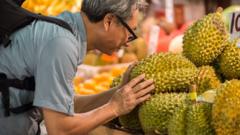
GLOBAL, JUNE 30, 2026 — As Malaysian durians are being sold at throwaway prices, farmers worry about their livelihoods.
As Malaysian durians are being sold at throwaway prices, farmers worry about their livelihoods.
This article is based on official sources. Additional context and analysis provided by Juba Global News Network.
Background
The durian, known as the king of fruits in Southeast Asia, is a cultural and economic phenomenon that defies easy description. Prized for its distinctive taste and texture but notorious for its pungent smell, the durian occupies a unique place in the cuisines and economies of Malaysia, Thailand, Indonesia, and Singapore. Premium varieties, particularly the Musang King cultivar from Malaysia, have commanded high prices driven by insatiable demand from China. The current price collapse reflects multiple factors: oversupply as more farmers planted durian orchards in response to high prices, changing consumer preferences, and economic pressures affecting luxury food spending. For farmers who invested heavily during the boom years, the bust represents a serious threat to livelihoods.
Analysis by Dr. Joseph M. Nyieth
Chief Analyst, Juba Global News Network
The durian price collapse carries lessons for agricultural development in Africa and South Sudan specifically. When a single crop becomes the focus of investment driven by high global prices, the inevitable correction can be devastating. South Sudan has its own agricultural potential in crops like gum arabic, sesame, and livestock, but must avoid the trap of commodity dependence that has left so many developing nations vulnerable to price fluctuations. Diversification, value addition through processing, and access to multiple markets are essential strategies for building resilient agricultural economies.
Local Perspective
While South Sudan does not produce durians, the dynamics of agricultural commodity markets apply directly to the nation’s economic development. South Sudan has rich agricultural land and a climate suitable for diverse crops, yet remains heavily dependent on oil revenues, leaving the economy vulnerable to price shocks in global energy markets. Developing agricultural export capacity could provide a buffer against oil price volatility, but must be approached strategically to avoid the boom-and-bust cycles that have plagued commodity-dependent economies worldwide.
Why This Matters
This story matters because it touches on universal questions that affect communities everywhere, including South Sudan. By understanding how other nations confront challenges ranging from wildfire management to trade negotiations, from sports regulation to historical memory, South Sudan can learn valuable lessons that inform its own development path. In an interconnected world, no story is entirely foreign, and every event carries insights that can be applied locally.
References
This article is based on reporting from multiple international news organizations. Analysis and additional reporting by Dr. Joseph M. Nyieth, Chief Analyst at Juba Global News Network.
Stay Connected with Juba Global News Network