

US Deploys 3,500 Marines to Middle East as Troop Total Surpasses 50,000
By Juba Global News Network | JubaGlobal.com March 30, 2026 The Pentagon has confirmed the deployment of an additional 3,500 Marines and sailors from a Mar
By Juba Global News Network | JubaGlobal.com
March 30, 2026
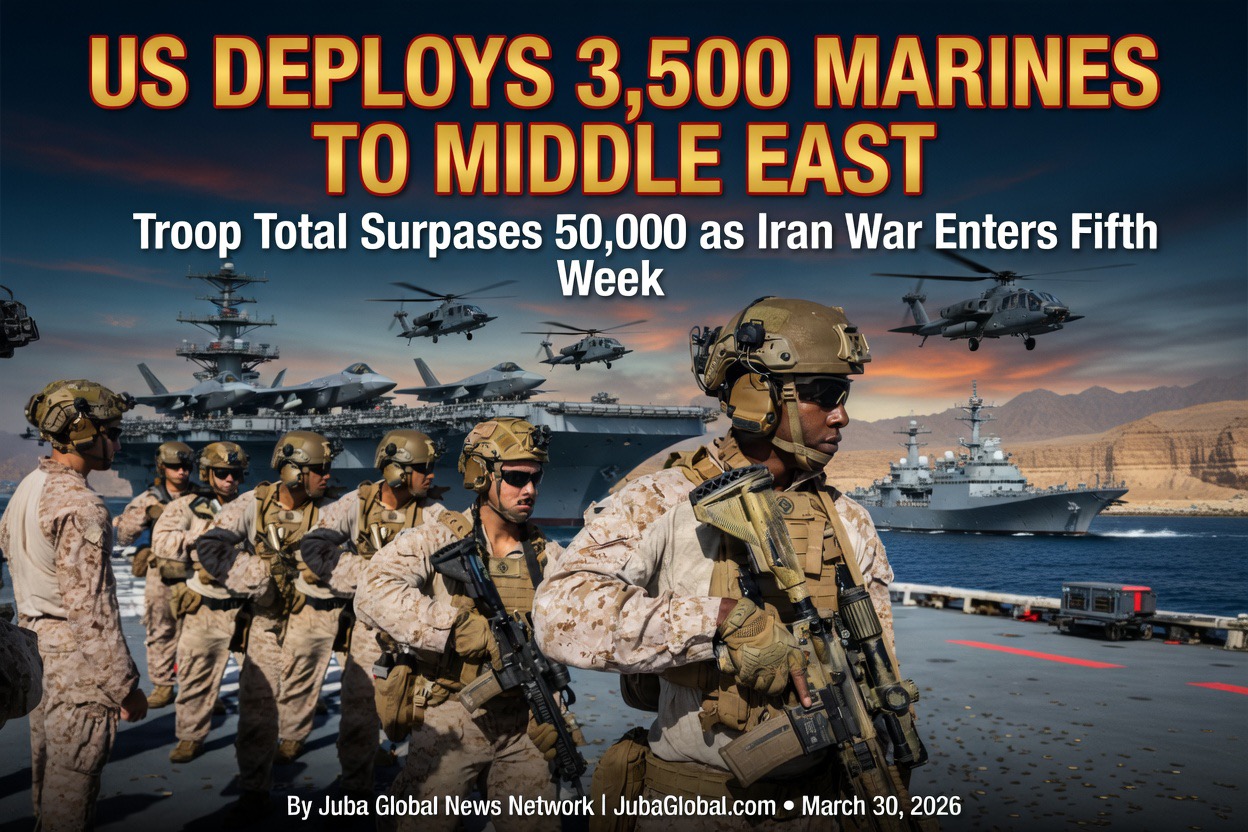
The Pentagon has confirmed the deployment of an additional 3,500 Marines and sailors from a Marine Expeditionary Unit aboard an amphibious assault group to the Middle East, pushing the total number of US troops in the region above 50,000 as the conflict with Iran enters its fifth week.
This significant reinforcement comes amid ongoing airstrikes, missile exchanges, and heightened diplomatic maneuvering. The fresh deployment strengthens US naval and amphibious capabilities in the strategically vital waters near the Strait of Hormuz and provides additional ground force options if the situation escalates further.
Pentagon spokesperson Major General Pat Ryder stated that the move is intended to “protect American interests, support allies, and maintain freedom of navigation” in response to Iranian threats and proxy activities across the region. The Marines are equipped for rapid response, humanitarian assistance, and potential combat operations, though officials emphasize that no ground invasion of Iran is currently planned.
Scale of US Military Buildup
With the arrival of these 3,500 Marines, the total US force presence in the Middle East now exceeds 50,000 personnel. This includes:
• Thousands of Air Force and Navy personnel operating fighter jets, bombers, and naval vessels conducting strikes.
• Army and Marine ground units positioned across multiple bases in the Gulf states.
• Special operations forces supporting targeted missions.
• Logistical and support personnel maintaining the massive supply chain required for sustained operations.
The buildup has been rapid since the conflict began in late February 2026. Several carrier strike groups, amphibious ready groups, and additional fighter squadrons have been surged into the theater. US Central Command (CENTCOM) reports that American and coalition forces have conducted thousands of sorties and struck over 10,000 targets inside Iran, focusing on nuclear facilities, missile production sites, air defenses, and naval assets.
Strategic Context and Objectives
The deployment occurs as President Trump claims Iran has “given in” to most of the US demands in a 15-point peace framework. However, Iranian officials continue to publicly reject negotiations under pressure and have vowed “severe retaliation” against any attempted US ground invasion.
Military analysts suggest the increased troop levels serve multiple purposes:
1. Deterrence — Signaling to Iran and its proxies (including the Houthis and Hezbollah) that the US is prepared for prolonged conflict.
2. Leverage — Providing military backing to diplomatic efforts and backchannel talks reportedly facilitated through intermediaries like Pakistan.
3. Force Protection — Ensuring robust defense of US bases and allies against potential Iranian missile or drone attacks.
4. Amphibious Flexibility — The Marines’ presence allows for operations along coastlines, rapid insertion, or evacuation if needed.
The amphibious assault group brings significant firepower, including attack helicopters, landing craft, and the ability to project power from the sea without relying solely on land bases.
Regional Reactions and Risks
The massive US presence has drawn mixed reactions across the Middle East. Gulf allies such as Saudi Arabia and the UAE have quietly welcomed the reinforcement for protection against Iranian retaliation. Israel continues close coordination with the US on targeting Iranian capabilities.
However, concerns about escalation remain high. Iranian leaders have warned that any attempt at a ground operation would trigger fierce resistance. Proxy forces have already intensified activities: Houthis launched attacks on Israel over the weekend, and clashes continue along the Israel-Lebanon border.
There are also worries about the strain on US resources. With simultaneous tensions involving Russia’s war in Ukraine and North Korea’s recent missile tests, some defense experts question whether the United States can sustain such high troop levels indefinitely without impacting readiness elsewhere.
Economic and Humanitarian Impact
The troop surge coincides with renewed volatility in global oil markets. Fears of prolonged disruption to shipping through the Strait of Hormuz — which carries about one-fifth of the world’s oil and LNG — have driven Brent crude prices higher once again.
Humanitarian organizations have raised alarms over civilian casualties and damage to infrastructure inside Iran from the sustained airstrikes. The influx of additional US forces could either hasten a diplomatic resolution or prolong the fighting, depending on how Iran responds in the coming days.
What Comes Next?
As the conflict reaches the 31-day mark, key questions include:
• Will the increased US military presence push Iran toward greater concessions in indirect talks?
• Could the Marines be used for limited amphibious operations or simply serve as a powerful deterrent?
• How will the expanded force affect the timeline for any potential ceasefire or reopening of the Strait of Hormuz?
President Trump has indicated that the original operational timeline was approximately four to five weeks but has stressed that US forces are prepared to continue operations “for as long as it takes” to achieve American objectives.
The situation remains highly fluid. Diplomatic channels continue behind the scenes while military pressure is maintained on multiple fronts.
Juba Global News Network will provide ongoing coverage of developments in troop movements, diplomatic signals, and battlefield updates.
Related Coverage:
• Trump Claims Iran Has ‘Given In’ to Most US Demands as War Enters Fifth Week
• Houthis Launch Attacks on Israel as Yemen Rebels Fully Enter the Iran War
• Oil Prices Jump as Iran War Reaches Fifth Week with Hormuz Disruptions Lingering
This article is based on official Pentagon statements, CENTCOM briefings, and reports from multiple international sources as of March 30, 2026. The situation continues to evolve rapidly

14 thoughts on “US Deploys 3,500 Marines to Middle East as Troop Total Surpasses 50,000”
Comments are closed.