

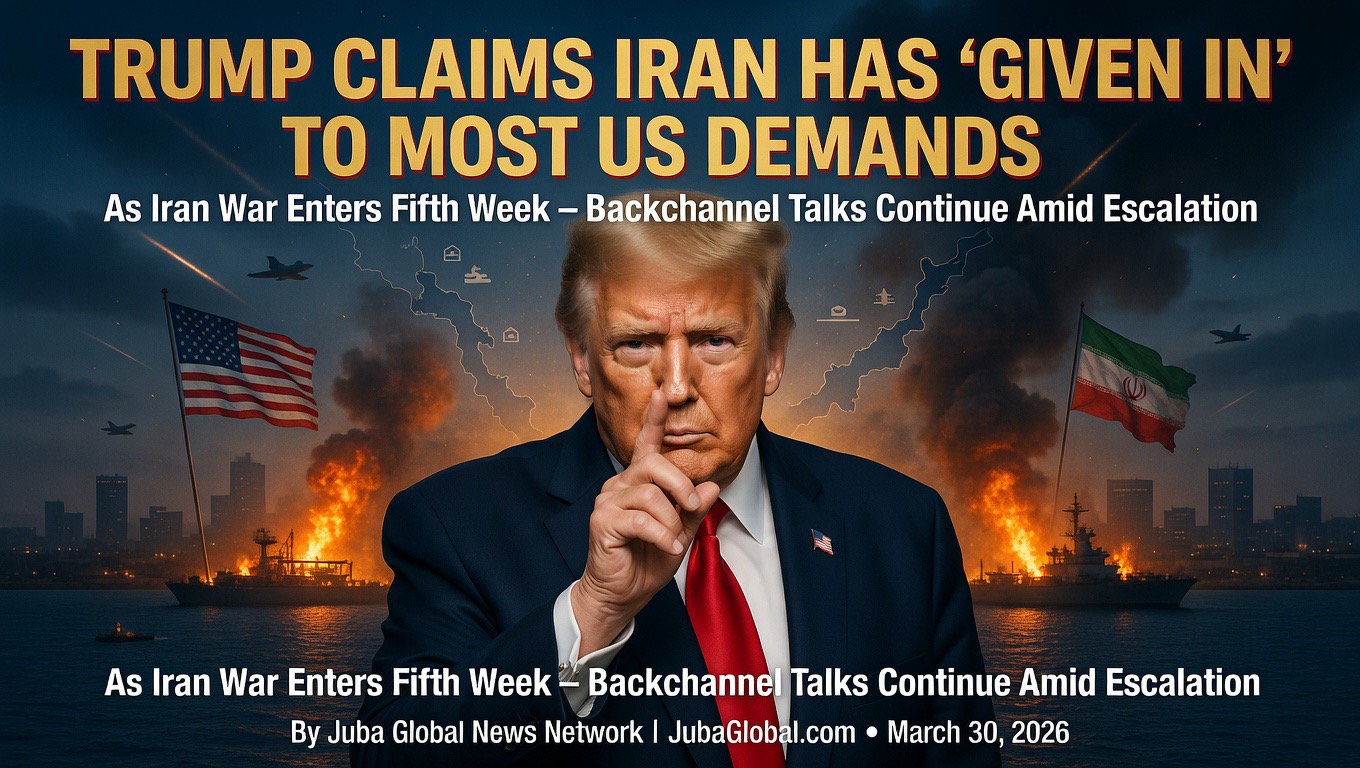
Trump Claims Iran Has ‘Given In’ to Most US Demands as War Enters Fifth Week
By Juba Global News Network | JubaGlobal.com March 30, 2026 President Donald Trump asserted on Monday that Iran has effectively conceded to the majority of
By Juba Global News Network | JubaGlobal.com
March 30, 2026
President Donald Trump asserted on Monday that Iran has effectively conceded to the majority of American demands outlined in a controversial 15-point peace framework, even as the US-led military campaign against the Islamic Republic entered its fifth week with no immediate ceasefire in sight.
Speaking aboard Air Force One and later during public remarks, Trump described the situation as “moving along very nicely,” claiming that Tehran has agreed “for the most part” to the US conditions aimed at ending the conflict. “We asked for 15 things and for the most part, we’re going to be asking for a deal,” the president stated, projecting optimism amid ongoing strikes and regional escalation.
The remarks come as mixed signals dominate the diplomatic landscape. Iranian officials have publicly rejected the 15-point plan as “maximalist” and “unreasonable,” with Tehran’s parliament speaker and foreign ministry continuing to deny direct or indirect negotiations with Washington. Despite this, Trump and senior administration officials insist that backchannel communications—reportedly facilitated through intermediaries such as Pakistan—are progressing and that Iran is showing signs of flexibility to avoid further destruction.
Background on the 15-Point Framework
The 15-point “action list” or roadmap, originally floated during earlier nuclear negotiations in 2025 and revived in recent weeks, reportedly includes core US demands such as:
• Complete halt to Iran’s nuclear weapons-related activities and transfer or down-blending of enriched uranium stockpiles.
• Severe restrictions on ballistic missile development and regional proxy support.
• Measures to ensure the reopening of the Strait of Hormuz for unrestricted oil traffic.
• Additional security guarantees and verification mechanisms involving international oversight.
Critics, including some analysts and Iranian diplomats, describe the plan as a rehash of previously rejected proposals that demand near-total capitulation without sufficient reciprocal concessions on sanctions relief or security assurances. Iran has repeatedly called the terms coercive and has insisted it will not negotiate under military pressure.
Nevertheless, Trump has pointed to limited movements—such as reports of several oil tankers being allowed through the Strait of Hormuz—as evidence of Iranian goodwill. He extended a deadline for full reopening of the strategic waterway, attributing the pause to ongoing “very good and productive conversations.”
War Enters Fifth Week Amid Intensified Operations
The conflict, which erupted in late February 2026 with coordinated US and Israeli strikes on Iranian nuclear, missile, and military targets, has now stretched into its 31st day. US Central Command reports that American forces have struck over 10,000 targets inside Iran, significantly degrading its naval capabilities, drone and missile launch rates, and air defense systems.
Iran has retaliated with missile and drone barrages targeting Israel and US bases in the region, while its proxies have increased activity. Over the weekend, Iran-backed Houthi forces from Yemen fully entered the fray by launching attacks on Israel, raising fears of a wider multi-front war.
On the ground, the Pentagon has ramped up its presence, with more than 50,000 US troops now deployed across the Middle East. This includes the recent arrival of approximately 3,500 Marines and sailors from an amphibious assault group, adding to speculation about potential ground operations—though the administration has not confirmed any such plans.
Iranian leaders have issued stern warnings against any US ground invasion, vowing “severe retaliation” that could further destabilize the region and disrupt global energy supplies.
Economic and Humanitarian Toll
The prolonged fighting has sent oil prices climbing once again, with Brent crude reacting to persistent uncertainty over the Strait of Hormuz—a chokepoint responsible for roughly one-fifth of global oil and LNG shipments. Limited tanker traffic and fears of escalation continue to weigh on energy markets and broader investor sentiment.
Humanitarian concerns are mounting. Strikes have damaged civilian infrastructure, cultural heritage sites, and universities in Iran, prompting international calls for restraint. In parallel theaters, clashes in southern Lebanon and Houthi actions have added layers of complexity.
Divergent Narratives and Diplomatic Efforts
The gap between Washington’s optimistic messaging and Tehran’s public defiance highlights the challenges of indirect diplomacy in wartime. While Trump portrays Iran as “begging to work out a deal” but fearful of domestic backlash, Iranian Foreign Minister Abbas Araqchi has emphasized that any messages exchanged via third parties do not constitute negotiations.
Regional players, including Pakistan, have offered to host talks, and other nations such as Oman and Egypt have previously attempted mediation. However, both sides appear locked in a high-stakes game of leverage: the US maintaining military pressure while dangling the prospect of sanctions relief, and Iran betting that sustained resistance and proxy actions will force more favorable terms.
Some observers suggest Trump’s upbeat claims may serve dual purposes—projecting strength to domestic audiences and signaling to Iran that time is running out—while others see it as an attempt to create momentum toward de-escalation before the conflict drags into a costlier phase.
What Lies Ahead?
As the war reaches the one-month mark, key questions remain unanswered:
• Will indirect channels produce a breakthrough before April 6, the latest extended deadline for Hormuz reopening?
• Could US troop levels signal preparation for more decisive action, or are they primarily leverage?
• How will proxy escalations by the Houthis and potential developments on the Israel-Lebanon front affect the broader calculus?
President Trump has maintained that the initial projection for the operation was four to five weeks but emphasized that US forces have the capability to sustain operations “far longer” if necessary.
For now, the world watches as military actions continue alongside competing diplomatic narratives. Strikes persist across the Middle East, markets remain volatile, and the human and economic costs accumulate.
Juba Global News Network will continue to monitor developments closely, including any verifiable progress in backchannel communications or shifts on the battlefield.
Related Coverage:
• US Deploys 3,500 Marines as Troop Total Surpasses 50,000
• Houthis Launch Attacks on Israel, Fully Entering the Conflict
• Oil Prices Surge as Hormuz Disruptions Linger
This article is based on statements from President Trump, reports from multiple international outlets, and official briefings as of March 30, 2026. Developments are fluid; check JubaGlobal.com for real-time updates.
13 thoughts on “Trump Claims Iran Has ‘Given In’ to Most US Demands as War Enters Fifth Week”
Comments are closed.