

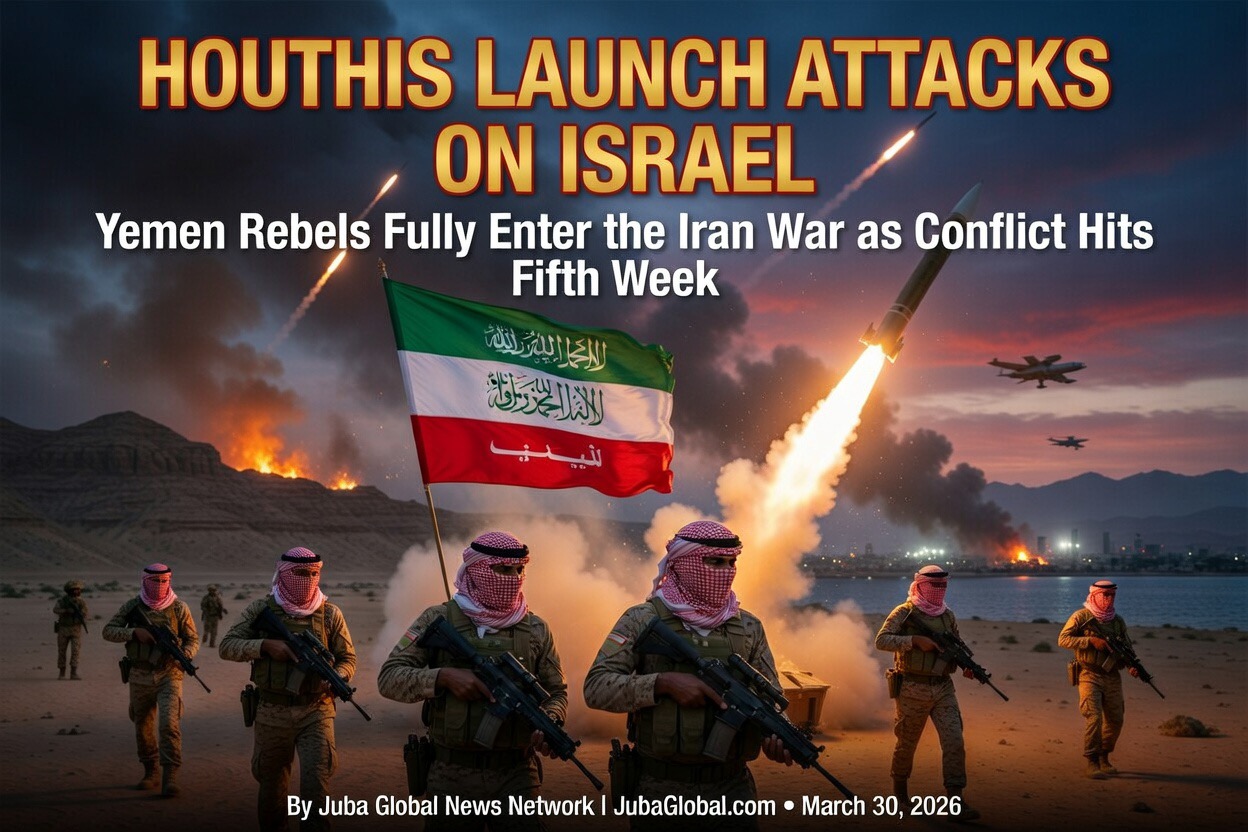
Houthis Launch Attacks on Israel as Yemen Rebels Fully Enter the Iran War
By Juba Global News Network | JubaGlobal.com March 30, 2026 Iran-backed Houthi rebels from Yemen have escalated their involvement in the ongoing conflict b
By Juba Global News Network | JubaGlobal.com
March 30, 2026
Iran-backed Houthi rebels from Yemen have escalated their involvement in the ongoing conflict by launching direct missile and drone attacks on Israel, marking their full entry into the Iran war as it enters its fifth week.
The attacks, which included several ballistic missiles and armed drones targeting Israeli territory, were intercepted by Israeli air defenses with assistance from US and allied forces. While no major casualties were reported on the Israeli side, the strikes represent a dangerous expansion of the conflict beyond the primary US-Iran theater and signal the Houthis’ commitment to supporting Tehran amid the broader regional crisis.
Houthi military spokesperson Yahya Saree announced the operation, stating that the group had fired “a large number of missiles and drones” at Israeli targets in solidarity with Iran and in response to ongoing Israeli and US military actions in the region. The statement declared that Yemen’s rebels are now “fully engaged” in the war against what they called the “American-Zionist aggression.”
A New Front Opens in the Multi-Front Conflict
The Houthi attacks come just days after the group intensified operations in the Red Sea, targeting commercial shipping and issuing threats against vessels linked to Israel, the US, and their allies. This latest development transforms the Houthis from peripheral proxies into active combatants on a second major front, joining Hezbollah’s ongoing clashes with Israel in southern Lebanon.
Military analysts note that the Houthis possess a significant arsenal of Iranian-supplied ballistic missiles, cruise missiles, and long-range drones capable of reaching deep into Israeli territory. Their entry adds complexity to an already volatile situation involving:
• Direct US and Israeli strikes on Iranian targets
• Iranian missile retaliation against Israel and US bases
• Sustained fighting along the Israel-Lebanon border
• Disruptions to Red Sea shipping lanes
The timing of the attacks coincides with the US deployment of additional Marines to the Middle East and President Trump’s claims of progress in indirect talks with Iran, suggesting the Houthis may be attempting to increase pressure on the negotiating table.
Houthi Capabilities and Iranian Support
The Houthis, formally known as Ansar Allah, have received advanced weaponry, training, and technical assistance from Iran’s Islamic Revolutionary Guard Corps (IRGC) over the past decade. This support has enabled them to develop indigenous missile and drone production capabilities, turning Yemen into a launchpad for asymmetric warfare against stronger adversaries.
Recent intelligence reports indicate that Iran has accelerated arms shipments to the Houthis since the start of the current conflict, including components for longer-range systems. The group’s ability to launch coordinated salvos demonstrates improved coordination with Tehran’s broader strategy of using proxies to stretch US and Israeli resources across multiple theaters.
Israeli officials have vowed a strong response, with Prime Minister Benjamin Netanyahu stating that Israel “will not tolerate attacks from any direction” and that the military is prepared to strike Houthi targets in Yemen if necessary. US Central Command has also increased patrols and readiness in the Red Sea and Gulf of Aden to counter the expanded threat.
Impact on Global Shipping and Energy Markets
The Houthi decision to fully enter the war has immediate implications for international trade. The Red Sea route, which handles approximately 12-15% of global maritime traffic, has already seen significant disruptions due to earlier Houthi attacks. Insurance costs for vessels transiting the area have skyrocketed, forcing many shipping companies to reroute around the Cape of Good Hope — adding weeks to transit times and increasing fuel costs.
This escalation raises fresh concerns about potential spillover into critical energy corridors. While the primary focus remains on the Strait of Hormuz, renewed threats in the Bab el-Mandeb Strait (the southern gateway to the Red Sea) could compound supply chain pressures and contribute to higher oil and commodity prices worldwide.
Humanitarian and Regional Consequences
Yemen, already suffering from one of the world’s worst humanitarian crises after years of civil war, faces the prospect of renewed intense fighting if Israel or the US decide to conduct direct strikes on Houthi strongholds. Civilian populations in Houthi-controlled areas could bear the brunt of any retaliation.
The wider region is also feeling the strain. Jordan, Saudi Arabia, and Egypt have all heightened border security and air defenses in response to the expanding conflict. Diplomatic efforts, including meetings of regional foreign ministers in Pakistan, are now grappling with how to contain multiple interconnected fronts.
Strategic Calculations
For the Houthis, full engagement serves several goals:
• Demonstrating loyalty to Iran and the “Axis of Resistance”
• Gaining domestic support by framing the fight as resistance against external powers
• Forcing the US and Israel to divert resources and attention away from Iran proper
For Iran, activating the Houthi front aims to impose costs on its adversaries, complicate US military planning, and potentially improve its bargaining position in any future negotiations.
However, this strategy carries risks. Expanded Houthi operations could provoke a decisive international response that weakens the group significantly, potentially undermining Iran’s regional influence in the long term.
Outlook as the Conflict Deepens
As the Iran war reaches day 31, the opening of a full Houthi front adds another layer of uncertainty. Key questions include:
• Will Israel launch retaliatory strikes deep into Yemen?
• How will the US adjust its naval deployments in the Red Sea to counter the new threats?
• Could Houthi actions derail or accelerate backchannel diplomatic efforts between Washington and Tehran?
The situation remains highly dynamic, with military movements, proxy escalations, and diplomatic signaling occurring simultaneously across the region.
Juba Global News Network will continue to monitor Houthi activities, Israeli responses, and the broader impact on the ongoing conflict.
Related Coverage:
• US Deploys 3,500 Marines to Middle East as Troop Total Surpasses 50,000
• Trump Claims Iran Has ‘Given In’ to Most US Demands as War Enters Fifth Week
• Oil Prices Jump as Iran War Reaches Fifth Week with Hormuz Disruptions Lingering
This article draws from official statements by Houthi spokespeople, Israeli and US military sources, and regional analysts as of March 30, 2026. Developments are evolving rapidly.

11 thoughts on “Houthis Launch Attacks on Israel as Yemen Rebels Fully Enter the Iran War”
Comments are closed.