

US Central Command Destroys Key Iranian Ballistic Missile Plant in Karaj
By Juba Global News Network JubaGlobal.com March 20, 2026 In a significant blow to Iran’s ballistic missile production capabilities amid the ongoing U.S.-I
By Juba Global News Network
JubaGlobal.com
March 20, 2026
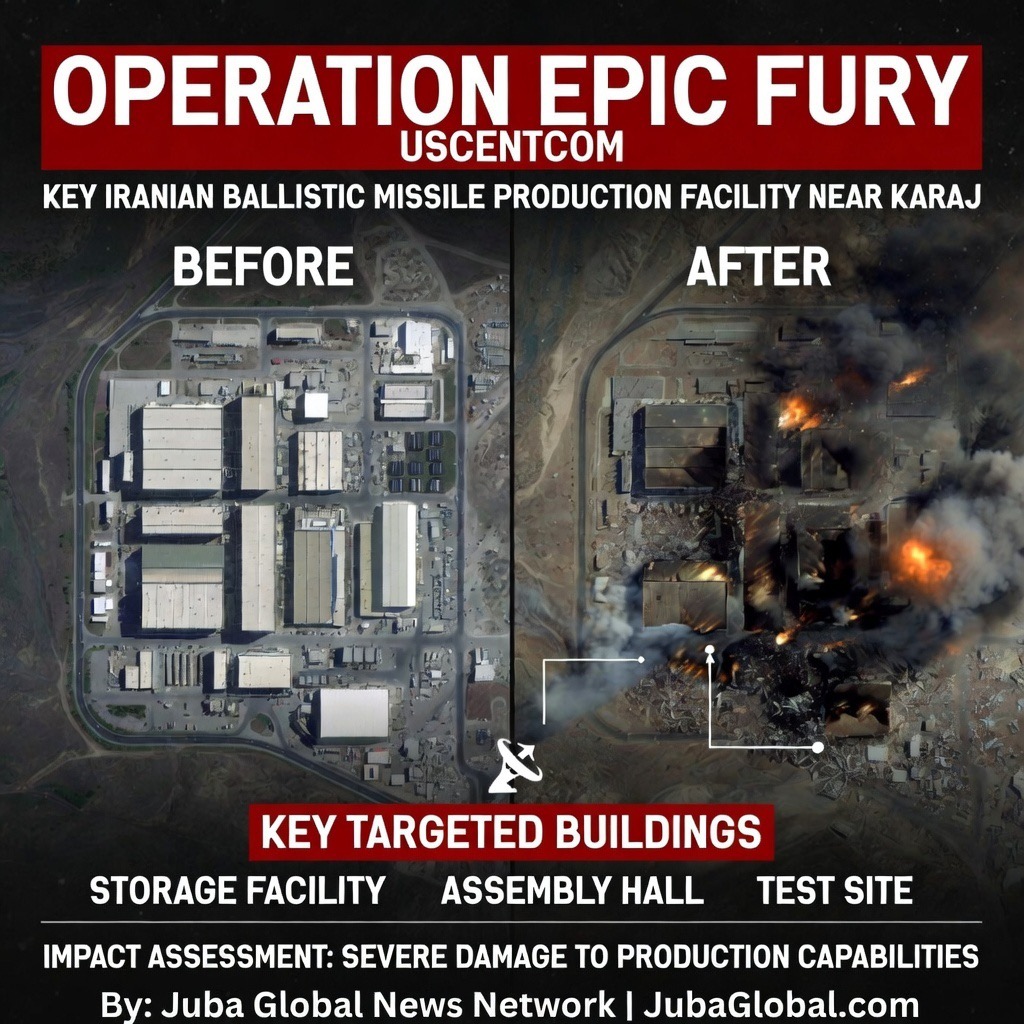
In a significant blow to Iran’s ballistic missile production capabilities amid the ongoing U.S.-Israeli military campaign, U.S. Central Command (CENTCOM) confirmed that American forces have completely destroyed the Karaj Surface-to-Surface Missile Plant as part of Operation Epic Fury. Satellite imagery released by CENTCOM shows dramatic before-and-after views of the facility, revealing extensive structural devastation following precision-guided strikes.
The Karaj plant, located in Alborz Province northwest of Tehran, served as a critical assembly site for surface-to-surface ballistic missiles under the control of Iran’s Islamic Revolutionary Guard Corps (IRGC). CENTCOM stated that the facility produced missiles posing direct threats to U.S. personnel, regional allies, neighboring countries, and international commercial shipping lanes—particularly through the vulnerable Strait of Hormuz.
Before and After: Visual Proof of Destruction
CENTCOM publicly released high-resolution satellite photographs comparing the site on March 1, 2026 (pre-strike) and March 11, 2026 (post-strike):
- The March 1 image depicts an intact industrial complex with long assembly halls, support buildings, storage structures, and operational infrastructure clearly visible.
- By March 11, the same location is reduced to rubble piles, collapsed roofs, fully destroyed buildings, and widespread debris fields. Multiple large structures appear completely leveled, with precision munitions having created craters and fire damage across the compound.
CENTCOM emphasized that the strikes were carried out with “precision munitions” to minimize collateral damage while maximizing degradation of Iran’s missile production capacity. The operation forms part of a broader, sustained U.S.-led air campaign targeting Iranian military infrastructure since late February 2026.
Context Within Operation Epic Fury
The Karaj strike is one of several high-impact actions under Operation Epic Fury, the codename for U.S. military efforts to degrade Iran’s ability to threaten regional stability and global energy routes. Recent CENTCOM actions include:
- Destruction of hardened anti-ship missile sites along Iran’s coastline near the Strait of Hormuz using 5,000-pound deep-penetrator munitions.
- Large-scale strikes on Kharg Island (over 90 targets hit), eliminating naval mine storage, missile facilities, and air defense systems.
- Elimination of Iranian naval vessels used for mine-laying and other threats to shipping.
These operations have directly responded to Iran’s missile barrages against U.S. allies (including strikes on energy infrastructure in Qatar, Saudi Arabia, Kuwait, and the UAE) and attempts to close or disrupt the Strait of Hormuz, through which roughly 20% of global oil and a significant portion of LNG flow.
Iranian state media has downplayed the Karaj damage, claiming limited impact and rapid recovery potential, but independent analysts and open-source imagery confirm severe degradation. The plant’s destruction is estimated to set back Iran’s ability to replenish ballistic missile stocks by months to years, depending on relocation and rebuilding efforts.
Strategic Implications
The Karaj facility was not merely a production site—it represented a core element of Iran’s asymmetric warfare doctrine, enabling rapid assembly and deployment of missiles capable of reaching Israel, U.S. bases in the Gulf, and commercial vessels. Its elimination reduces Tehran’s immediate retaliatory options and strengthens deterrence.
President Trump has repeatedly stated that U.S. operations aim to neutralize threats without committing ground troops, focusing instead on air and naval superiority. In related developments, Israel has conducted parallel strikes on Iranian missile production and air defense sites, including areas near Karaj and in Tehran.
Iran’s response has included missile and drone attacks on Gulf energy assets, contributing to the current oil price volatility (Brent settling near $108 after peaking at $119) and LNG supply disruptions. Tehran has vowed continued resistance, but analysts note growing strain on regime resources after weeks of sustained bombardment.
As the conflict enters its third week, the Karaj strike underscores the U.S. commitment to systematically dismantling Iran’s most dangerous military capabilities. With satellite evidence now public, the message from CENTCOM is clear: threats to American forces, allies, and global commerce will be met with decisive, precise force.
For ongoing coverage of Operation Epic Fury, satellite analysis, and the broader Middle East crisis, visit JubaGlobal.com.
Juba Global News Network — Tracking the strikes that shape tomorrow’s security.
