

IRGC Spokesperson Killed in US-Israeli Airstrikes, Tehran Reports
By Juba Global News Network JubaGlobal.com March 20, 2026 In a major symbolic and operational setback for Iran’s Islamic Revolutionary Guard Corps (IRGC),
By Juba Global News Network
JubaGlobal.com
March 20, 2026
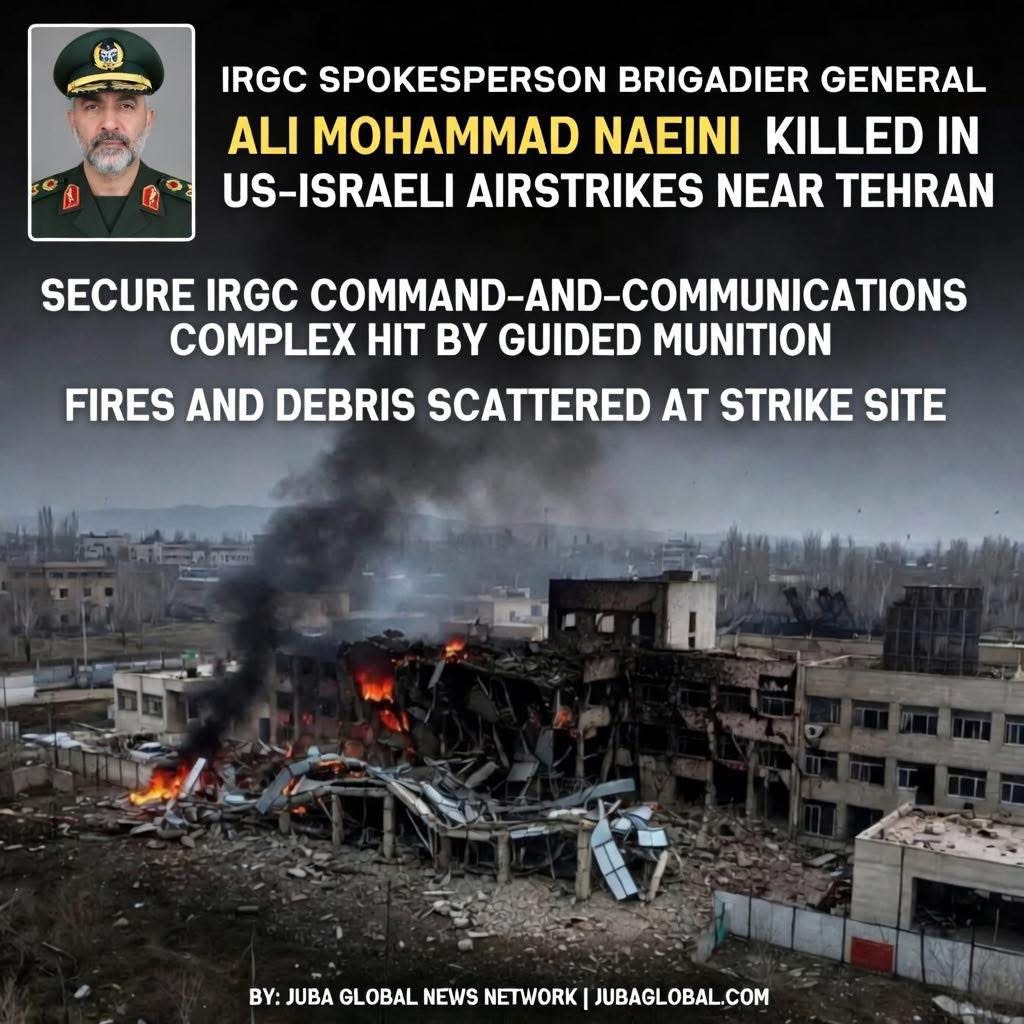
In a major symbolic and operational setback for Iran’s Islamic Revolutionary Guard Corps (IRGC), senior spokesperson Brigadier General Ali Mohammad Naeini was killed early Thursday morning in a precision airstrike jointly attributed to U.S. and Israeli forces. Iranian state media confirmed the death hours later, describing it as a “cowardly assassination” and vowing “severe revenge” against both Washington and Tel Aviv.
The strike occurred at approximately 03:45 local time near a secure IRGC command-and-communications complex on the outskirts of Tehran. Iranian officials stated that Naeini was attending an emergency coordination meeting when the building was hit by multiple guided munitions. At least four other senior officers and several support personnel were also reported killed in the same attack.
Who Was Ali Mohammad Naeini?
Brigadier General Ali Mohammad Naeini, 52, had served as the official military spokesperson for the IRGC since late 2023. In that role, he became one of the most visible and frequently quoted faces of the Revolutionary Guard on state television, international press briefings, and official Telegram channels.
Naeini was widely regarded inside Iran as a disciplined propagandist and information-warfare specialist rather than a frontline field commander. His daily televised appearances—often in crisp uniform against the backdrop of IRGC insignias—delivered defiant messages during the escalating conflict:
- He repeatedly claimed that Iranian missile barrages had “crippled” Israeli air defenses.
- He accused the United States of “direct occupation” of Gulf waters after CENTCOM operations intensified.
- He downplayed reported damage to missile production sites, nuclear-related facilities, and now energy infrastructure, insisting that “the Zionist-American aggression has only strengthened national resolve.”
Western intelligence agencies and open-source analysts had long identified Naeini as a key figure in shaping domestic morale and managing the IRGC’s external narrative during wartime. His elimination removes one of the regime’s most consistent and recognizable voices at a moment when Tehran is struggling to project strength amid mounting losses.
The Strike: Part of a Broader Targeting Campaign
The operation that killed Naeini fits into a clear pattern of U.S.-Israeli efforts to degrade not only Iran’s kinetic capabilities but also its command structure and propaganda apparatus.
Since the launch of sustained airstrikes in late February 2026, the coalition has systematically targeted:
- Senior IRGC-Quds Force commanders involved in proxy operations
- Missile force headquarters and production facilities (including the recently destroyed Karaj ballistic missile plant)
- Air defense radar and command nodes
- Key propagandists and psychological warfare assets
U.S. Central Command has not officially commented on the Naeini strike at time of publication, but Israeli Defense Forces (IDF) spokesperson Rear Adm. Daniel Hagari stated Thursday morning: “We continue to remove threats at every level—those who plan attacks, those who execute them, and those who attempt to justify and glorify them.”
Iranian officials, meanwhile, released grainy security camera footage purportedly showing the moment of impact: a bright flash followed by a secondary explosion that collapsed much of the multi-story building. State television interrupted regular programming to broadcast mourning footage and images of Naeini addressing crowds in previous years.
Regime Response and Internal Pressure
The killing has intensified internal pressure on Iran’s leadership. Hardline factions within the IRGC and the clerical establishment are reportedly pushing Supreme Leader Ali Khamenei to authorize more dramatic retaliatory measures—including potentially targeting U.S. military assets directly or escalating attacks on energy infrastructure beyond what has already occurred in Qatar, Saudi Arabia, and Kuwait.
At the same time, more pragmatic voices inside Tehran are said to be warning that further escalation could invite even more devastating coalition strikes, especially now that key missile production capacity has been heavily damaged and the Strait of Hormuz remains a high-risk transit zone.
President Trump, speaking briefly to reporters before boarding Air Force One Thursday, reiterated his position: “We’re not looking for endless war. But if they keep attacking our allies and trying to close global shipping lanes, they’re going to keep losing people and pieces of their military. Simple as that.”
Symbolic Weight in Week Three of the Conflict
With the war now entering its third full week, the death of the IRGC’s chief spokesperson arrives at a psychologically critical moment. Iran has suffered:
- Destruction of major missile assembly sites
- Significant degradation of air defenses around Tehran and key nuclear-related facilities
- Direct hits on energy infrastructure (South Pars) and retaliatory strikes on shared Gulf assets (Ras Laffan LNG hub)
- Mounting casualties among senior military figures
Naeini’s elimination removes a daily presence that Iranians had grown accustomed to seeing on screens—someone who promised victory even as blackouts, fuel shortages, and now airstrikes during Nowruz celebrations have become reality for many citizens.
Whether his death galvanizes resistance or accelerates disillusionment inside Iran remains to be seen. What is clear is that the coalition continues to methodically dismantle layers of the regime’s military and messaging machine.
For continuing coverage—including analysis of command structure impacts, satellite imagery updates, and the latest market reactions—visit JubaGlobal.com.
Juba Global News Network — When regimes lose their voices, the battlefield changes.
