

Iran Launches Massive Missile Barrage on Qatar’s LNG Export Hub, Halting 20% of World Supply
By Juba Global News Network JubaGlobal.com March 20, 2026 In one of the most severe escalations yet in the ongoing U.S.-Israeli war against Iran, Iranian f
By Juba Global News Network
JubaGlobal.com
March 20, 2026
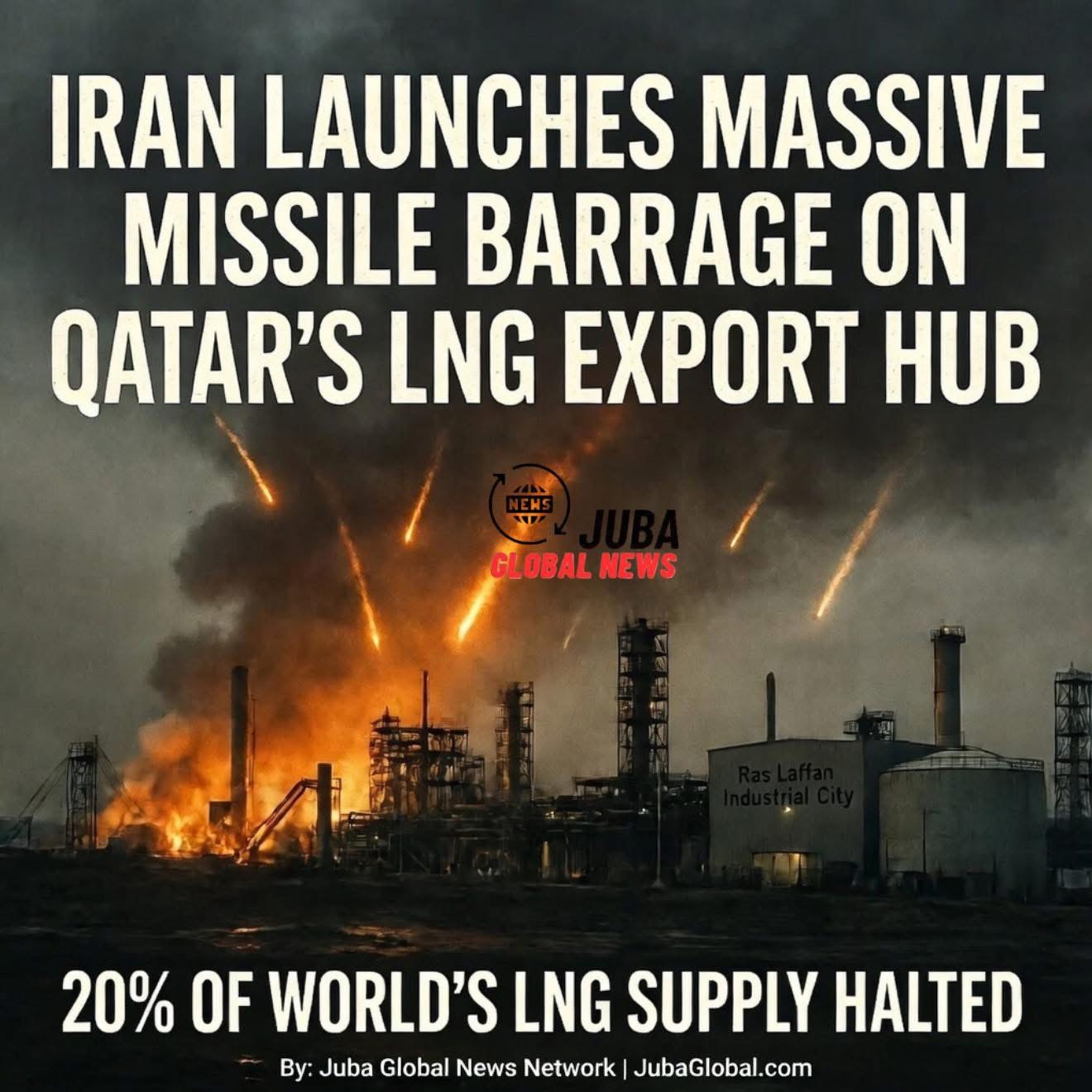
In one of the most severe escalations yet in the ongoing U.S.-Israeli war against Iran, Iranian forces unleashed a barrage of ballistic missiles and drones targeting Qatar’s Ras Laffan Industrial City late Wednesday into early Thursday, March 18-19, 2026. The strikes ignited massive fires across the world’s largest liquefied natural gas (LNG) export complex, forcing a complete and indefinite shutdown of operations and removing approximately 20% of global LNG supply from the market overnight.
QatarEnergy, the state-owned giant that operates the facility, confirmed “extensive damage” and “sizeable fires” at multiple sites within Ras Laffan, including key liquefaction trains, the Pearl gas-to-liquids (GTL) plant operated in partnership with Shell, and associated processing infrastructure. Qatar’s Ministry of Foreign Affairs denounced the attack as a “blatant” and “dangerous escalation,” promptly declaring Iran’s military and security attaches persona non grata and expelling them from Doha.
The Strike: Retaliation in Full Force
The assault came directly in response to Israel’s March 18 airstrike on Iran’s South Pars gas field—the Iranian portion of the world’s largest natural gas reservoir, shared with Qatar (where it is known as the North Field). Iranian officials framed the Qatar strikes as measured retaliation against what they called an attack on shared economic infrastructure, vowing “zero restraint” if Gulf energy assets face further threats.
Qatari defense systems intercepted several incoming missiles, but at least one ballistic missile breached defenses and struck critical areas, according to Qatar’s Interior Ministry and QatarEnergy statements. No casualties were reported, but the physical toll was catastrophic: flames lit up the night sky over Ras Laffan, visible from miles away, as emergency crews battled blazes amid damaged high-pressure equipment and storage tanks.
QatarEnergy CEO Saad al-Kaabi told Reuters on Thursday that the damage has “knocked out” roughly 17% of Qatar’s total LNG export capacity—equivalent to about 12.8 million tonnes per annum—for an estimated 3 to 5 years of repair and reconstruction. This translates to potential annual revenue losses exceeding $20 billion for Qatar alone, not counting secondary impacts on condensate, LPG, helium, and naphtha exports.
Global Energy Shockwaves
Ras Laffan processes virtually all of Qatar’s LNG output, making it the linchpin for the Gulf state’s position as the world’s second-largest LNG exporter (behind the United States). Qatar supplies nearly 20% of global LNG trade, with cargoes flowing heavily to Asia (Japan, South Korea, China, India) and increasingly to Europe as a replacement for Russian pipeline gas.
The immediate fallout has been brutal:
- LNG spot prices in Asia and Europe surged 25-40% in hours following confirmation of the strikes, with some contracts trading at record premiums.
- Force majeure declarations are already being issued on Qatari contracts, triggering supply shortfalls and frantic rerouting of cargoes from other sources.
- Natural gas futures in the U.S. (Henry Hub) and Europe (TTF) jumped sharply, compounding the oil price volatility from concurrent Gulf disruptions.
- Asian buyers, who rely on Qatari volumes for power generation and industry, face the prospect of winter shortages if repairs drag on.
- European nations, still weaning off Russian energy, now confront a dual crisis: soaring prices and uncertain deliveries.
The broader Persian Gulf energy theater remains paralyzed. The Strait of Hormuz sees minimal tanker traffic amid mine and drone threats, while Saudi, Kuwaiti, and UAE facilities also reported hits or precautionary shutdowns in the same wave of Iranian retaliation.
Diplomatic and Strategic Fallout
Qatar—long a mediator in regional conflicts and host to the massive U.S. Al Udeid Air Base—has maintained careful neutrality in the Iran war. The attack on its soil marks a sharp turning point, forcing Doha into a more confrontational posture. Expelling Iranian diplomats signals a break in quiet backchannels, while Qatar’s allies (including the U.S.) condemned the strikes as reckless endangerment of global energy security.
President Trump warned earlier that any repeated attacks on Qatari energy sites would trigger a “massive” U.S. response, including potential strikes on Iran’s remaining major gas fields. Israeli officials have remained largely silent on the Qatar developments, focusing instead on ongoing operations inside Iran.
Analysts warn the targeting of shared Iran-Qatar infrastructure risks turning the Persian Gulf into a prolonged battlefield, with cascading environmental, economic, and humanitarian consequences. Repairing Ras Laffan could take years, involving specialized international contractors under heightened security. In the interim, the world faces the real prospect of an energy crunch rivaling—or exceeding—the 1970s oil shocks.
As fires still smolder over Ras Laffan and markets brace for prolonged tightness, the question looms: can diplomacy pull back from the brink before more of the world’s energy arteries are severed?
For live updates on the Gulf energy crisis and the wider Middle East war, visit JubaGlobal.com.
Juba Global News Network — Reporting the stakes when the world runs on fire.
