US and Israel Strike Natanz Nuclear Facility Again: Tehran Denies Radiation Leak as Conflict Enters Critical Phase
By Juba Global News Network | JubaGlobal.com
March 22, 2026 – Updated 09:15 AM EDT
Fort George G. Meade Junction, Maryland
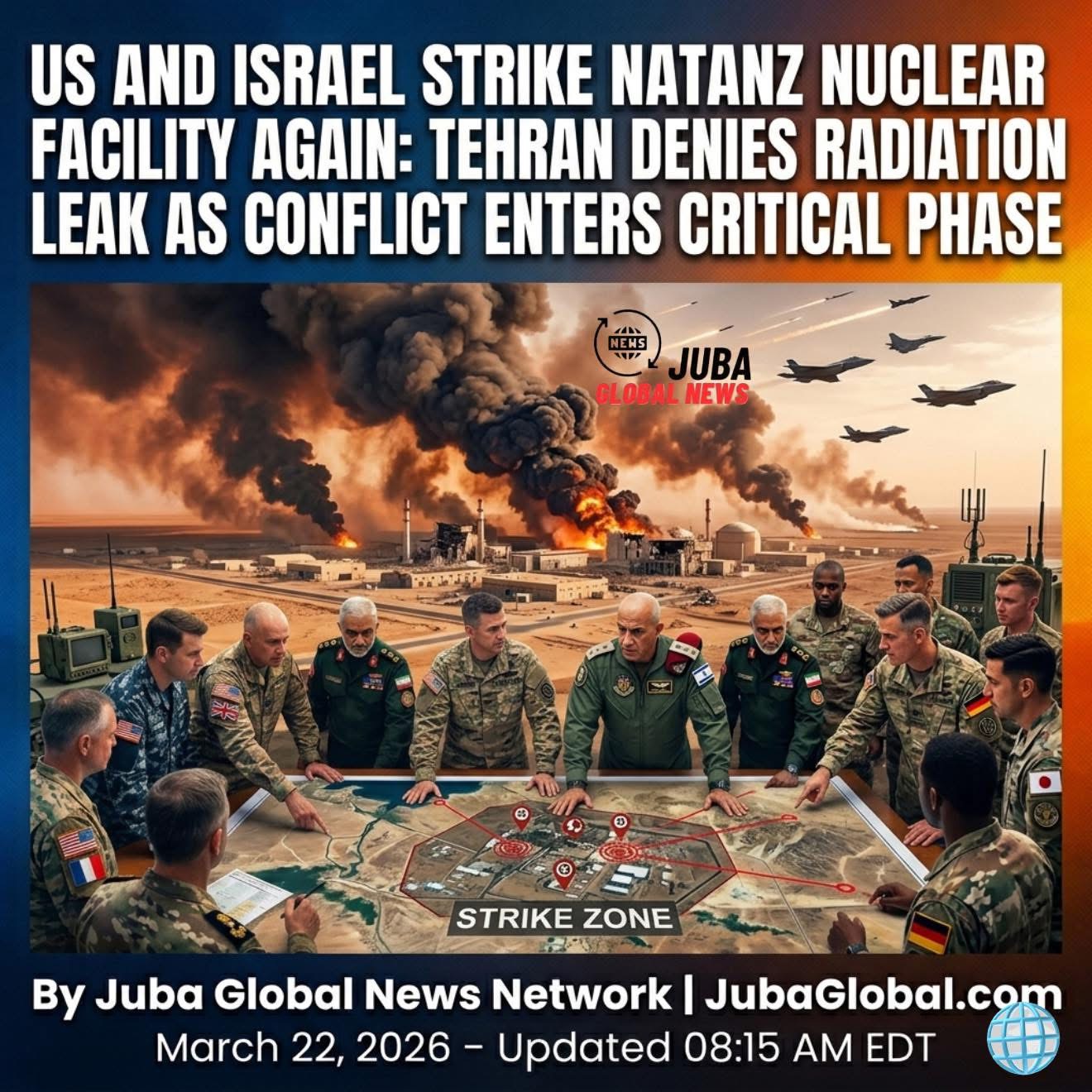
In the latest major escalation of the ongoing U.S.-Israel-Iran war, joint American and Israeli air forces conducted a fresh precision strike on Iran’s Natanz Fuel Enrichment Plant (FEP) early Sunday morning local time (late Saturday EDT, March 21–22, 2026). The attack marks at least the third confirmed direct hit on the underground nuclear complex since the conflict began on February 28, and comes amid reports that bunker-buster munitions were again employed to penetrate hardened subterranean halls.
Iranian state media and the Atomic Energy Organization of Iran (AEOI) immediately denied any release of radioactive material, insisting that “no damage occurred to enrichment centrifuges or uranium stockpiles” and that “all safety systems functioned as designed.” Tehran labeled the strike “another act of state terrorism” and vowed “severe and painful” retaliation.
Western intelligence assessments and satellite imagery analysis circulating among defense outlets paint a more contested picture: several large craters and secondary explosions were visible near the centrifuge assembly buildings and power supply infrastructure, with smoke rising from multiple points across the 100,000-square-meter site. Independent nuclear experts monitoring commercial satellite feeds noted “significant thermal signatures” consistent with strikes on underground ventilation systems and backup generators.
Natanz: The Heart of Iran’s Enrichment Program
The Natanz facility, located approximately 220 km south of Tehran in Isfahan Province, remains Iran’s primary site for uranium enrichment. Key features include:
- Underground Fuel Enrichment Plant (FEP): Houses thousands of IR-1, IR-2m, IR-4, and more advanced IR-6 centrifuges in heavily fortified halls buried 8–23 meters beneath reinforced concrete and earth.
- Above-ground Pilot Fuel Enrichment Plant (PFEP): Used for testing newer centrifuge models and higher enrichment levels.
- Extensive power, cooling, and air filtration systems critical to centrifuge operation.
Previous strikes in the current conflict (reported February 28–March 10 and again March 15–18) had already damaged or destroyed several centrifuge cascades, disrupted electrical substations, and forced Iran to relocate some advanced centrifuge production lines. Sunday’s raid appears to have targeted remaining operational power feeds and ventilation infrastructure—systems essential to sustaining large-scale enrichment without risking cascade failures from overheating or contamination.
U.S. Central Command has not yet issued an official statement on the latest Natanz strike as of 09:15 AM EDT, but unnamed Pentagon officials told reporters that the operation was “designed to further degrade Iran’s near-term breakout capability” while avoiding actions that would guarantee a radiological release.
Iran’s Immediate Response and Radiation Denial
AEOI spokesman Behrouz Kamalvandi appeared on state television within hours of the explosions, reading a prepared statement:
“The Zionist-American aggressors once again targeted Natanz, but thanks to divine protection and the resilience of our engineers, no breach of containment occurred. There is zero radiation leakage. Enrichment activities continue uninterrupted at other secure locations. The criminals will pay a heavy price.”
Iran activated its National Nuclear Safety System and invited International Atomic Energy Agency (IAEA) inspectors already stationed in the country to conduct an immediate radiation survey of the perimeter. Preliminary IAEA readout (released via X at 07:40 Tehran time) reported “no detectable increase in off-site radiation levels” as measured by environmental monitoring stations up to 50 km from the site.
Skeptics, however, point out that Natanz’s underground halls make any internal release difficult to detect externally unless a major breach occurs. Past incidents—most notably the 2021 sabotage attributed to Israel—showed that even significant centrifuge hall damage can be contained without widespread environmental contamination.
Timing and Strategic Context
The renewed Natanz strike occurred less than 12 hours after:
- President Trump’s 48-hour ultimatum demanding Iran fully reopen the Strait of Hormuz or face U.S. strikes on power plants.
- Iranian ballistic missile attacks on southern Israeli cities Dimona and Arad, injuring over 100 people.
- CENTCOM’s announcement that more than 8,000 targets had been struck in Iran, with the Iranian navy “degraded” to near non-operational status.
Analysts interpret the timing as a deliberate signal: even as diplomatic and economic pressure mounts over the Hormuz blockade, the U.S. and Israel are unwilling to pause efforts to set back Iran’s nuclear program. Some suggest the strike was intended to preempt any Iranian attempt to accelerate enrichment to weapons-grade levels (90% U-235) in response to battlefield setbacks.
Global Ramifications and Next Risks
The attack raises several immediate concerns:
- Radiological Risk — While both sides claim no leak, any future strike that breaches centrifuge halls containing enriched uranium hexafluoride (UF₆) could disperse radioactive particles locally.
- Iranian Retaliation — Tehran has repeatedly warned that nuclear-site attacks cross a red line. Possible responses include intensified missile barrages, proxy activation across multiple fronts, or attempts to target U.S. nuclear-related assets symbolically.
- Diplomatic Fallout — Russia and China condemned the strike as “reckless warmongering.” A group of 22 nations urging reopening of the Strait did not mention Natanz directly but warned against actions that could “irreversibly escalate” the conflict.
- Market Impact — Oil futures ticked higher on fears that further nuclear-related strikes could provoke Iranian closure of the Strait or attacks on Gulf energy infrastructure.
As the war reaches day 24, Natanz once again stands at the center of a conflict that began over nuclear negotiations and now threatens to reshape the global energy and security landscape.
Juba Global News Network continues to monitor Natanz developments, IAEA statements, satellite imagery analysis, and official reactions. For live satellite photo updates, radiation monitoring data, and expert commentary, visit JubaGlobal.com. 🌍
Information compiled from AEOI statements, IAEA preliminary readouts, commercial satellite imagery analysis, U.S. and Israeli defense sources, and international media reporting as of March 22, 2026, 09:15 AM EDT. Details remain subject to confirmation and rapid change.