U.S. Pushes AI Exports & Sovereignty at India AI Impact Summit: A Strategic Play for Global Leadership
By: Juba Global News Network | JubaGlobal.com
February 20, 2026
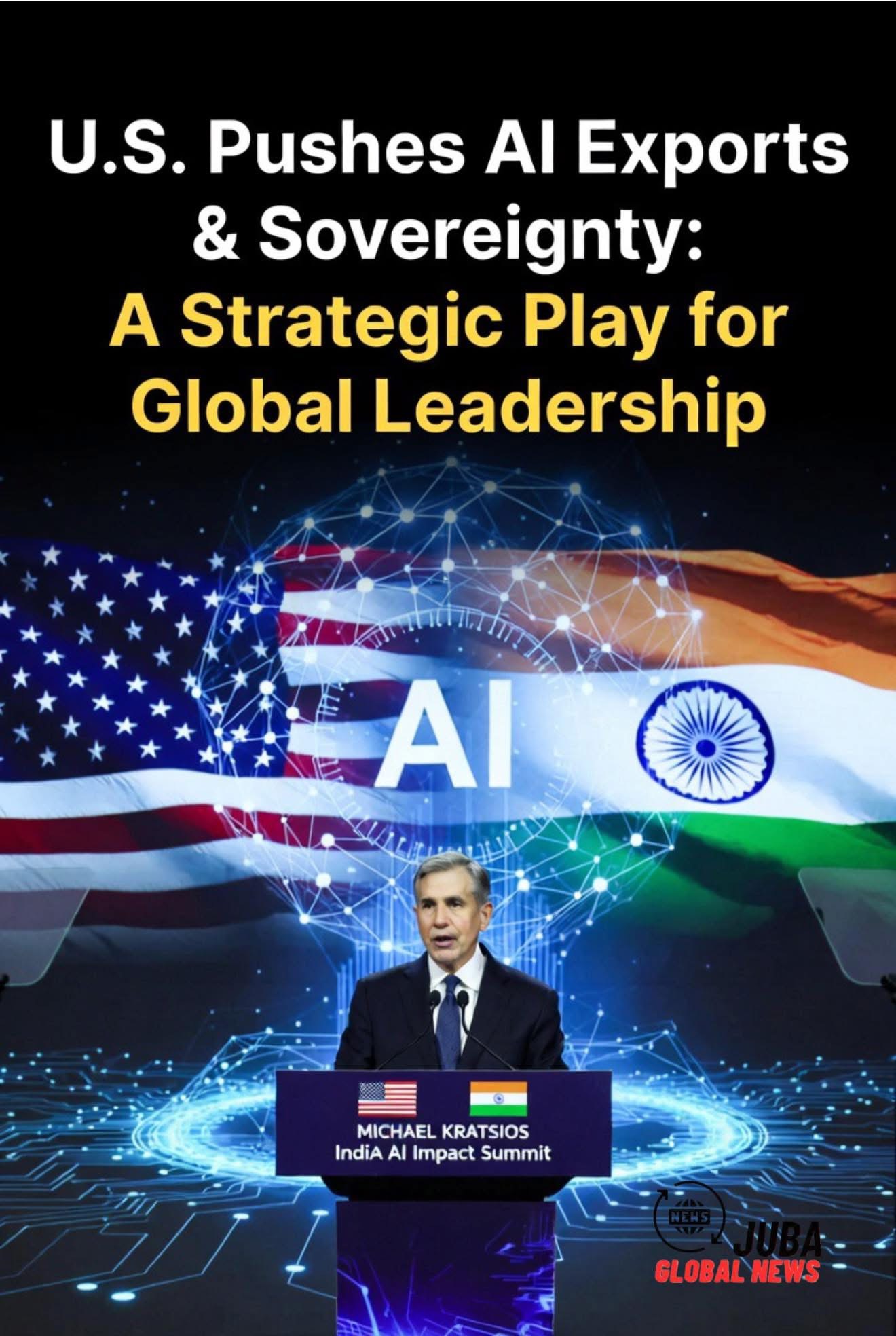
At the India AI Impact Summit 2026 in New Delhi, U.S. officials delivered a clear and assertive message: America remains the undisputed leader in artificial intelligence, and it is ready to export its cutting-edge technology stack to trusted partners—while firmly rejecting any form of centralized global governance over AI. Leading the U.S. delegation was Michael Kratsios, Assistant to the President and Director of the White House Office of Science and Technology Policy (OSTP), who used the high-profile gathering to outline the Trump administration’s vision for “real AI sovereignty,” rapid global adoption of American AI systems, and expanded exports.
The summit, running from February 16–20 at Bharat Mandapam, brought together heads of state, foreign ministers, tech executives, policymakers, and business leaders from dozens of countries. It marked a shift in global AI discourse—from earlier focuses on “safety” and regulation to “impact,” adoption, and national development. India positioned itself as a voice for the Global South, emphasizing public-good AI applications in healthcare, agriculture, education, energy, and public services.
Kratsios’s Key Remarks: Sovereignty Without Isolation
In his address on February 20, Kratsios emphasized that “real AI sovereignty” does not mean full technological self-sufficiency—an unrealistic goal given the complexity of the modern AI stack—but rather strategic autonomy combined with access to the world’s best tools.
“Real AI sovereignty means owning and using best-in-class technology for the benefit of your people, and charting your national destiny in the midst of global transformations,” Kratsios declared. “Complete technological self-containment is unrealistic for any country… But strategic autonomy alongside rapid AI adoption is achievable, and it is a necessity for independent nations. America wants to help.”
He explicitly rejected global governance models for AI, stating: “As the Trump Administration has now said many times: We totally reject global governance of AI.” This stance contrasts sharply with European calls for tighter regulation and “safe spaces” for innovation, as articulated by figures like French President Emmanuel Macron earlier in the week.
Kratsios highlighted the reversal of previous U.S. policies, noting that the prior administration’s “diffusion framework” had restricted exports and relegated partners like India to lower-tier access. Under President Trump, that approach has been repealed in favor of empowerment through partnership.
Launch of the American AI Exports Program & New Initiatives
A centerpiece of the U.S. presentation was the American AI Exports Program, a whole-of-government effort to accelerate worldwide adoption of trusted American AI systems. Kratsios announced a suite of supporting initiatives, including:
- Financing mechanisms and technical cooperation to help partners deploy U.S. AI components.
- Standards development for interoperability and openness.
- A new Technology Prosperity Corps (modeled on the historic Peace Corps), which will send thousands of U.S. science, math, and engineering graduates abroad over the next five years to provide “last-mile” support for AI deployment in public services, particularly in developing nations. The program aims to counter China’s growing AI influence by embedding American technical talent and boosting reliance on U.S. technology.
The U.S. delegation—also including Under Secretary of State Jacob Helberg, Under Secretary of Commerce William Kimmitt, and Ambassador Sergio Gor—framed these efforts as a way to build a competitive, open, and interoperable global AI ecosystem while advancing U.S. economic and national security interests.
Broader Geopolitical & Economic Context
The summit occurred amid deepening U.S.-India ties, including recent trade adjustments, India’s formal joining of the U.S.-led Pax Silica coalition for critical minerals and AI supply chain resilience, and commitments from companies like Google and others to expand AI infrastructure in India. Prime Minister Narendra Modi pitched India as a global AI hub: “Design and develop in India. Deliver to the world. Deliver to humanity.”
U.S. officials positioned India as a central partner in this vision, with Kratsios noting that American AI is “the gold standard” and that the U.S. is eager to deliver it to allies. Discussions also touched on sovereign compute, workforce transitions, biotech innovation, and supply chain security—areas where U.S.-India collaboration could challenge China’s dominance.
Reactions varied: Supporters praised the focus on empowerment and rapid adoption; critics questioned whether heavy reliance on American tech truly delivers sovereignty or creates new dependencies. European voices pushed back on the anti-regulation tone, while Global South participants welcomed the emphasis on development-focused AI.
Looking Ahead
As the summit concluded with a leaders’ declaration (delayed to maximize signatories), the U.S. push signals a proactive strategy: share American AI leadership broadly with partners, reject multilateral bureaucratic control, and position the U.S. stack as the foundation for sovereign national AI capabilities worldwide.
With initiatives like the Technology Prosperity Corps and expanded exports now rolling out, the coming months will test whether this approach accelerates global AI progress—or deepens geopolitical divides in the race for technological supremacy.
Juba Global News Network will continue tracking outcomes from the India AI Impact Summit, implementation of U.S. initiatives, and evolving U.S.-India tech cooperation.
(Images: Michael Kratsios speaking at the India AI Impact Summit podium; Futuristic AI graphics merging U.S. and Indian flags; Group photo of U.S. delegation with Indian officials; Conceptual image of global AI network with data flows and sovereignty icons)