

Trump Raises Global Tariffs to 15% in Defiant Response to Supreme Court Ruling Striking Down Previous Levies
By: Juba Global News Network | JubaGlobal.com February 23, 2026 – Amid escalating trade tensions In a bold and rapid escalation of his trade agenda, U.S. P
By: Juba Global News Network | JubaGlobal.com
February 23, 2026 – Amid escalating trade tensions
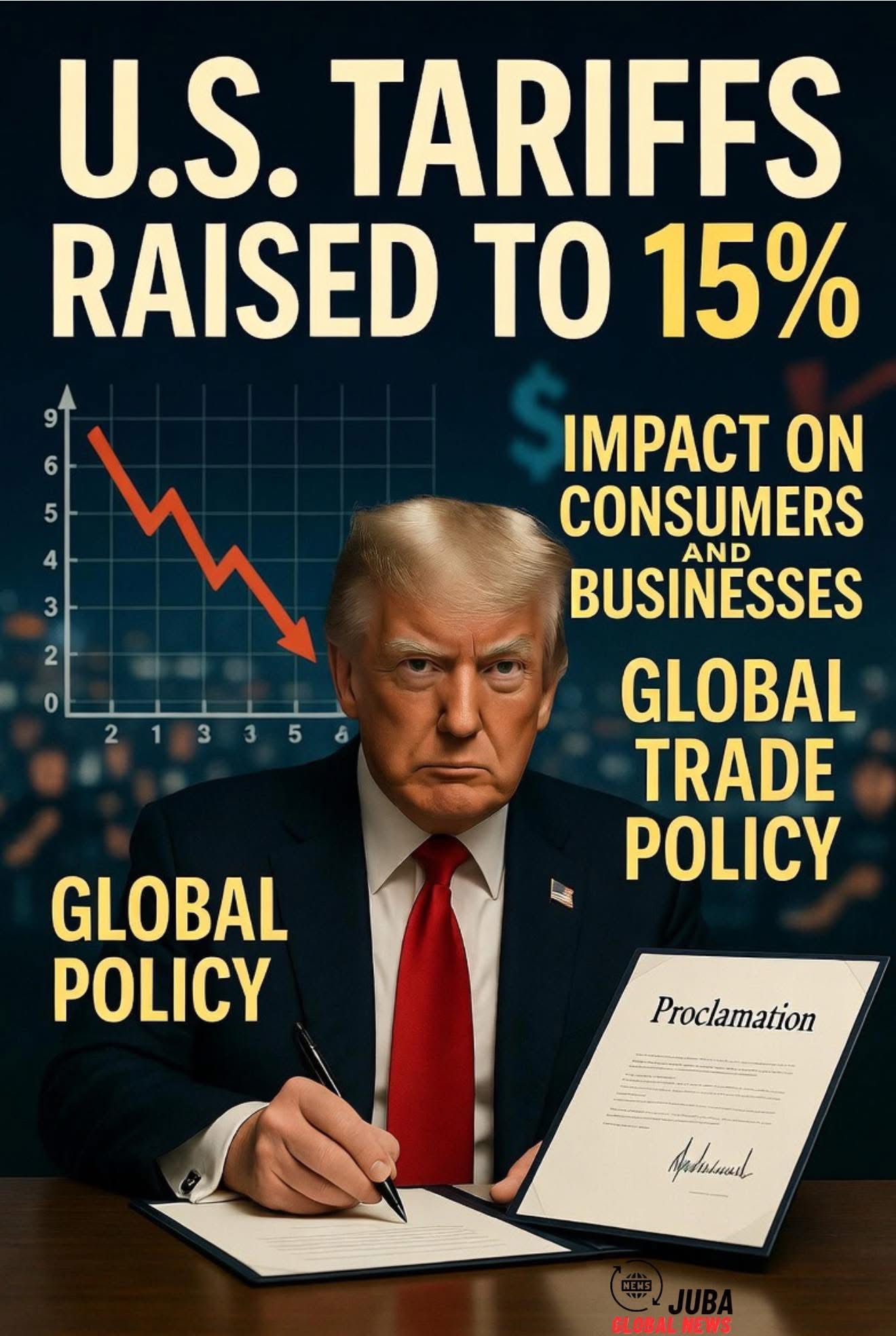
In a bold and rapid escalation of his trade agenda, U.S. President Donald Trump announced on Saturday, February 21, 2026, that he would increase a newly imposed global tariff on imports from all countries to 15%, up from the 10% rate he had declared just one day earlier. The move comes directly on the heels of a landmark Supreme Court decision on Friday, February 20, 2026, that invalidated a large portion of his previous broad tariffs as exceeding presidential authority.
The announcement has injected fresh uncertainty into global markets, supply chains, and international relations, with businesses bracing for higher costs, potential inflation pressures, and retaliatory measures from trading partners. While the new tariffs are framed as temporary and limited in scope compared to the struck-down measures, they represent Trump’s unyielding commitment to using trade policy as leverage against perceived economic imbalances and unfair practices.
The Supreme Court Ruling: A Major Setback
On Friday, the U.S. Supreme Court issued a 6-3 decision in the consolidated cases Learning Resources, Inc. v. Trump and related challenges, ruling that the International Emergency Economic Powers Act (IEEPA)—a 1977 law granting the president broad powers during declared national emergencies—does not authorize the imposition of tariffs.
The Court, in an opinion written by Chief Justice John Roberts and joined by Justices Sotomayor, Kagan, Gorsuch, Barrett, and Jackson, emphasized that the power to tax and impose duties lies with Congress under the Constitution. IEEPA’s language allowing the president to “regulate… importation” does not extend to levying tariffs, as the statute makes no mention of duties, taxes, or revenue-raising measures. The justices noted that no prior president had interpreted IEEPA this way, and doing so would represent an extraordinary delegation of congressional authority.
The invalidated tariffs stemmed from multiple executive actions during Trump’s second term:
- Tariffs targeting fentanyl trafficking and border security, including 25% on most non-USMCA-compliant imports from Mexico and Canada, and 10% on Chinese goods.
- Broader “reciprocal” or “Liberation Day” tariffs imposed in 2025 on imports from nearly every trading partner to address persistent U.S. trade deficits.
These measures had generated billions in revenue—estimates exceed $160–175 billion in collected duties—but also sparked widespread legal challenges from importers, businesses, and some states. The ruling opens the door to potential refunds for importers, though the Court left questions of retroactive relief to lower courts, creating ongoing uncertainty.
In dissent, Justices Thomas, Kavanaugh, and Alito argued for broader executive flexibility in national emergencies, with Kavanaugh warning that refunds could reach billions and destabilize trade deals negotiated under the tariff pressure.
Trump’s Immediate Pivot: From IEEPA to Section 122
Hours after the ruling, Trump signed a proclamation invoking Section 122 of the Trade Act of 1974, a rarely used provision allowing the president to impose temporary import surcharges of up to 15% for up to 150 days to address “large and serious” balance-of-payments deficits or fundamental international payment problems.
The initial 10% global tariff was set to take effect Tuesday, February 24, 2026 (coinciding with the State of the Union address), with exemptions for certain goods (including those under Section 232 national security tariffs on steel/aluminum and USMCA-compliant items from Canada and Mexico). On Saturday, Trump posted on Truth Social that he was raising the rate to the maximum 15% “effective immediately,” denouncing the Supreme Court’s decision as “ridiculous, poorly written, and extraordinarily anti-American.”
White House officials, including U.S. Trade Representative Jamieson Greer, insisted the policy direction remains unchanged despite the ruling. Greer emphasized that existing bilateral trade deals (with countries like the UK, EU, Japan, and Switzerland) would not be disrupted, and the new measure is distinct from prior frameworks.
Economic and Global Implications
The shift to a blanket 15% surcharge—though temporary and less targeted—still poses risks:
- Higher costs for U.S. consumers and businesses: Importers typically pass on tariff expenses, potentially raising prices for goods from electronics and apparel to industrial inputs.
- Market volatility: Stocks and futures showed initial dips following the announcement, though analysts described the reaction as muted compared to prior tariff escalations, viewing it as “noise” rather than a structural shift.
- Retaliation risks: Trading partners may respond with countermeasures, especially as the tariffs apply broadly (with noted exemptions for Canada and Mexico under USMCA).
- Temporary nature: Limited to 150 days without congressional extension, the measure buys time but requires legislative action for permanence—unlikely in a divided Congress.
- Broader agenda: Trump hinted at future “new and legally permissible” tariffs in coming months, suggesting ongoing efforts to reshape global trade.
Critics argue the pivot exploits a loophole while undermining congressional authority; supporters see it as necessary to protect American manufacturing and address chronic deficits.
Looking Ahead
The Supreme Court’s rebuke marks a rare check on executive trade power, but Trump’s swift response underscores his determination to press forward. As the 150-day clock starts, attention turns to Congress, potential legal challenges to the new tariffs, refund processes for prior duties, and international negotiations.
For now, the 15% global tariff stands as Trump’s latest salvo in an ongoing trade war—one that continues to reshape the global economic landscape amid heightened uncertainty.
By: Juba Global News Network | JubaGlobal.com
This article is compiled from real-time reporting by BBC, The Guardian, Al Jazeera, Reuters, CNN, PBS, CNBC, NPR, The New York Times, Supreme Court opinions, and White House statements as of February 23, 2026. Developments are ongoing—monitor official sources for updates.
