

EU Refuses Any Increase in US Tariffs, Demands Strict Compliance with Existing Trade Deal Amid Trump’s Latest Escalation
By: Juba Global News Network | JubaGlobal.com February 23, 2026 – Transatlantic tensions rise as tariff uncertainty deepens In a strongly worded statement
By: Juba Global News Network | JubaGlobal.com
February 23, 2026 – Transatlantic tensions rise as tariff uncertainty deepens
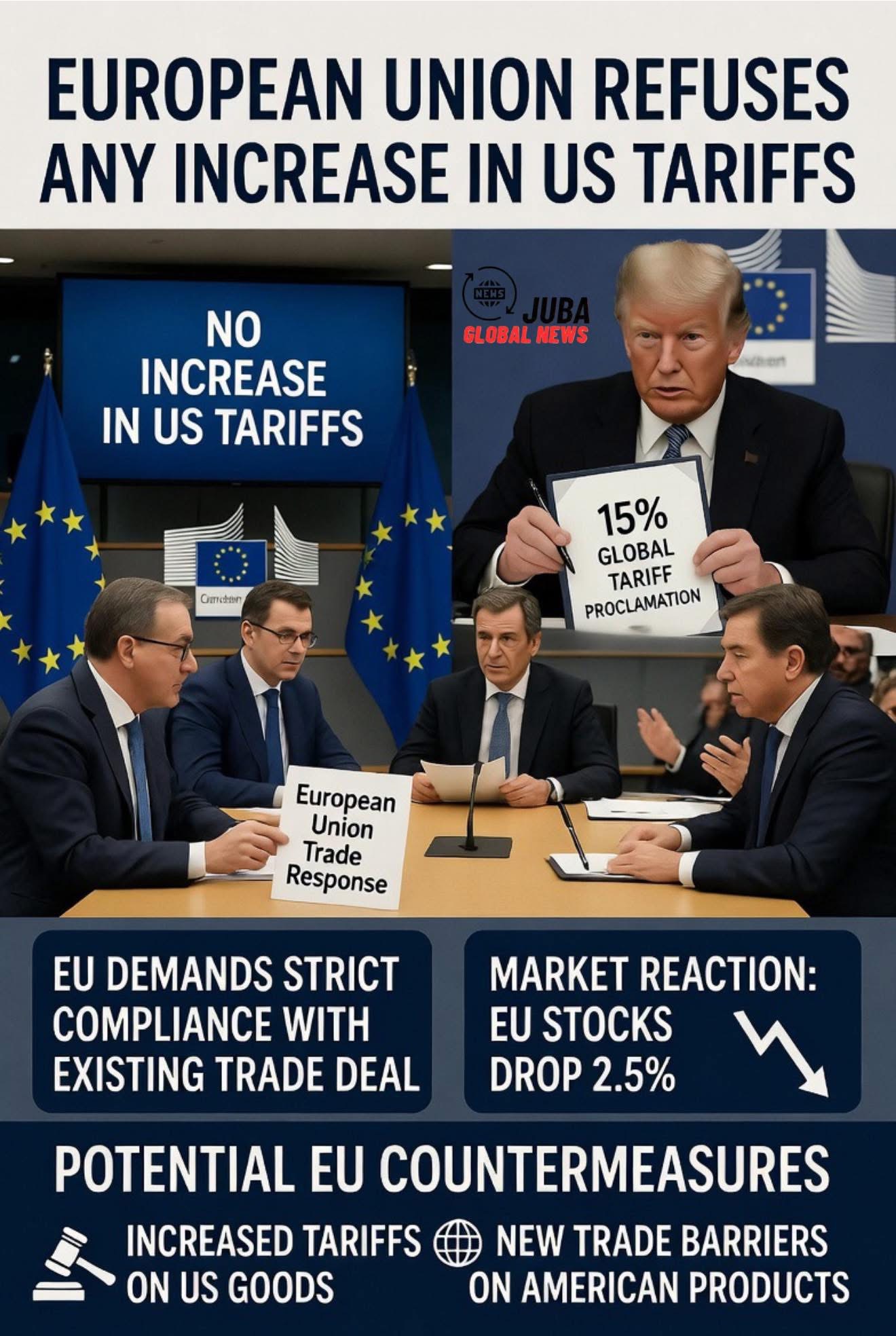
In a strongly worded statement issued on Sunday, February 22, 2026, the European Commission declared that the European Union will not accept any increase in U.S. tariffs beyond the ceilings established in last year’s bilateral trade agreement. The EU insisted that “a deal is a deal,” demanding full compliance from the United States following President Donald Trump’s rapid imposition of a new 15% global tariff—a move that came mere hours after a landmark U.S. Supreme Court ruling invalidated much of his prior tariff regime.
The Commission’s firm stance highlights growing transatlantic friction, with EU officials warning that unpredictable U.S. trade policy undermines confidence in global markets, disrupts supply chains, and jeopardizes the “fair, balanced, and mutually beneficial” framework agreed upon in the EU-U.S. Joint Statement of August 2025.
Background: The Supreme Court Ruling and Trump’s Swift Response
On Friday, February 20, 2026, the U.S. Supreme Court ruled 6-3 that President Trump exceeded his authority by invoking the International Emergency Economic Powers Act (IEEPA) to impose broad global tariffs. The decision struck down levies targeting fentanyl flows, border security, and trade deficits, which had generated billions in revenue but faced widespread legal challenges from importers and allies.
Trump responded aggressively: On Saturday, he announced a temporary 10% across-the-board import surcharge under Section 122 of the Trade Act of 1974 (allowing up to 15% for 150 days to address balance-of-payments issues), then quickly raised it to the maximum 15%. The move was framed as a continuation of his “America First” agenda, but it has reignited concerns among key trading partners.
The EU-U.S. Trade Deal: What Was Agreed?
Last summer, European Commission President Ursula von der Leyen and President Trump finalized a framework agreement (often called the Turnberry Agreement) to avert a full-scale trade war. Key elements included:
- A 15% ceiling on U.S. tariffs for most EU goods (excluding certain sectoral tariffs like steel/aluminum under Section 232).
- Zero tariffs on select products, such as aircraft, spare parts, and other industrial items.
- EU concessions: Removal of duties on many U.S. exports and withdrawal of threatened retaliatory measures.
- Mutual commitments to pursue “fair, balanced, and mutually beneficial” trade, including efforts to lower tariffs overall.
The deal was intended to provide predictability for businesses on both sides of the Atlantic. However, ratification by the European Parliament has been delayed—initially paused in protest over unrelated U.S. demands (including threats related to Greenland)—and was tentatively scheduled for late February. The recent developments have thrown this timeline into doubt.
EU’s Firm Rebuttal: “No Increases Beyond the Agreed Ceiling”
In its Sunday statement, the European Commission emphasized:
- The current U.S. actions create an environment “not conducive” to the agreed principles of fair transatlantic trade.
- The EU expects Washington to honor the Joint Statement “just as the EU stands by its commitments.”
- EU products “must continue to benefit from the most competitive treatment, with no increases in tariffs beyond the clear and all-inclusive ceiling previously agreed.”
- Unpredictable tariff changes harm global market confidence and supply-chain stability.
The language marked a sharper tone than the Commission’s initial Friday response, which had been limited to studying the ruling and maintaining contact with U.S. officials. Brussels now demands “full clarity” on how the new 15% global levy interacts with the bilateral deal—whether it supersedes the agreement, stacks atop existing duties, or eliminates EU-specific exemptions.
European Parliament trade committee chair Bernd Lange announced he would propose suspending ratification at an emergency meeting on Monday, February 23, pending a “comprehensive legal assessment” and explicit U.S. commitments on tariff policy. He described the situation as “pure tariff chaos.”
Other EU voices echoed the frustration:
- German Chancellor Friedrich Merz indicated a unified European position ahead of his upcoming White House visit.
- French officials signaled readiness to use countermeasures if needed.
The EU has tools at its disposal, including the Anti-Coercion Instrument (allowing restrictions on U.S. investments, public tenders, and services) and pre-identified lists of retaliatory targets worth billions in U.S. exports.
Broader Implications: Risks to Transatlantic Ties and Global Trade
The standoff carries significant stakes:
- Economic impact — EU exports to the U.S. (its largest single market) could face higher effective duties if the new tariffs override deal protections, raising costs for European manufacturers in autos, machinery, pharmaceuticals, and luxury goods.
- Market reactions — European stocks dipped, and the euro weakened amid renewed uncertainty.
- Geopolitical ripple effects — The dispute distracts from shared priorities like Ukraine support, energy security, and countering China.
- Future of trade deals — Similar frameworks with the UK, Japan, South Korea, and others face questions about enforceability under fluctuating U.S. policy.
U.S. Trade Representative Jamieson Greer has insisted existing bilateral deals remain intact and urged partners to honor them, but the EU views the blanket 15% levy as a potential breach.
Path Forward: Negotiation or Escalation?
As the 150-day window on the new tariffs begins, pressure mounts for urgent talks. The EU prioritizes preserving a “stable, predictable transatlantic trading environment” while positioning itself as a defender of rules-based global trade.
Whether through diplomacy or countermeasures, the coming weeks will test the resilience of the transatlantic alliance. For now, Brussels has drawn a clear red line: No further tariff increases—and full compliance with what was solemnly agreed.
By: Juba Global News Network | JubaGlobal.com
Compiled from statements by the European Commission, Reuters, CNBC, AP, DW, The Guardian, and other real-time sources as of February 23, 2026. The situation evolves quickly—follow official EU and U.S. channels for the latest.
