

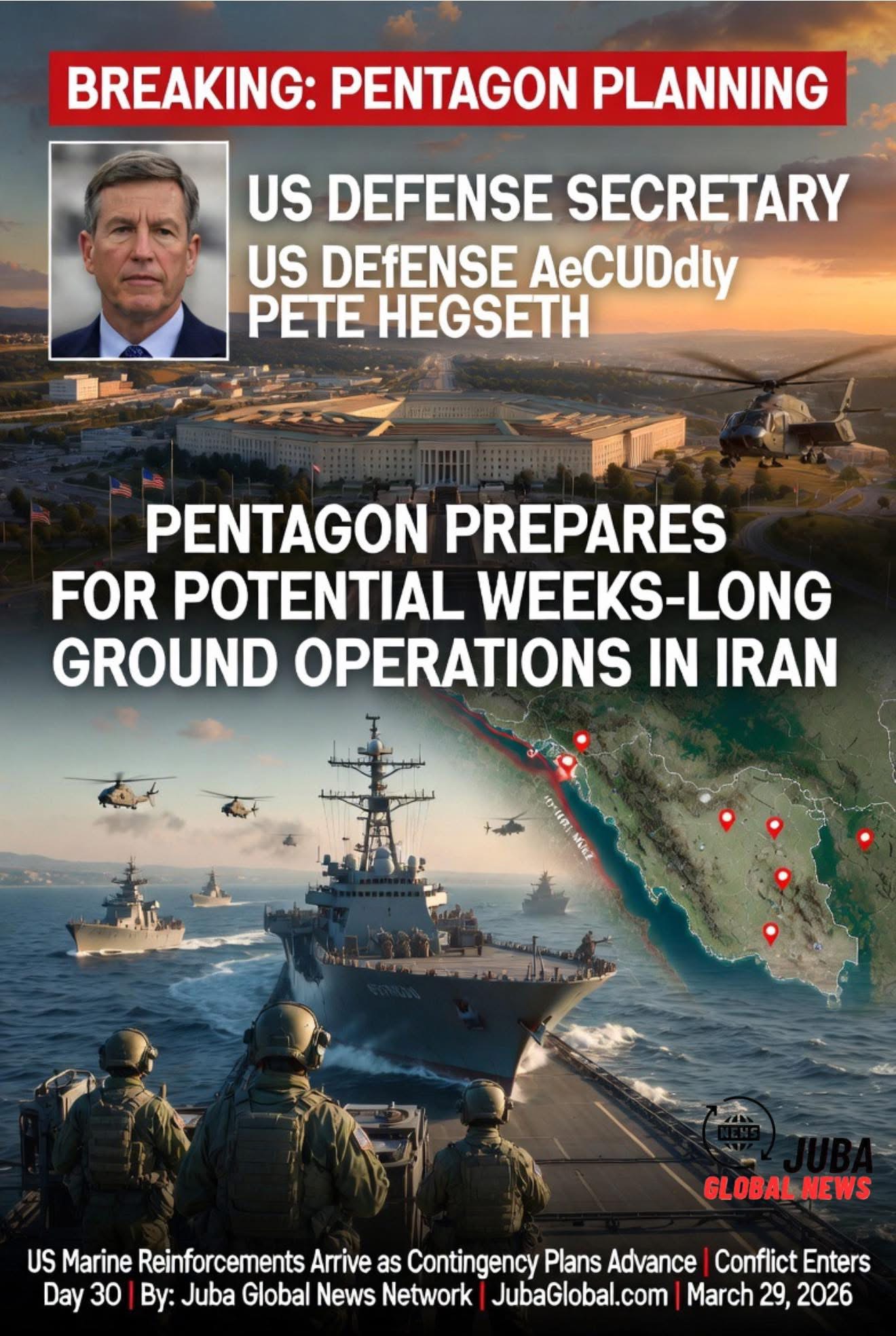
Pentagon Prepares for Potential Weeks-Long Ground Operations in Iran
By: Juba Global News Network | JubaGlobal.com March 29, 2026 WASHINGTON, D.C. — The Pentagon is actively preparing for the possibility of extended ground o
By: Juba Global News Network | JubaGlobal.com
March 29, 2026
WASHINGTON, D.C. — The Pentagon is actively preparing for the possibility of extended ground operations inside Iran that could last several weeks or longer, as the US-Israeli war with Iran enters its 30th day and US Marine reinforcements continue to flow into the Middle East.
Senior US defense officials have signaled that while the primary focus remains on airstrikes and naval operations to degrade Iranian military capabilities, contingency planning now includes scenarios for sustained ground engagements if diplomatic efforts fail or if Iranian forces continue asymmetric attacks that threaten regional stability and global energy security.
The development comes as the amphibious assault ship USS Tripoli, carrying approximately 3,500 Marines and sailors, has arrived in the region, joining other Marine Expeditionary Units already positioned in the Persian Gulf and surrounding waters. Additional forces from the 11th Marine Expeditionary Unit aboard the USS Boxer are expected to bolster capabilities in the coming days.
Details of Pentagon Planning
According to sources familiar with internal discussions, the Pentagon’s planning encompasses several potential ground missions:
• Securing key islands or maritime chokepoints in the Persian Gulf to ensure freedom of navigation through the Strait of Hormuz.
• Protecting critical energy infrastructure from Iranian sabotage or proxy attacks.
• Conducting limited raids against high-value Iranian targets, including remaining missile production sites or command centers that have proven resilient to airstrikes.
• Supporting potential stabilization efforts if the Iranian regime’s control weakens significantly.
Defense Secretary Pete Hegseth and top military commanders have briefed congressional leaders on these contingencies, emphasizing that any ground operations would be “limited in scope and duration” but could extend for “several weeks” depending on battlefield developments and Iranian responses.
A senior Pentagon official, speaking on condition of anonymity, stated: “We are not seeking a full-scale invasion or regime change through boots on the ground. However, we must be prepared for scenarios where air and naval power alone cannot achieve our objectives of protecting shipping lanes and neutralizing persistent threats.”
Context of the Broader Conflict
The war began on February 28 with coordinated US-Israeli strikes targeting Iranian leadership, including the reported assassination of Supreme Leader Ali Khamenei and senior military commanders. Since then, sustained airstrikes have damaged significant portions of Iran’s air defenses, missile stockpiles, and command infrastructure.
Iran has retaliated with ballistic missile barrages against Israel and US bases in the Gulf, while activating proxy forces. Most notably, the Iran-backed Houthis in Yemen officially entered the conflict on Saturday by launching ballistic missiles toward Israel, raising fears of multi-front escalation.
The Strait of Hormuz remains severely restricted, keeping global oil prices above $100 per barrel. Russia has warned of potential “catastrophe” following strikes near the Bushehr nuclear plant, and missile debris has already injured civilians in the UAE, including five Indian workers near Abu Dhabi’s KEZAD industrial zone.
In this environment, US planners view ground forces — particularly highly mobile and versatile Marine units — as a critical insurance policy against scenarios where Iranian forces attempt to close key waterways or launch sustained attacks on Gulf allies.
Role of US Marines
The Marine Corps’ Amphibious Ready Groups (ARGs) and Marine Expeditionary Units (MEUs) are uniquely suited for rapid response in littoral environments. The USS Tripoli and associated ships provide:
• Helicopter and tilt-rotor assault capabilities
• Amphibious landing craft for ship-to-shore operations
• Command and control assets for joint operations with naval and air forces
• Logistics support for sustained missions
Military analysts note that these forces could be used to seize and hold strategic islands, conduct raids on coastal missile sites, or secure oil platforms if Iranian forces threaten them directly.
However, any ground presence on Iranian soil would carry significant risks, including potential urban combat in densely populated areas, asymmetric warfare from Iranian Revolutionary Guard Corps (IRGC) units, and the danger of drawing in additional regional actors.
Mixed Signals from the Trump Administration
President Donald Trump has sent conflicting messages in recent weeks. At times, he has hinted at “winding down” operations and pursuing negotiations; at other moments, he has authorized continued strikes and troop deployments while issuing strong warnings to Iran about the consequences of disrupting global energy flows.
White House spokespeople have emphasized that the goal is not prolonged occupation but rather forcing Iran to cease its destabilizing activities and return to serious diplomatic talks. Critics argue that the deployment of additional Marines signals preparation for a longer conflict than publicly acknowledged.
Congressional and International Reactions
Members of Congress from both parties have expressed concerns about the potential for mission creep. Some hawkish lawmakers support robust action to counter Iran, while others warn against repeating past Middle East ground wars.
Internationally, reactions have been mixed. Israel has welcomed the US buildup as necessary to counter Iranian threats. Gulf allies such as Saudi Arabia and the UAE have quietly supported efforts to secure shipping lanes but remain wary of direct confrontation on their soil.
Russia and China have criticized the US military posture, with Moscow using the deployments to highlight what it calls American aggression while simultaneously warning about risks near its own nuclear cooperation projects in Iran.
Humanitarian and Strategic Considerations
Defense planners are acutely aware of the humanitarian implications of any ground operations. Urban fighting in Iranian cities could lead to significant civilian casualties and further strain already stretched international aid efforts.
Strategically, the Pentagon is weighing the balance between degrading Iran’s conventional military power through air campaigns and the need to address persistent asymmetric threats that require more direct intervention.
Analysts suggest that any ground operations would likely be highly targeted and time-limited, focusing on specific military objectives rather than broad territorial control.
What Lies Ahead?
As the conflict approaches its one-month mark, the question of ground operations remains one of the most critical uncertainties. Diplomatic channels — including meetings among regional foreign ministers in Islamabad and back-channel communications — continue in parallel with military preparations.
For now, the arrival of additional US Marines signals that Washington is preparing for a range of scenarios, including the possibility that weeks of further fighting may be necessary to achieve its stated goals of protecting navigation, deterring Iranian aggression, and creating conditions for de-escalation.
Juba Global News Network will continue monitoring Pentagon planning, Marine deployments, and any developments regarding potential ground operations in the region.

12 thoughts on “Pentagon Prepares for Potential Weeks-Long Ground Operations in Iran”
Comments are closed.