

The Death of ‘El Mencho’: Mexico’s Most Wanted Cartel Leader Killed in Dramatic Military Raid, Sparking Nationwide Chaos
By: Juba Global News Network | JubaGlobal.com February 23, 2026 – Updated as events unfold In a stunning development that has sent shockwaves through Mexic
By: Juba Global News Network | JubaGlobal.com
February 23, 2026 – Updated as events unfold
In a stunning development that has sent shockwaves through Mexico and beyond, Nemesio Rubén Oseguera Cervantes, infamously known as “El Mencho”, the longtime leader of the Jalisco New Generation Cartel (CJNG), was killed on Sunday, February 22, 2026, during a high-intensity Mexican military operation. The raid, conducted in the rural town of Tapalpa in Jalisco state, marked one of the most significant strikes against organized crime in Mexico’s modern history. However, the immediate aftermath has plunged large parts of the country into turmoil, with retaliatory violence, highway blockades, arson attacks, and widespread disruptions affecting residents and tourists alike.
The Raid: Operation Details and Execution
The operation unfolded early Sunday morning in Tapalpa, a quiet municipality about two hours southwest of Guadalajara in the CJNG’s traditional stronghold. According to Mexico’s Secretariat of National Defense (SEDENA), elite units from the Mexican Army Special Forces, supported by air force helicopters and the National Guard’s Immediate Reaction Force, targeted a location where intelligence indicated El Mencho was present.
A fierce shootout ensued as cartel gunmen resisted. Official reports confirm that El Mencho was seriously wounded during the clash. He, along with several injured associates, was airlifted toward Mexico City for urgent medical care but succumbed to his injuries en route. At least four CJNG members were killed at the scene, with additional fatalities (including El Mencho) occurring during transport, bringing the total cartel deaths to around seven. Three Mexican soldiers sustained injuries, though no civilian casualties were reported from the initial raid itself.
The U.S. government played a key supporting role, providing critical intelligence that helped locate the elusive leader. White House statements described the operation as a “great development” in joint efforts to combat drug trafficking, particularly the flow of fentanyl into the United States. This cooperation comes amid heightened bilateral tensions, including recent U.S. tariff pressures and demands for stronger action against Mexican cartels.
The mission was framed as an attempt to capture El Mencho rather than an outright assassination, aligning with Mexico’s official policy under recent administrations to prioritize arrests where possible. However, the lethal outcome has been celebrated by authorities as a decisive blow to one of the world’s most powerful criminal organizations.
Who Was El Mencho? From Humble Roots to Cartel Kingpin
Born on July 17, 1966, in Aguililla, Michoacán, Nemesio Oseguera Cervantes—nicknamed “El Mencho” (a colloquial shortening of Nemesio)—rose from modest origins to become Mexico’s most feared and sought-after drug lord. He briefly worked as a police officer before entering the criminal underworld in the 1990s. After serving time in the United States for drug-related offenses and subsequent deportation, he returned to Mexico and helped splinter off from earlier groups to co-found the CJNG around 2010.
Under his leadership, the CJNG transformed into Mexico’s dominant cartel, outpacing even the fragmented Sinaloa Cartel in violence and territorial control. The group is notorious for its extreme brutality—including public beheadings, massacres, and attacks on military targets—as well as its dominance in fentanyl production and trafficking to the U.S., alongside methamphetamine, cocaine, heroin, and precursor chemicals. The cartel also extorts industries like avocados and fuel theft (“huachicoleo”), while employing advanced tactics such as armed drones and improvised explosives.
El Mencho evaded capture for over a decade despite a $15 million U.S. reward and constant pursuit. His ability to hide in rural strongholds, corrupt officials, and maintain a vast network of safe houses made him a symbol of impunity. His death at approximately age 59 removes a central architect of one of the hemisphere’s most violent criminal enterprises.
Retaliatory Fury: Chaos Spreads Across Mexico
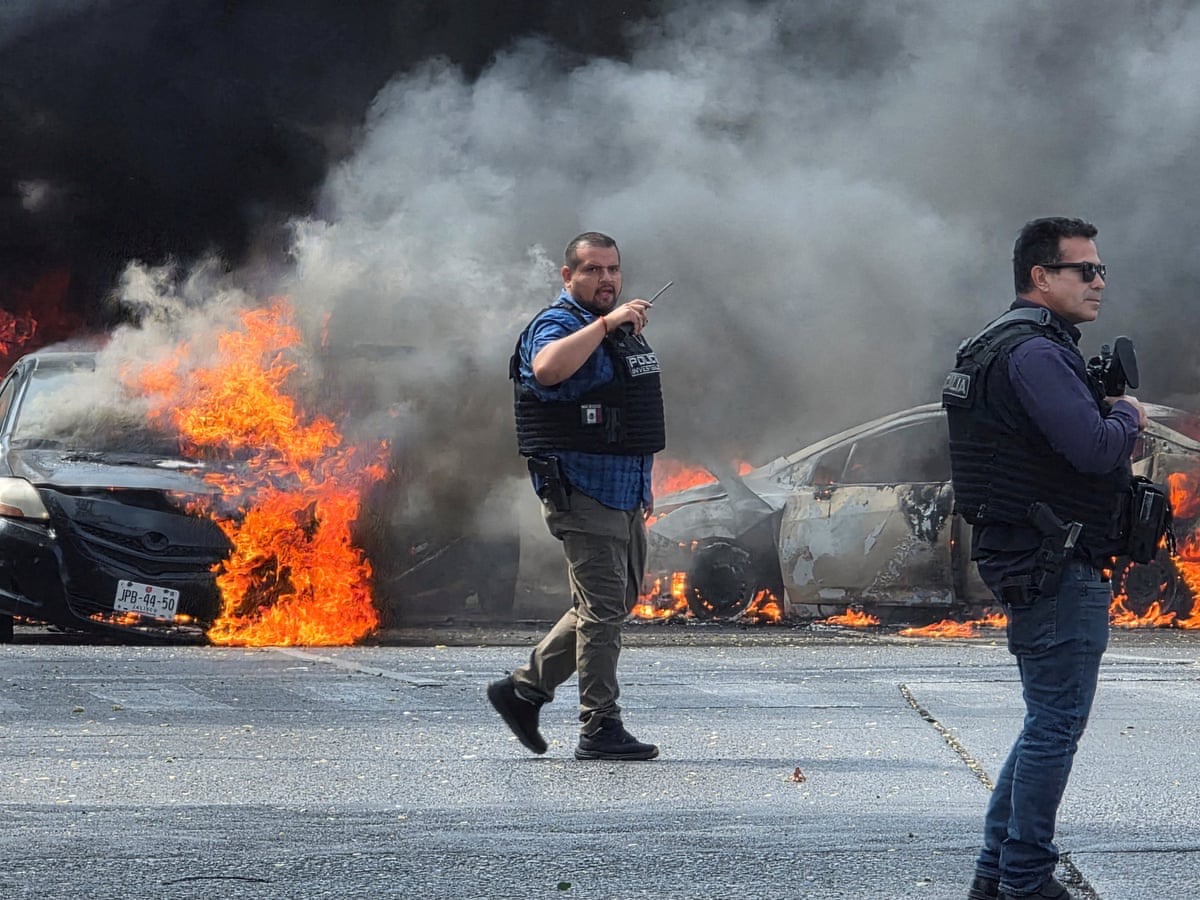
Within hours of the news breaking, CJNG loyalists unleashed coordinated reprisals. Suspected cartel members set vehicles, buses, businesses, banks, and gas stations ablaze, while blocking major highways with burning barricades. Clashes with security forces erupted in multiple locations, and over 250 roadblocks were reported across roughly 20 of Mexico’s 32 states, though many have since been cleared.
The violence hit hardest in CJNG strongholds like Jalisco, Colima, Michoacán, Nayarit, and Guanajuato, but extended to areas including Tamaulipas and even Baja California (with incidents reported in Tijuana). Schools closed en masse, public events—including soccer matches—were canceled, and local governments declared emergency measures.
Tourist areas faced severe disruptions: In coastal hotspots like Puerto Vallarta, U.S. and Canadian visitors were stranded in hotels, unable to travel due to blocked roads, and urged to shelter in place by embassy advisories. Families described armed men forcing drivers from vehicles and igniting cars, while drone footage captured thick smoke rising over cities.
This pattern echoes previous high-profile cartel leader losses (such as Joaquín “El Chapo” Guzmán’s arrests), where power vacuums often trigger internal feuds, splintering, or escalated attacks to demonstrate strength. Analysts warn the CJNG’s deep infrastructure and succession planning could allow it to weather the storm, potentially with increased short-term violence as factions vie for control.
Broader Ramifications: A Win Amid Uncertainty
For Mexico’s government, the operation represents a major achievement in the fight against cartels, demonstrating military capability and international collaboration amid U.S. pressure on fentanyl and border security. It may bolster diplomatic standing in ongoing trade and migration discussions.
Yet experts remain cautious. Cartels rarely collapse with the death of a single leader; the CJNG’s fentanyl labs and global reach mean supply chains could persist or shift to successors—possibly family members or trusted lieutenants. The immediate human cost—disrupted lives, economic losses from closed businesses and tourism, and the fear gripping communities—highlights the persistent challenge of dismantling entrenched criminal networks without massive societal fallout.
As investigations continue and security forces work to restore order, Mexico enters a volatile period. The elimination of El Mencho is a historic milestone, but the fires still smoldering on highways serve as a stark reminder that the war on drugs is far from over.
By: Juba Global News Network | JubaGlobal.com
This report draws from verified statements by Mexico’s Defense Ministry, White House confirmations, and real-time coverage from major outlets including CNN, Reuters, AP, BBC, NPR, The Guardian, and others as of February 23, 2026. The situation remains highly fluid—monitor official channels for the latest developments.
