

Four Years of War: Ukraine Marks Grim Anniversary as Peace Remains Elusive Despite U.S.-Led Diplomatic Push
By: Juba Global News Network | Juba Global News Network | JubaGlobal.com February 22, 2026 – On February 24, 2026, Ukraine will mark the fourth anniversary
By: Juba Global News Network | Juba Global News Network | JubaGlobal.com
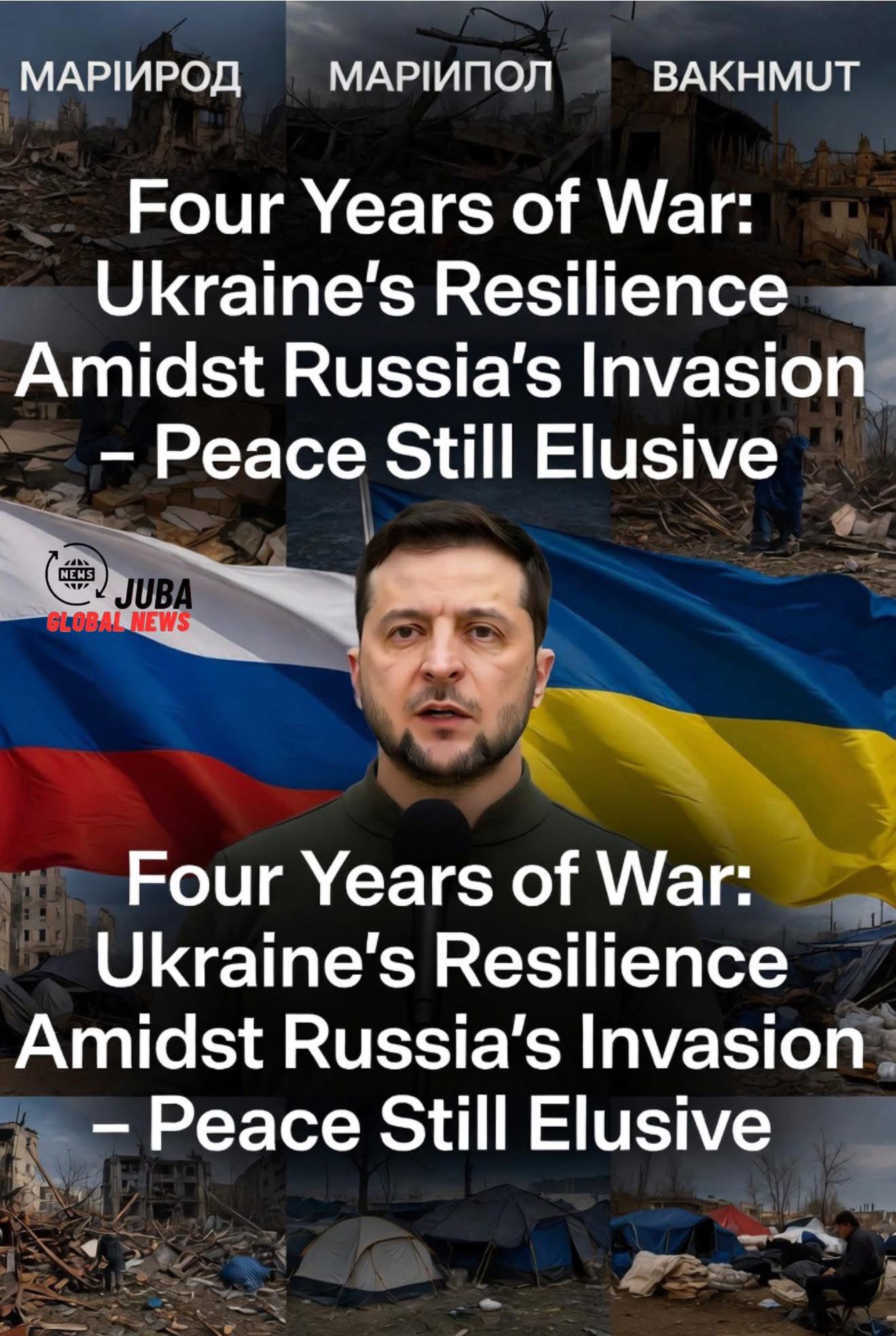
February 22, 2026 – On February 24, 2026, Ukraine will mark the fourth anniversary of Russia’s full-scale invasion—a milestone that has transformed from a shocking geopolitical rupture into a grinding, attritional war with no clear end in sight. Four years on, the conflict has claimed tens of thousands of lives, displaced millions, devastated entire cities, and redrawn the map of Eastern Europe, while diplomatic efforts—led most visibly by the United States—have yet to produce a durable ceasefire or negotiated settlement.
President Volodymyr Zelenskyy addressed the nation and the world in a somber pre-anniversary video statement late Saturday, February 21: “Four years ago, they thought we would fall in days. We did not fall. We are still standing. But every day that passes without peace means more graves, more ruined homes, more children growing up knowing only sirens and shelters.” His words captured the exhaustion and resolve that now define Ukrainian public sentiment after 1,460 days of fighting.
The human and material toll is staggering. According to the latest United Nations estimates, civilian deaths exceed 11,000 (with the true figure believed to be significantly higher), while military casualties on both sides are counted in the hundreds of thousands. Over 8 million Ukrainians remain displaced internally or as refugees abroad. Entire regions—Mariupol, Bakhmut, Avdiivka, parts of Kherson and Zaporizhzhia oblasts—lie in ruins. Russia currently occupies roughly 18–19% of Ukraine’s internationally recognized territory, including Crimea (annexed in 2014) and large swathes of the Donbas.
Russia’s strategy since late 2022 has increasingly emphasized long-range strikes against civilian infrastructure, particularly the energy grid. In the past week alone, Moscow launched over 1,300 drones, more than 1,400 guided aerial bombs, and nearly 100 missiles. The massive barrage overnight into February 22 targeted power facilities in Kyiv, Odesa, Dnipro, and other regions, killing at least one person, injuring dozens, and triggering emergency blackouts across multiple oblasts. President Zelenskyy described the pattern bluntly: “They invest more in destruction than in diplomacy.”
Despite the unrelenting violence, diplomatic channels have remained active—though progress has been glacial. The most prominent effort is the U.S.-mediated track that began gaining traction in late 2025. Senior American officials, including special envoy Keith Kellogg and Secretary of State Marco Rubio, have shuttled between Kyiv, Moscow, European capitals, and neutral venues in an attempt to broker a framework agreement. Key elements reportedly under discussion include:
- A phased ceasefire along current lines of control
- Security guarantees for Ukraine short of full NATO membership
- Territorial questions deferred to future negotiations
- Lifting of some Western sanctions in exchange for Russian troop withdrawals from certain areas
- Prisoner exchanges and humanitarian corridors
Ukrainian officials have repeatedly stressed that any deal must include the return of occupied territories, war-crimes accountability, and credible security assurances. Russia, for its part, insists on recognition of its annexations (Crimea, Donetsk, Luhansk, Kherson, Zaporizhzhia) and formal Ukrainian neutrality—no NATO path.
The gap remains wide. In recent weeks, Russian Foreign Minister Sergei Lavrov dismissed U.S. proposals as “unrealistic,” while Zelenskyy warned that freezing the conflict without firm guarantees would simply give Moscow time to rearm. Public opinion in Ukraine remains overwhelmingly opposed to major territorial concessions, according to multiple independent polls conducted in early 2026.
Western support continues, though fatigue is visible. The United States has provided over $175 billion in aid since 2022 (military, financial, humanitarian), with the latest supplemental package approved in December 2025. European allies have pledged long-term security commitments, including bilateral defense pacts with the UK, France, Germany, and others. Yet debates rage over the sustainability of aid flows, the pace of weapons deliveries (especially long-range systems and air defenses), and the political cost at home.
The February 22 energy strikes and the separate deadly explosion in Lviv—officials called a “terrorist act” after a police officer was killed—underscore that hybrid threats and frontline attrition show no sign of abating. As winter deepens, the risk of further grid collapse looms large if Russian drone and missile barrages persist.
Four years after tanks rolled across the border, Ukraine has proven remarkably resilient—repelling the initial assault on Kyiv, liberating swathes of territory in 2022 counteroffensives, and holding the line through three brutal winters. Yet the war has settled into a punishing stalemate, with incremental Russian gains in the Donbas paid for at enormous cost and Ukrainian forces stretched thin defending a 1,000-kilometer front.
As the anniversary approaches, the overriding question remains unchanged: how does this end? Diplomacy offers hope but no breakthrough. Battlefield realities favor neither side decisively. And civilians—cold, grieving, and weary—continue to bear the heaviest burden.
The path to peace is still distant, but the determination of a nation under siege endures. Four years in, Ukraine fights not just for territory, but for the right to exist as a sovereign, democratic state. The world watches, aids, debates—and waits.
Juba Global News Network – Delivering unbiased global coverage from the heart of emerging stories.
