

South African Farmers Face Devastating Threat from Foot-and-Mouth Disease Outbreak: Government Vaccination Drive Criticized as Too Slow Amid Fears for Agriculture Sector
Pretoria / Cape Town – February 21, 2026: South Africa’s multi-billion-rand red meat and dairy industry is on high alert as a virulent strain of foot-and-m
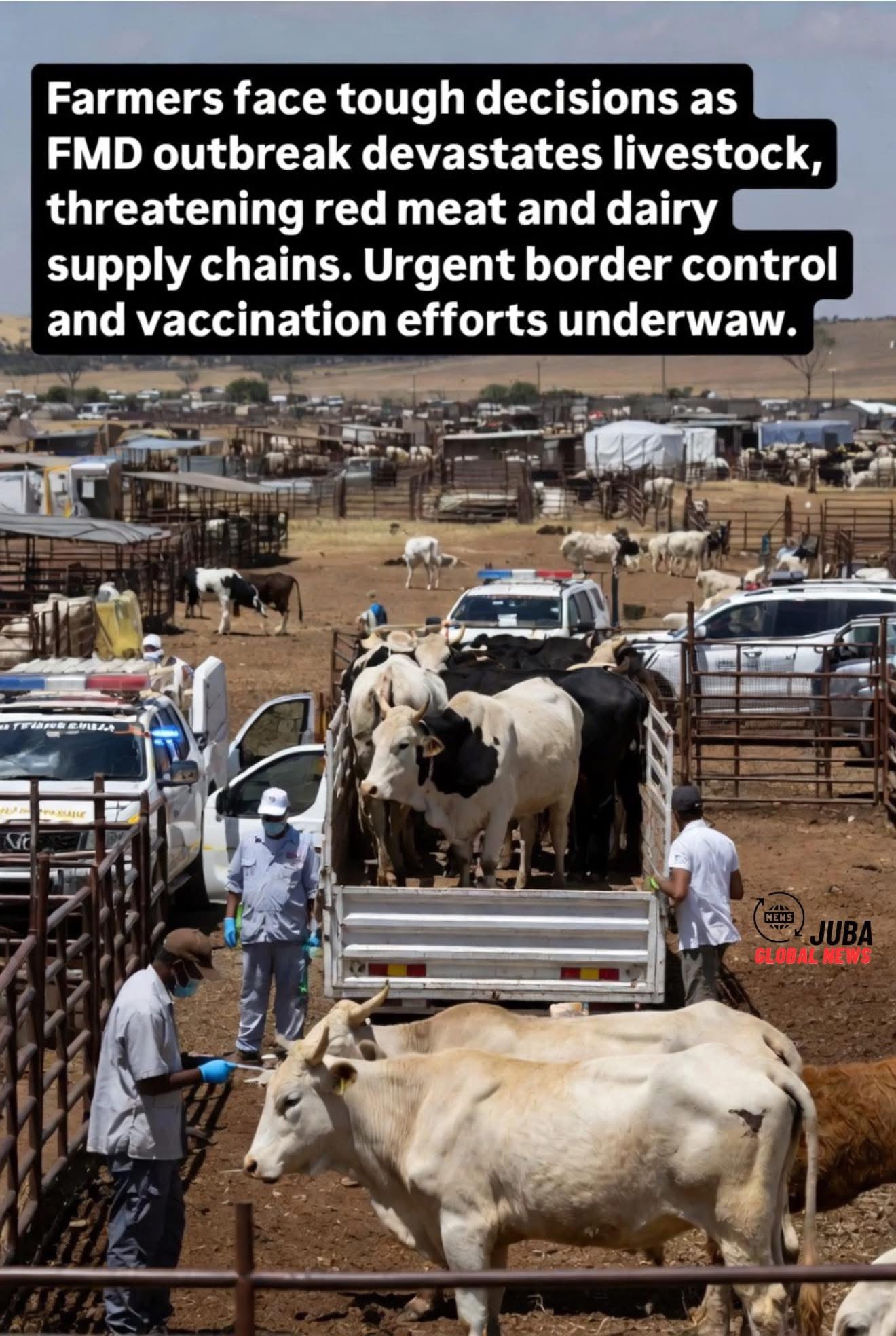
Pretoria / Cape Town – February 21, 2026: South Africa’s multi-billion-rand red meat and dairy industry is on high alert as a virulent strain of foot-and-mouth disease (FMD) continues to spread across several provinces, threatening the livelihoods of thousands of commercial and smallholder farmers. The outbreak, first detected in Limpopo province in late 2024 and now confirmed in parts of Mpumalanga, North West, Free State, and Gauteng, has already led to the culling of tens of thousands of cattle, massive trade restrictions, and growing panic among producers who warn that delays in the national vaccination and containment strategy could cause irreparable economic damage.
The Scale of the Crisis
The Department of Agriculture, Land Reform and Rural Development (DALRRD) reports that, as of mid-February 2026, more than 180,000 cattle have been vaccinated in emergency campaigns, but the disease has now been detected in at least 28 new foci outside the original protection zone. Over 45,000 animals have been culled since the outbreak began, with compensation payments to farmers lagging months behind.
Foot-and-mouth disease — a highly contagious viral illness affecting cloven-hoofed animals (cattle, sheep, goats, pigs) — causes fever, painful blisters on the mouth and feet, lameness, reduced milk production, and weight loss. While rarely fatal in adult animals, the economic impact is catastrophic due to international trade bans: South Africa lost access to major export markets (China, EU, Middle East, Southern African Customs Union partners) almost immediately after the first cases were confirmed outside the historically FMD-controlled zones.
The loss of export markets alone is estimated to cost the red meat value chain between R5 billion and R12 billion annually, depending on how long restrictions remain in place. Domestic prices for beef and dairy have already begun to soften in some regions as panic selling occurs, while input costs (feed, veterinary care, transport) continue to rise.
Why Farmers Are Furious: “Too Little, Too Late”
Agricultural unions — including Agri SA, TLU SA (Transvaal Agricultural Union), and the African Farmers’ Association of South Africa (AFASA) — have issued increasingly sharp criticism of the government’s response. Key grievances include:
- Delayed rollout of vaccination: Emergency vaccination only began in earnest in mid-2025, months after initial detections outside the controlled zone. Farmers argue that earlier, wider-scale vaccination could have contained the spread.
- Insufficient vaccine supply: South Africa relies on a single local producer (MSD Animal Health / Onderstepoort Biological Products) and imported doses. Stock shortages have forced prioritization of commercial feedlots and dairy herds, leaving many smallholder and emerging farmers unprotected.
- Slow compensation: Farmers whose animals are culled under state order are entitled to compensation, but payments are reportedly taking 6–12 months, leaving many in financial distress.
- Porous borders and biosecurity failures: Repeated breaches of the FMD protection zone — often linked to informal livestock movement across the Zimbabwe, Mozambique, and Botswana borders — have undermined containment efforts.
Agri SA president Dr. Theo de Jager stated in a recent interview: “We are staring at the potential collapse of large parts of our red meat sector if decisive action is not taken now. Vaccination is our only realistic tool to regain disease-free status and reopen export markets. Every week of delay costs jobs, food security, and billions in revenue.”
Government Response: “We Are Scaling Up”
The DALRRD and Minister of Agriculture John Steenhuisen have defended the response, pointing to:
- A national emergency vaccination campaign now targeting over 500,000 animals in high-risk zones
- Deployment of additional veterinary teams and mobile vaccination units
- Negotiations with the World Organisation for Animal Health (WOAH) to compartmentalize unaffected areas and potentially regain export status for specific zones
- Increased border patrols and stricter movement controls
Officials insist that South Africa remains “FMD-free with vaccination” in large parts of the country and that the current outbreak is confined to the historically vaccinated zones near international borders. They warn farmers against moving animals illegally, which they say is the primary driver of spread.
The Bigger Picture: A Sector Already Under Pressure
South African agriculture has faced multiple shocks in recent years: load-shedding, rising input costs, land reform uncertainty, climate extremes (droughts and floods), and now FMD. The red meat industry employs over 450,000 people directly and indirectly and contributes roughly R80–90 billion annually to GDP. Losing export markets — especially premium cuts to the Middle East and Asia — could trigger widespread farm closures, job losses, and reduced food availability.
Smallholder and emerging farmers — many already operating on thin margins — are particularly vulnerable. Without swift containment and vaccination coverage, the disease could become endemic in new areas, permanently altering South Africa’s FMD status and locking the country out of high-value export markets for years.
Looking Ahead: A Race Against the Virus
The coming months will be decisive. If vaccination coverage expands rapidly and illegal movement is curtailed, South Africa may regain control and begin negotiating phased reopening of export markets by late 2026 or early 2027. Failure to do so risks turning a manageable outbreak into a long-term national crisis.
For now, thousands of farmers across Limpopo, Mpumalanga, and beyond wake each morning checking their herds for telltale signs of blisters and lameness — praying their animals remain healthy, their markets reopen, and that help from Pretoria arrives before it is too late.
The clock is ticking. South Africa’s beef and dairy farmers are watching — and waiting — for action that matches the scale of the threat.
