

Oil Markets Volatile as Trump Touts ‘Big Present’ from Iran on Oil and Gas
By Juba Global News Network | JubaGlobal.comMarch 25, 2026 Global oil markets swung sharply on March 25 as President Donald Trump revealed that Iran had de
By Juba Global News Network | JubaGlobal.comMarch 25, 2026
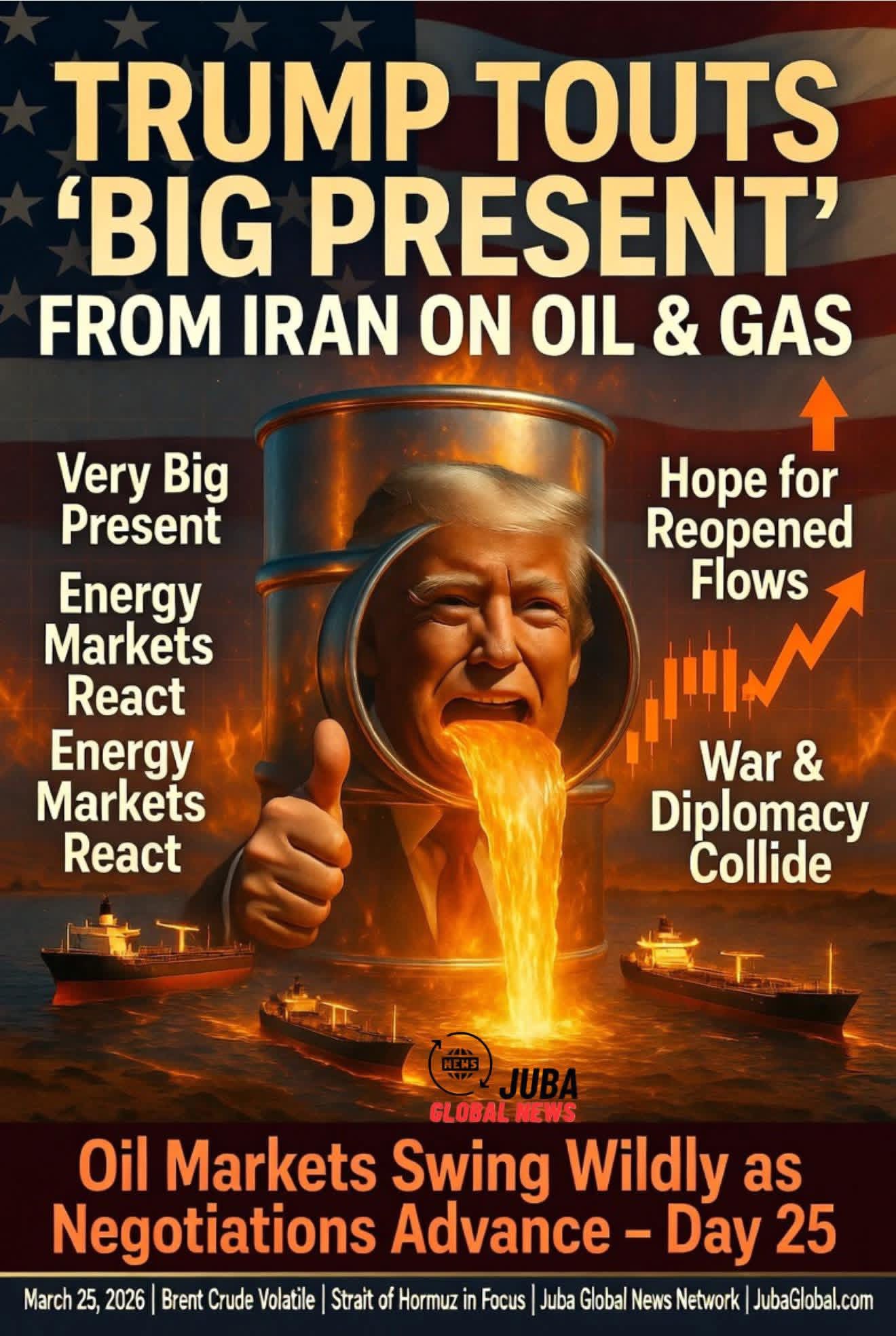
Global oil markets swung sharply on March 25 as President Donald Trump revealed that Iran had delivered what he described as a “very big present” related to oil and gas cooperation — a development he linked to advancing negotiations aimed at ending the 25-day-old US-Israel-Iran conflict.
Speaking to reporters in the Oval Office on March 24, Trump stated: “They gave us a present and the present arrived today. It was a very big present worth a tremendous amount of money. It wasn’t nuclear-related, it was oil-and gas-related, and it was a very nice thing they did.”
When pressed, the president confirmed the gift was connected to the Strait of Hormuz, the narrow waterway through which roughly one-fifth of the world’s oil supply normally passes. He described it as a “very significant prize” that signals the U.S. is “dealing with the right people” in Iran and that Tehran “wants to make a deal” badly.
Details of the Mysterious “Present”
Trump declined to disclose specifics, but sources close to the negotiations suggest the concession may involve commitments to ease disruptions in the Strait, guarantees for resumed tanker traffic, or indirect assurances on future Iranian oil and gas exports once a ceasefire is reached. The timing — arriving on the same day Trump claimed the war had effectively been “won” — appears designed to inject optimism into volatile energy markets.
This announcement came despite fresh Iranian missile barrages targeting Israel and Gulf sites, and Tehran’s continued public rejection of direct talks. Analysts interpret the move as classic Trump-style deal-making: maximum public pressure paired with private incentives.
Market Reaction: Sharp Swings and Lingering Uncertainty
Oil prices reacted immediately but remained highly volatile:
- Brent crude, the global benchmark, fluctuated between gains and losses, hovering near $110–$114 per barrel after earlier spikes above $100 triggered by the conflict.
- West Texas Intermediate (WTI) showed similar turbulence, reflecting trader uncertainty about whether the “present” would translate into actual resumed flows through the Strait of Hormuz.
Since the conflict began on February 28, 2026, the effective partial closure of the Strait — combined with attacks on shipping and Gulf infrastructure — has driven prices up dramatically. At one point, Brent surged more than 40% from pre-war levels, with analysts warning of potential sustained highs into 2027 if disruptions persist.
Energy traders are now pricing in two scenarios: a rapid diplomatic breakthrough that restores roughly 15–20 million barrels per day of transit capacity, or prolonged fighting that keeps supplies tight and premiums elevated.
Broader Economic Ripple Effects
The Iran war’s impact on energy markets has already triggered global consequences:
- Asia, heavily dependent on Gulf oil, has imposed austerity measures and declared fuel emergencies (notably in the Philippines).
- Europe postponed its planned permanent ban on Russian oil imports to avoid compounding shortages.
- Gulf states face direct threats to their export infrastructure, prompting urgent diplomatic calls for a ceasefire.
- Airlines, shipping firms, and consumers worldwide are feeling the pain through higher fuel costs and inflation risks.
Goldman Sachs and other major banks have revised upward their 2026–2027 oil price forecasts, citing a lasting geopolitical risk premium even if the Strait reopens soon.
Context Within the 15-Point Peace Plan
The “big present” fits into the broader 15-point proposal reportedly delivered by the U.S. to Iranian intermediaries. Key energy-related demands include:
- Full reopening of the Strait of Hormuz to unrestricted international shipping.
- Verifiable reductions in threats to Gulf energy facilities.
- Potential sanctions relief tied to compliance on oil and gas flows.
- Long-term regional security arrangements to prevent future disruptions.
Trump has repeatedly emphasized that ending the energy crunch is a top priority, alongside dismantling Iran’s nuclear program and curbing support for proxy groups.
Contrasting Signals on the Ground
While Trump touts progress, the battlefield tells a different story. Iranian forces launched new missile and drone attacks on March 25, striking Israeli cities and Gulf targets. Israel continues airstrikes, and the U.S. is deploying additional paratroopers from the 82nd Airborne Division to reinforce regional positions.
Iranian officials have dismissed negotiation claims as “psychological warfare,” creating a fog of conflicting narratives that keeps markets on edge.
Outlook: Hope vs. Reality
If the undisclosed oil-and-gas concession leads to tangible improvements in Hormuz transit within days or weeks, analysts predict a swift pullback in crude prices. However, persistent attacks or failure to implement any agreement could push Brent toward or beyond $120 per barrel, with severe consequences for the global economy.
President Trump has indicated flexibility on timelines but warned that without progress, the U.S. and Israel will continue operations “with great force.”
As Day 25 draws to a close, the world’s energy markets hang on whether Trump’s “very big present” marks the beginning of de-escalation — or merely another twist in one of the most consequential conflicts of the decade.
Juba Global News Network will continue monitoring oil markets, diplomatic channels, and battlefield developments. For live updates and in-depth analysis, visit JubaGlobal.com.
This comprehensive report provides balanced context and the latest market insights on a fast-moving story. Stay informed with Juba Global News Network.
