

US Deploys 1,000+ Paratroopers to Middle East as Negotiations with Iran Advance
By Juba Global News Network | JubaGlobal.comMarch 25, 2026 Amid mixed signals of diplomatic progress and continued military escalation, the Pentagon has or
By Juba Global News Network | JubaGlobal.comMarch 25, 2026
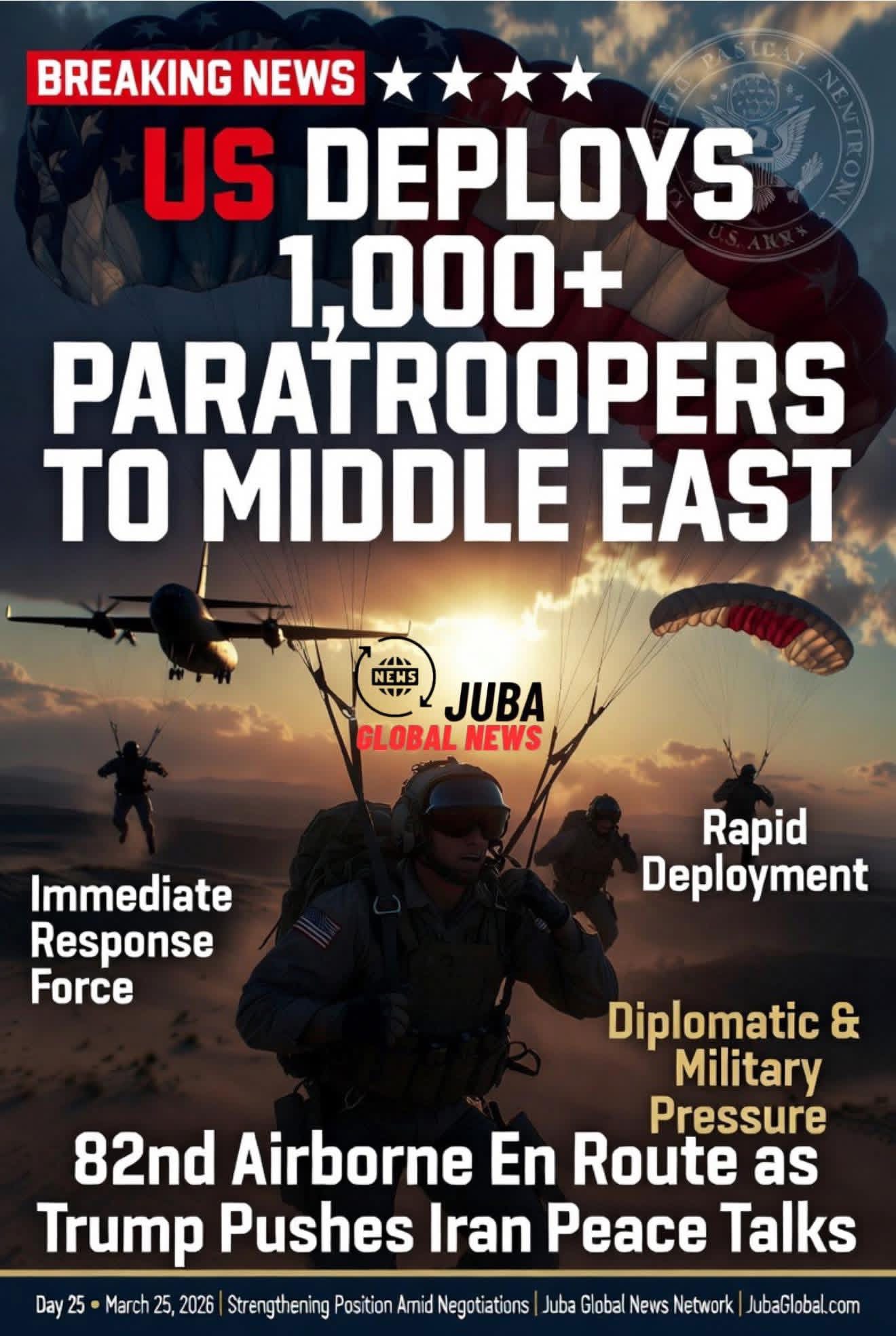
Amid mixed signals of diplomatic progress and continued military escalation, the Pentagon has ordered the deployment of approximately 1,000 to 3,000 elite paratroopers from the U.S. Army’s renowned 82nd Airborne Division to the Middle East. The move comes on Day 25 of the US-Israel military campaign against Iran, even as President Donald Trump expresses optimism about advancing negotiations and a potential 15-point peace plan.
According to multiple U.S. officials and defense sources, the deployment includes elements of the division’s Immediate Response Force (IRF), a battalion from the 1st Brigade Combat Team, and command staff led by Maj. Gen. Brandon Tegtmeier. These highly trained airborne soldiers specialize in rapid deployment, seizing airfields, securing key terrain, and conducting operations in hostile environments — capabilities that could prove critical if the conflict shifts toward ground operations or enforcement of any future ceasefire.
Strategic Timing: Diplomacy and Deterrence
The troop movement occurs as the Trump administration claims indirect talks with Tehran are progressing. President Trump has repeatedly stated that the U.S. is communicating with “the right people” in Iran through intermediaries, including a comprehensive 15-point peace proposal that demands the dismantlement of Iran’s nuclear program, cessation of support for proxy militias, and reopening of the Strait of Hormuz.
Defense officials emphasize that the deployment is not necessarily a prelude to large-scale ground invasion but rather a prudent measure to strengthen U.S. posture in the region. With roughly 50,000 American troops already stationed across the Middle East, the additional paratroopers provide Trump with greater flexibility — whether to support ongoing airstrikes, protect vital shipping lanes, deter Iranian retaliation, or enforce terms of a potential agreement.
Pentagon spokespeople described the orders as part of routine contingency planning, yet the timing underscores the administration’s dual-track approach: pursuing diplomatic breakthroughs while maintaining overwhelming military pressure.
The 82nd Airborne: America’s Rapid-Response Force
The 82nd Airborne Division, based at Fort Liberty, North Carolina, is one of the U.S. military’s most combat-ready units. Nicknamed “All American,” its paratroopers are trained to deploy anywhere in the world within 18 hours via parachute assault. Their inclusion signals seriousness about potential high-risk missions, such as securing strategic locations near the Strait of Hormuz or responding to threats against U.S. allies.
This deployment builds on earlier reinforcements, including additional Marine Expeditionary Units and naval assets already en route or positioned in the Gulf.
Iranian Reaction and Battlefield Realities
Iranian officials have dismissed U.S. claims of productive talks as “psychological warfare,” vowing continued resistance. Fresh Iranian missile and drone barrages struck Israeli cities including Tel Aviv and targeted sites in Saudi Arabia, Bahrain, Kuwait, and the UAE on March 25, highlighting the fragile nature of any diplomatic opening.
Tehran has accused Washington of using negotiation rhetoric to buy time while bolstering forces for potential escalation. Despite the U.S. pausing strikes on certain Iranian energy infrastructure for five days, Israeli airstrikes continue, and exchanges with Hezbollah along the Lebanon border persist.
Broader Context: A Conflict Entering Its Fourth Week
The 2026 Iran war erupted on February 28 with massive coordinated U.S.-Israeli strikes aimed at neutralizing Iran’s nuclear facilities, ballistic missile capabilities, and senior leadership. The campaign has caused significant disruptions to global energy markets due to threats against shipping in the Strait of Hormuz and attacks on Gulf infrastructure.
Global reactions remain divided:
- Israel continues high-intensity operations, showing little inclination to ease pressure until core threats are eliminated.
- Gulf states express growing concern over spillover effects on oil production and regional stability.
- China and other international actors have urged an immediate ceasefire to avert broader economic damage.
- Markets continue to fluctuate wildly on every hint of progress or setback.
Critics of the deployment worry it risks escalating the conflict into a prolonged ground war, while supporters argue it strengthens America’s negotiating position and protects vital U.S. interests and allies.
What Happens Next?
The coming days will test whether diplomacy can outpace military momentum. Trump has indicated that failure to reach an agreement could lead to intensified operations, while the arrival of additional U.S. paratroopers could either deter further Iranian attacks or prepare the ground for enforcement actions.
As the 82nd Airborne prepares for rapid deployment, the world watches closely to see if this show of force will tip the balance toward de-escalation — or push the conflict into a more dangerous phase.
Juba Global News Network will continue providing real-time coverage and analysis. For live updates and the full series on the 2026 Iran conflict, visit JubaGlobal.com.
This in-depth report offers comprehensive context on a pivotal development in the ongoing Middle East crisis. Stay informed with Juba Global News Network.
