

Russia Launches Nearly 1,000 Drones at Ukraine in Massive Overnight Barrage
By Juba Global News Network | JubaGlobal.comMarch 25, 2026 In one of the largest aerial assaults of the entire Ukraine war, Russian forces unleashed nearly
By Juba Global News Network | JubaGlobal.comMarch 25, 2026
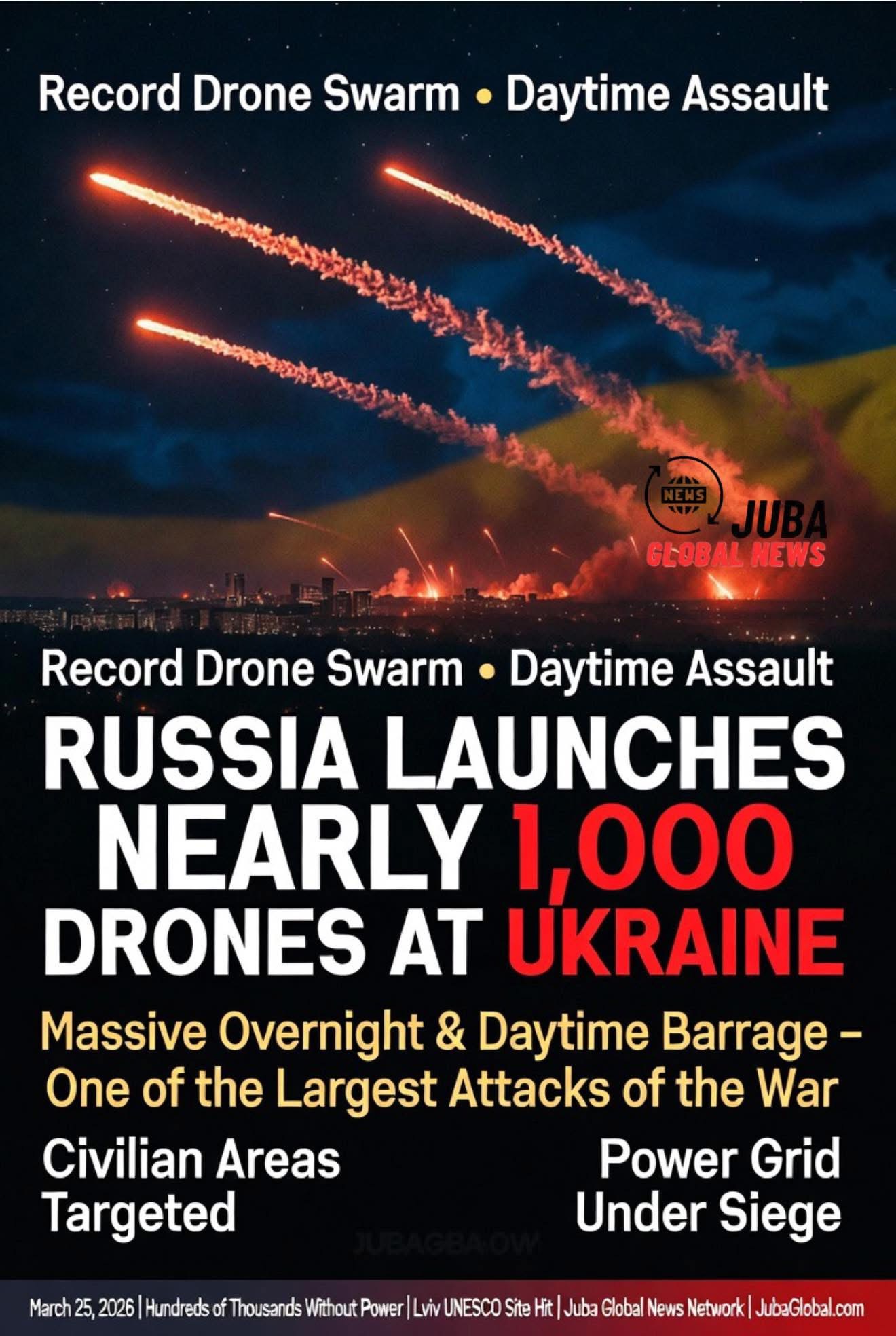
In one of the largest aerial assaults of the entire Ukraine war, Russian forces unleashed nearly 1,000 drones and missiles against Ukrainian targets over a roughly 24-hour period spanning March 23–24, 2026. The barrage — described by Ukrainian officials as the biggest strike series to date — combined overnight missile and drone attacks with a rare large-scale daytime drone assault, hitting cities and infrastructure across multiple oblasts, including western Ukraine far from the front lines.
According to the Ukrainian Air Force, Russia launched approximately 392 drones and 34 missiles overnight (from the evening of March 23 into the morning of March 24), followed by another 556 drones during the daytime on March 24. This brought the total close to 1,000 aerial threats in a single day. Ukrainian defenses intercepted a significant portion — around 256 drones and 25 missiles overnight, plus 541 of the daytime drones — but many strikes still got through, causing widespread damage and civilian casualties.
Scale and Tactics: A Record-Breaking Assault
The attack featured a mix of weapons:
- Shahed-type (Iranian-designed kamikaze drones), Gerbera, Italmas, and other strike drones.
- Cruise missiles including Kh-101, Kh-59/69/31, and Iskander-K variants.
- Ballistic missiles such as Iskander-M and S-300 surface-to-air missiles repurposed for ground attacks.
Notably, Russian forces conducted an unusual daytime drone swarm, targeting broader areas than in the overnight phase and launching many from northern directions. Ukrainian Air Force spokesperson Colonel Yuriy Ihnat highlighted that seven ballistic missiles were fired at frontline-adjacent regions in Zaporizhia and Poltava oblasts, where intercepts proved more difficult.
The strikes affected at least 11 oblasts, including Chernihiv, Dnipropetrovsk, Ivano-Frankivsk, Kharkiv, Kyiv, Lviv, Mykolaiv, Odesa, Sumy, Vinnytsia, and Zaporizhia. Targets included civilian areas, energy infrastructure, transport hubs, and even a UNESCO World Heritage site in Lviv.
Devastation on the Ground
- Lviv: Russian drones struck the historic Ensemble of the Bernardine Monastery (a 17th-century UNESCO-listed site) in central Lviv during the afternoon, sparking a major fire. Damage assessments were ongoing, with Ukrainian officials condemning the attack on cultural heritage.
- Power outages: Widespread damage to energy facilities left hundreds of thousands without electricity, exacerbating an already strained grid after months of previous Russian strikes on power plants.
- Casualties: At least four to seven civilians were reported killed, with dozens more injured. President Volodymyr Zelensky confirmed overnight strikes alone killed at least four people.
- Other impacts: Fires, structural damage to residential buildings, and disruptions to transport networks were reported in multiple regions.
Ukrainian emergency services worked through the night and day to extinguish fires and rescue victims, while air raid sirens blared for extended periods across the country.
Strategic Context: Spring Offensive Signals?
Analysts view the massive barrage as part of Russia’s intensified efforts ahead of or during an anticipated spring ground offensive. By combining overwhelming drone numbers with missiles and rare daytime operations, Moscow aims to overwhelm Ukrainian air defenses, exhaust interceptor stocks, and degrade critical infrastructure — particularly energy systems — to weaken Ukrainian morale and military logistics.
This attack comes as global attention remains heavily focused on the ongoing US-Israel-Iran conflict in the Middle East. Ukrainian officials have expressed concern that the international spotlight on the Middle East could reduce support and attention for Ukraine’s defense needs at a critical time.
Ukrainian Response and Air Defense Challenges
Ukraine’s air defenses performed impressively given the scale, downing hundreds of threats. However, the sheer volume — especially the daytime swarm — stretched resources thin. Officials noted that ballistic missiles aimed at frontline areas were harder to intercept, and some drone strikes succeeded in causing damage.
Ukraine has increasingly relied on its own long-range drone capabilities for retaliatory strikes deep inside Russia, targeting oil refineries, fuel depots, and military infrastructure. Yet the asymmetry in production and launch capacity remains a major challenge.
International Reactions
- Western allies expressed solidarity and condemned the attacks on civilian and cultural targets.
- Calls grew for increased air defense supplies to Ukraine, including more interceptors and systems capable of handling mass drone swarms.
- The strike on Lviv’s UNESCO site drew particular outrage, with Ukrainian Foreign Minister urging international cultural organizations to respond.
As the war enters its fifth year, this record barrage underscores Russia’s determination to press its advantage through attrition and aerial superiority, while Ukraine continues to appeal for sustained international backing.
Outlook
The coming days will reveal whether this massive strike marks the beginning of a sustained Russian aerial campaign or a one-off escalation. Ukrainian forces are already preparing for potential follow-on attacks, while repair crews race to restore power and essential services.
With the Middle East conflict dominating headlines, the people of Ukraine face yet another night of uncertainty under the shadow of Russian drones.
Juba Global News Network will continue to monitor developments in both the Ukraine and Iran conflicts. For live updates and in-depth coverage, visit JubaGlobal.com.
This comprehensive report captures the scale and impact of Russia’s latest escalation. Stay informed with Juba Global News Network.
