

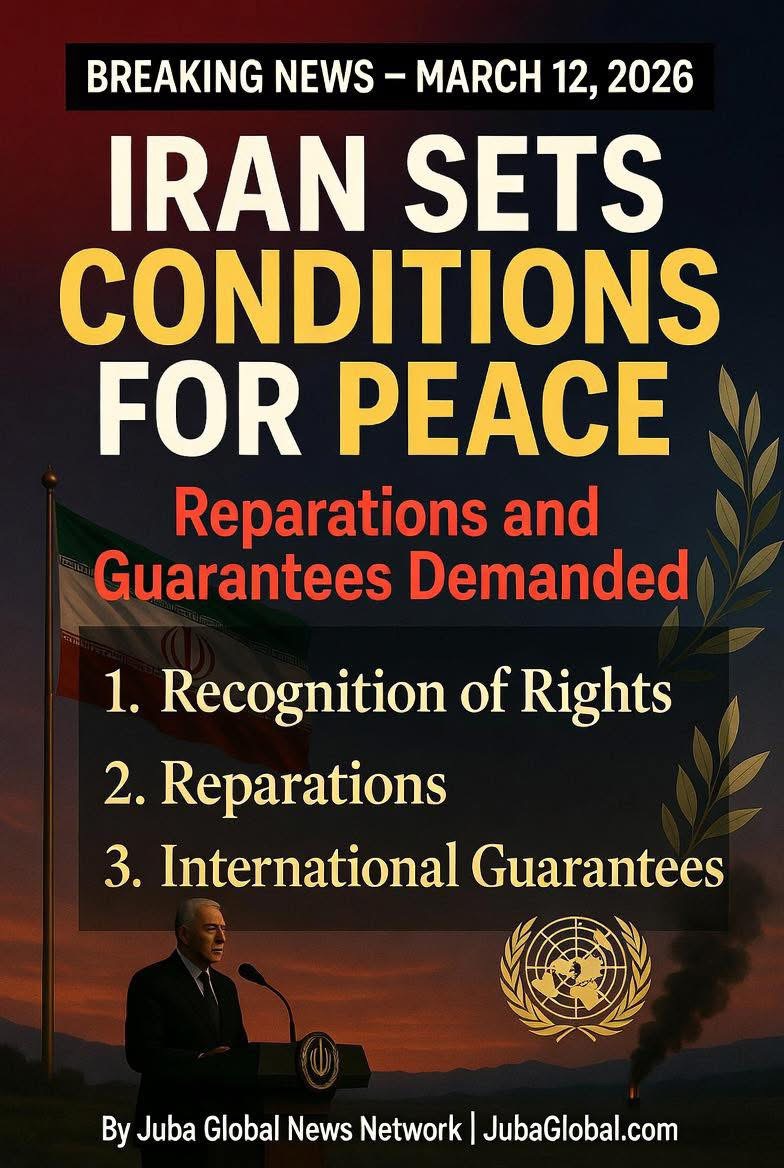
Iran Sets Conditions for Peace: Reparations and Guarantees Demanded
By Juba Global News Network | JubaGlobal.com March 12, 2026 TEHRAN / WASHINGTON — In a dramatic televised address from Tehran late Wednesday, Iranian Presi
By Juba Global News Network | JubaGlobal.com
March 12, 2026
TEHRAN / WASHINGTON — In a dramatic televised address from Tehran late Wednesday, Iranian President Masoud Pezeshkian laid out three explicit conditions for ending the devastating war with the United States and Israel, signaling Tehran’s first public willingness to negotiate while the conflict rages on and global oil prices surge past $100 per barrel.
Speaking in measured but firm Persian before a room of senior Revolutionary Guard commanders, diplomats, and state media cameras, Pezeshkian declared: “We are ready for peace, but it must be a just and honourable peace — not surrender.”
The three non-negotiable demands, according to the president and confirmed by Iran’s Foreign Ministry, are:
- Full international recognition and acceptance of Iran’s legitimate rights, including its nuclear programme for peaceful purposes and its regional security interests.
- Payment of reparations for the destruction of Iranian infrastructure, civilian deaths, and economic losses caused by U.S. and Israeli strikes.
- Binding international guarantees — preferably through the United Nations Security Council — that neither the United States nor Israel will launch future military aggression against Iran.
Pezeshkian described the ongoing campaign as “illegal and criminal” and accused Washington of “economic terrorism” by weaponising sanctions and military force. He placed the human cost at the centre of his message, citing the latest figures from Iran’s Health Ministry: more than 1,348 civilians killed and over 17,000 injured since the conflict intensified at the end of February.
A Calculated Olive Branch Amid Escalation
The timing of the speech is significant. It comes just hours after Iranian forces launched fresh attacks on shipping in the Strait of Hormuz, pushing oil prices to their highest level in years and triggering emergency reserve releases by more than 30 countries. Analysts say Tehran is using its asymmetric military leverage — drones, missiles, and naval disruption — to strengthen its negotiating position at the very moment the world is feeling the economic pain.
“This is classic Iranian diplomacy: fight hard on the battlefield while keeping the door to talks slightly open,” said Dr. Sanam Vakil, deputy director of the Middle East and North Africa programme at Chatham House in London. “Pezeshkian is showing domestic hardliners that he is not weak, while sending a message to the Trump administration that a face-saving exit is still possible.”
Iranian state television repeatedly aired footage of damaged oil tankers and burning Gulf infrastructure alongside clips of the president’s address, framing the demands as the only path to “dignity and stability.”
Washington’s Initial Reaction: Dismissive but Watching Closely
The White House response was swift and sceptical. Press Secretary Karoline Leavitt told reporters: “President Trump will not negotiate under duress or while American interests are under attack. Iran must first cease its aggression in the Strait of Hormuz and return to the table without preconditions.”
However, behind closed doors, senior U.S. officials are quietly assessing the offer. A source familiar with National Security Council discussions told Reuters that “the reparations demand is a non-starter, but the idea of international guarantees is something that could be explored if Iran stops targeting shipping.”
Israeli Prime Minister Benjamin Netanyahu, speaking from Jerusalem, rejected the proposal outright. “Iran has no right to demand anything after years of sponsoring terrorism across the region,” he said. “The only guarantee Israel needs is the complete dismantling of Iran’s nuclear and missile programmes.”
International Players Weigh In
The international community is divided. China’s Foreign Ministry welcomed the “constructive tone” from Tehran and urged all sides to “return to dialogue and de-escalation.” Russian President Vladimir Putin, who earlier offered to mediate, repeated his readiness to host talks in Moscow.
European leaders expressed cautious optimism but stressed that any ceasefire must include verifiable limits on Iran’s nuclear activities. French President Emmanuel Macron called for an emergency G7 virtual summit, while the United Nations Secretary-General António Guterres appealed for an immediate humanitarian pause to allow aid into affected Iranian cities.
At the United Nations in New York, Iran’s ambassador is preparing to present detailed evidence of civilian casualties and infrastructure damage, hoping to build global pressure on Washington and Jerusalem.
The Human and Economic Stakes
The war has already exacted a heavy toll. Power outages plague Tehran and other major cities after Israeli strikes on energy facilities. Food prices inside Iran have risen sharply, and millions of civilians have been displaced. On the economic front, the global ripple effects are impossible to ignore: stock markets tumbled, airlines added fuel surcharges, and families in Europe and Asia are bracing for higher heating and transport costs.
Pezeshkian used part of his speech to address ordinary Iranians directly: “We have paid a high price in blood and treasure. Now the world must decide — justice or continued chaos.”
What Happens Next?
Diplomatic sources in Geneva and Vienna say back-channel contacts between Iranian and American intermediaries have already begun through third parties. The next 72 hours will be critical. If Iran continues its attacks on shipping, any chance of talks could collapse. Conversely, a temporary halt in Gulf operations could open the door for shuttle diplomacy.
President Trump has scheduled a major national address for Thursday evening, where insiders expect him to outline America’s red lines. Pentagon officials confirm that U.S. carrier strike groups remain on high alert in the region.
For millions watching around the world, the question is no longer whether the war will end — but whether the conditions set by Tehran can ever be reconciled with those demanded by Washington and Jerusalem.
Juba Global News Network will continue tracking every development. As one senior European diplomat put it: “This is the first crack in the wall. Whether it becomes a door to peace or simply another broken promise depends on what both sides do in the next few days.”
This is a rapidly evolving story. Follow live updates, expert analysis, and full video of President Pezeshkian’s speech at JubaGlobal.com.
