

Global Markets Reel: Airfares, Economy Hit Hard by Two-Week Iran Conflict
By Juba Global News Network Staff JubaGlobal.com March 13, 2026 Two weeks into the US-Israeli war against Iran, the economic shockwaves have moved far beyo
By Juba Global News Network Staff
JubaGlobal.com
March 13, 2026
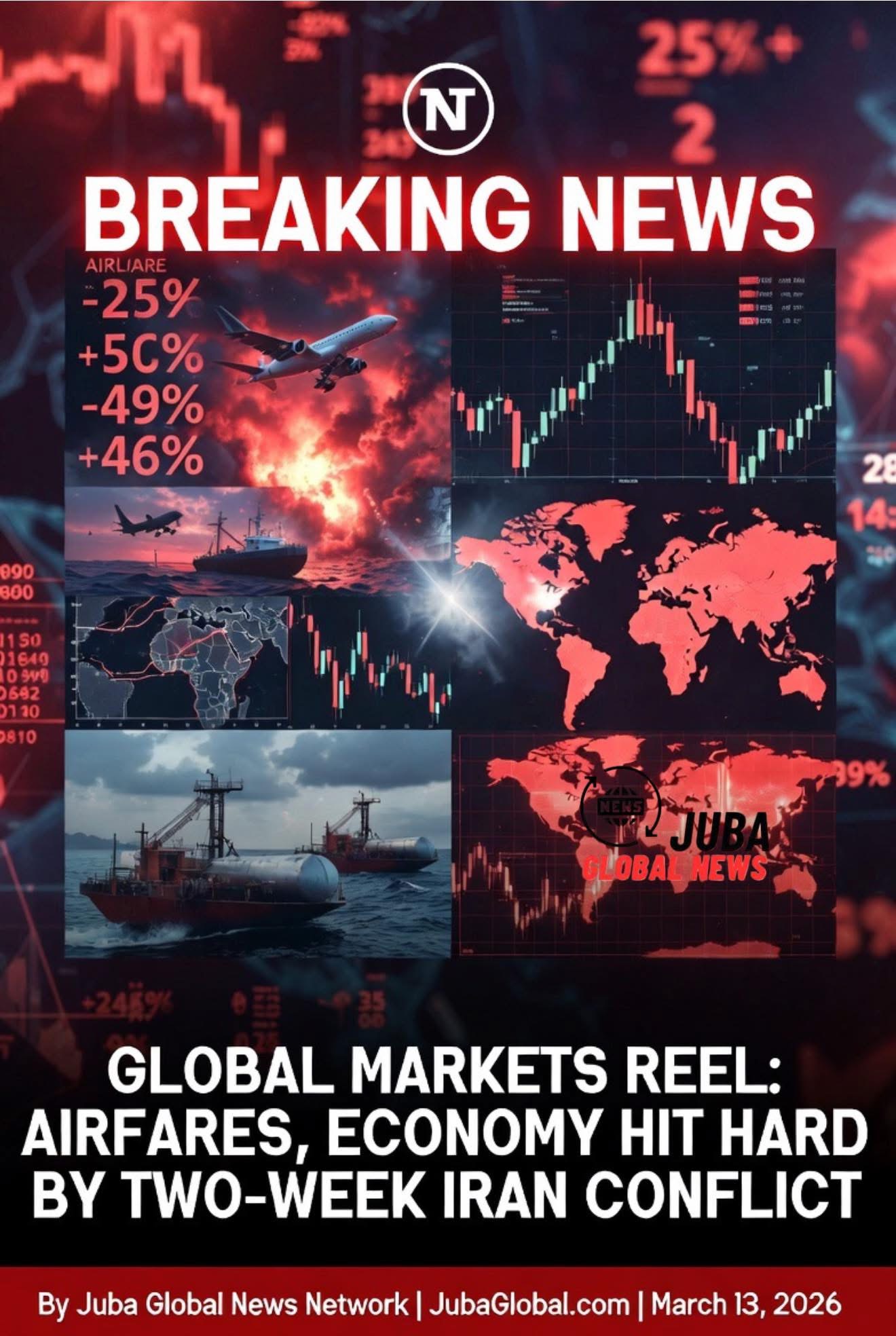
Two weeks into the US-Israeli war against Iran, the economic shockwaves have moved far beyond oil terminals and missile silos. Global financial markets, supply chains, consumer prices, corporate earnings forecasts, central-bank policy paths, and household budgets are all being violently rewritten in real time. From Wall Street to the Bombay Stock Exchange, from European airline boardrooms to Asian manufacturing floors, the conflict’s collateral damage is now measurable in trillions of dollars of lost or at-risk value—and the meter is still running.
Oil & Energy: The Primary Vector of Pain
Brent crude futures have spent most of the past week trading above $100 per barrel, with intraday spikes reaching $119.50 earlier in the crisis—the highest sustained level since mid-2022. The International Energy Agency has already labeled the disruption the most severe supply shock in modern history, driven by:
- Near-total closure of the Strait of Hormuz to commercial traffic
- Repeated Iranian drone and missile strikes on Saudi and UAE export infrastructure
- Houthi threats forcing rerouting or suspension of Red Sea voyages
- Physical damage to Iranian terminals (Kharg Island partially offline)
U.S. retail gasoline has risen an average of 68–72 cents per gallon nationwide since February 28, with West Coast and Northeast prices pushing toward or past $5/gallon in many metro areas. Jet fuel prices have surged even faster, directly feeding into airline cost structures.
Aviation Sector: Bloodbath in the Skies
The International Air Transport Association (IATA) now estimates the two-week disruption has already cost the global airline industry between $4.8–7.2 billion in extra fuel burn, canceled flights, and lost revenue. Key impacts include:
- Airfares on Europe–Asia, North America–Middle East, and intra-Asia routes up 80–250% on average (some last-minute bookings 300–400% higher)
- Rerouting around Africa adding 10–14 hours and 15–40% more fuel burn on long-haul flights
- Cancellations and suspensions by Emirates, Qatar Airways, Etihad, Turkish Airlines, Lufthansa, British Airways, Singapore Airlines, and others
- Insurance premiums for war-risk coverage up 300–500%; many policies now exclude Middle East-related claims entirely
Major carriers have warned of quarterly losses in the billions if the conflict persists into Q2. Airport operators in Dubai, Doha, Abu Dhabi, and Bahrain report international passenger throughput down 60–85%.
Broader Equity Markets & Corporate Earnings
Major indices have turned deeply volatile:
- S&P 500: down 4.8% over two weeks, with energy stocks the only consistent outperformers
- Nasdaq Composite: -6.2%, dragged by travel, logistics, and consumer discretionary names
- STOXX 600 (Europe): -5.1%, with airlines, chemicals, and luxury goods hardest hit
- Nikkei 225 & Hang Seng: both down >7%, reflecting Asia’s exposure to energy imports and disrupted supply chains
Sectors feeling acute pain include:
- Airlines & travel — Delta, United, American, Lufthansa, IAG, Air France-KLM all issued profit warnings
- Shipping & logistics — Maersk, MSC, CMA CGM, Hapag-Lloyd rerouting costs and war-risk surcharges exploding
- Chemicals & fertilizers — soaring natural gas and oil feedstock prices hammering margins
- Consumer discretionary — higher fuel and airfare costs squeezing household budgets and discretionary spending
Conversely, pure-play oil producers (ExxonMobil, Chevron, Occidental, Saudi Aramco) and defense contractors have seen sharp rallies.
Central Banks & Inflation Outlook
The sudden reacceleration of energy-driven inflation has forced policymakers into an uncomfortable recalibration:
- Federal Reserve — traders now price in only one 25 bps cut for 2026 instead of the three previously expected
- ECB — Lagarde indicated the bank is “data-dependent” but acknowledged energy shock risks
- Bank of England — Bailey warned of “second-round effects” on wage demands
Emerging-market central banks from India to Brazil to Turkey face the double bind of defending currencies while imported inflation surges.
Real-World Human Impact
Beyond the tickers:
- American families are seeing weekly fuel budgets rise $30–80
- Indian and Pakistani migrant workers in the Gulf face repatriation delays and skyrocketing ticket prices
- European households brace for heating-oil and electricity bills 20–40% higher than last winter
- Small businesses reliant on air freight or just-in-time imports report order cancellations and margin collapse
The World Bank has already downgraded its 2026 global growth forecast by 0.4–0.7 percentage points, with further cuts likely if the Strait remains closed.
No Quick Off-Ramp in Sight
With no ceasefire on the horizon, Iran vowing to keep the Strait shut, fresh Israeli strikes hitting 200+ targets daily, Hezbollah barrages continuing, and Houthi threats escalating, markets are pricing in a prolonged energy crisis rather than a short, sharp shock. The IEA’s planned release of 120–180 million barrels from strategic reserves (potentially the largest ever) may blunt the worst price spikes, but it cannot reopen sea lanes or restore damaged infrastructure overnight.
For investors, corporations, and ordinary citizens alike, the Iran war has become the dominant macro variable—more powerful than interest rates, more immediate than trade policy, and more unpredictable than almost any other geopolitical flashpoint in recent memory.
Two weeks in, the global economy is no longer watching the conflict from the sidelines. It is living inside it.
Juba Global News Network will continue tracking market movements, corporate updates, and central-bank responses as the crisis evolves.
Stay informed. Visit JubaGlobal.com for live economic coverage.
#Economy #IranWarImpact #OilCrisis #Airfares #GlobalMarkets #MiddleEastWar #JubaGlobal