

Civilian Toll Rises: Strikes Damage Hospitals, Universities in Iran and Lebanon
By Juba Global News Network Staff JubaGlobal.com March 13, 2026 As the US-Israeli war against Iran enters its third brutal week, the human cost has escalat
By Juba Global News Network Staff
JubaGlobal.com
March 13, 2026
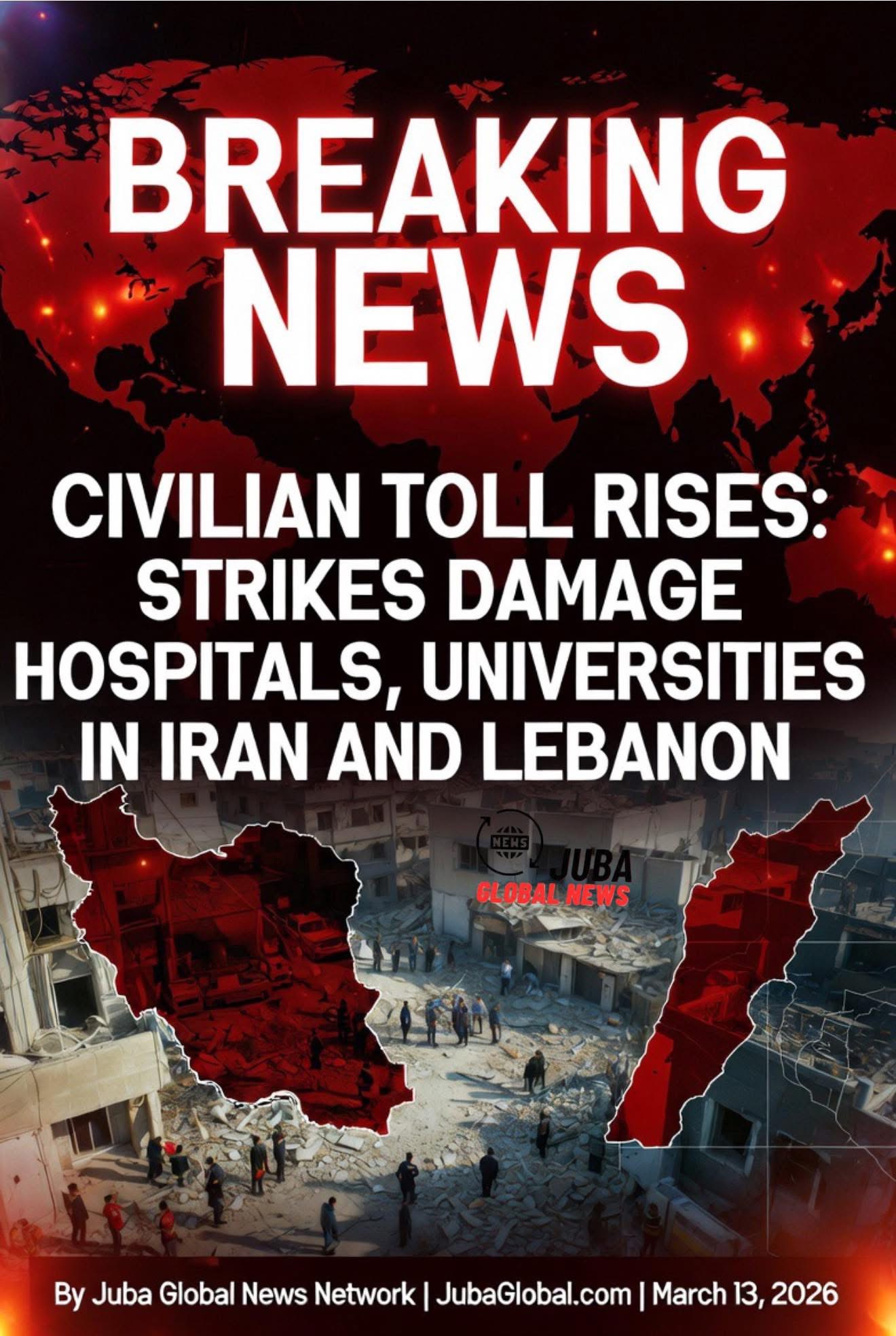
As the US-Israeli war against Iran enters its third brutal week, the human cost has escalated sharply with mounting evidence of widespread damage to civilian infrastructure — including hospitals, medical clinics, universities, schools, and residential neighborhoods — in both Iran and Lebanon. International humanitarian organizations, local health authorities, and independent monitors now report that at least 31 major clinical facilities in Iran have sustained partial or total damage, while a direct Israeli airstrike on the Lebanese University campus in southern Beirut has killed students and faculty and forced the indefinite closure of one of the country’s largest public higher-education institutions.
The pattern of strikes — which Israeli officials describe as necessary to degrade Hezbollah command structures and Iranian missile production embedded in or near civilian areas — has drawn sharp condemnation from the United Nations, the International Committee of the Red Cross (ICRC), and several neutral governments. Both sides accuse the other of deliberately using or targeting civilian objects, deepening what is already one of the most serious humanitarian crises to emerge from the conflict.
Iran: Hospitals and Clinics Under Fire
Iran’s Deputy Health Minister Ali Jafarian held an emergency press conference in Tehran late Thursday, releasing a preliminary damage assessment compiled by the Ministry of Health and Medical Education:
- 31 major hospitals and specialized medical centers have been hit or severely damaged since February 28.
- 12 facilities are now completely non-functional due to destroyed operating theaters, collapsed wards, or loss of electricity and oxygen supply.
- At least 47 smaller clinics and primary-care centers have been damaged or forced to close.
- Estimated civilian medical casualties directly linked to infrastructure strikes: 1,395 killed and more than 4,800 injured (figures do not include deaths from missile strikes on residential areas).
Satellite imagery analyzed by independent groups such as the Australian Strategic Policy Institute and the James Martin Center for Nonproliferation Studies shows clear impact craters and fire damage at several prominent medical complexes:
- Valiasr Hospital in Tehran (western district) — main surgical block destroyed.
- Imam Khomeini Hospital Complex in Tehran — multiple buildings damaged, oncology and dialysis units offline.
- Several trauma centers in Isfahan and Shiraz — heavily hit after reported nearby strikes on missile production or storage sites.
Iranian officials accuse Israel of “systematic targeting of civilian health infrastructure” in violation of international humanitarian law. The ICRC issued a rare public statement reminding all parties that “hospitals, ambulances, and medical personnel are protected under the Geneva Conventions and may not be attacked unless they are being used to commit acts harmful to the enemy.”
Israeli military spokespeople countered that “every strike is intelligence-driven and aimed at military targets,” asserting that Hezbollah and IRGC forces routinely locate command posts, missile launchers, and drone assembly sites inside or immediately adjacent to hospitals and universities. “We take extraordinary measures to minimize civilian harm,” an IDF statement read, “but when the enemy deliberately uses human shields, tragic outcomes are unavoidable.”
Lebanon: University Campus Becomes Battlefield
The most visually shocking incident occurred early Friday when Israeli F-35s struck a multi-story building directly adjacent to the main campus of the Lebanese University in Hadath (southern Beirut). Lebanese authorities and university officials report:
- Two students and one professor killed instantly when shrapnel and blast waves tore through nearby lecture halls.
- At least 14 students and 8 staff injured; several in critical condition.
- Multiple classrooms, a library wing, and administrative offices heavily damaged or destroyed.
- All classes suspended indefinitely; thousands of students displaced from dormitories near the strike site.
Video footage circulating on social media shows students fleeing in panic as smoke rises over the campus, with shattered glass and debris littering walkways that only hours earlier were filled with morning lectures. The Lebanese University — the country’s largest public institution with over 80,000 students — has become a powerful symbol of how deeply the war has penetrated civilian life in Lebanon.
Hezbollah immediately claimed the targeted building housed a command node for its Radwan Force planning unit. Israel has not denied the military objective but insists the strike was “precise” and that civilian casualties were unintended.
Lebanese Prime Minister Nawaf Salam called the university strike “an outrageous escalation against education itself” and demanded an emergency Arab League and UN Security Council session.
Cumulative Human and Humanitarian Impact
Beyond the headline medical and educational targets, cumulative civilian tolls continue to climb:
- Iran — Red Crescent Society estimates nearly 20,000 civilian buildings damaged or destroyed, including 16,000 homes. Power outages affect millions; air quality in Tehran has deteriorated sharply from fires at energy and industrial sites.
- Lebanon — Constant Hezbollah rocket fire into northern Israel has displaced over 50,000 Israelis, while Israeli counterstrikes have damaged infrastructure across southern Lebanon and Beirut’s southern suburbs.
- Gulf states — Repeated Iranian drone and missile attacks have caused civilian casualties and widespread fear in Dubai, Abu Dhabi, and Bahrain.
The UN Office for the Coordination of Humanitarian Affairs (OCHA) warned that access for aid deliveries into Iran and Lebanon is now “severely constrained,” with border crossings closed, airspace contested, and port facilities damaged or blockaded.
International Response and Legal Questions
Amnesty International and Human Rights Watch have launched urgent investigations into alleged violations of international humanitarian law by all parties. The UN Human Rights Council president announced plans for a special session next week.
The United States has expressed “deep concern” over civilian casualties but reiterated support for Israel’s right to self-defense. Russia and China have accused the US and Israel of “indiscriminate bombing” and called for an immediate ceasefire.
As the war grinds into its 15th day, the rising civilian death toll — especially among the sick, wounded, students, and medical workers — is becoming one of the defining and most politically explosive features of the conflict. Each new damaged hospital or university campus fuels outrage, hardens positions, and makes any negotiated off-ramp appear more distant.
Juba Global News Network continues to report from the ground, from hospitals in Tehran and Beirut, and from the diplomatic corridors where the fate of millions now hangs in the balance.
Stay informed. Visit JubaGlobal.com for continuing humanitarian coverage.
#HumanitarianCrisis #IranWar #LebanonWar #CivilianCasualties #MiddleEastWar #IranWar #JubaGlobal
