

Gas Prices Hit Highest Levels Since 2023 Amid Hormuz Crisis
By: Juba Global News Network | JubaGlobal.com March 18, 2026 — Washington, D.C. / Dubai, UAE Global gasoline and diesel prices surged to their highest sust
By: Juba Global News Network | JubaGlobal.com
March 18, 2026 — Washington, D.C. / Dubai, UAE
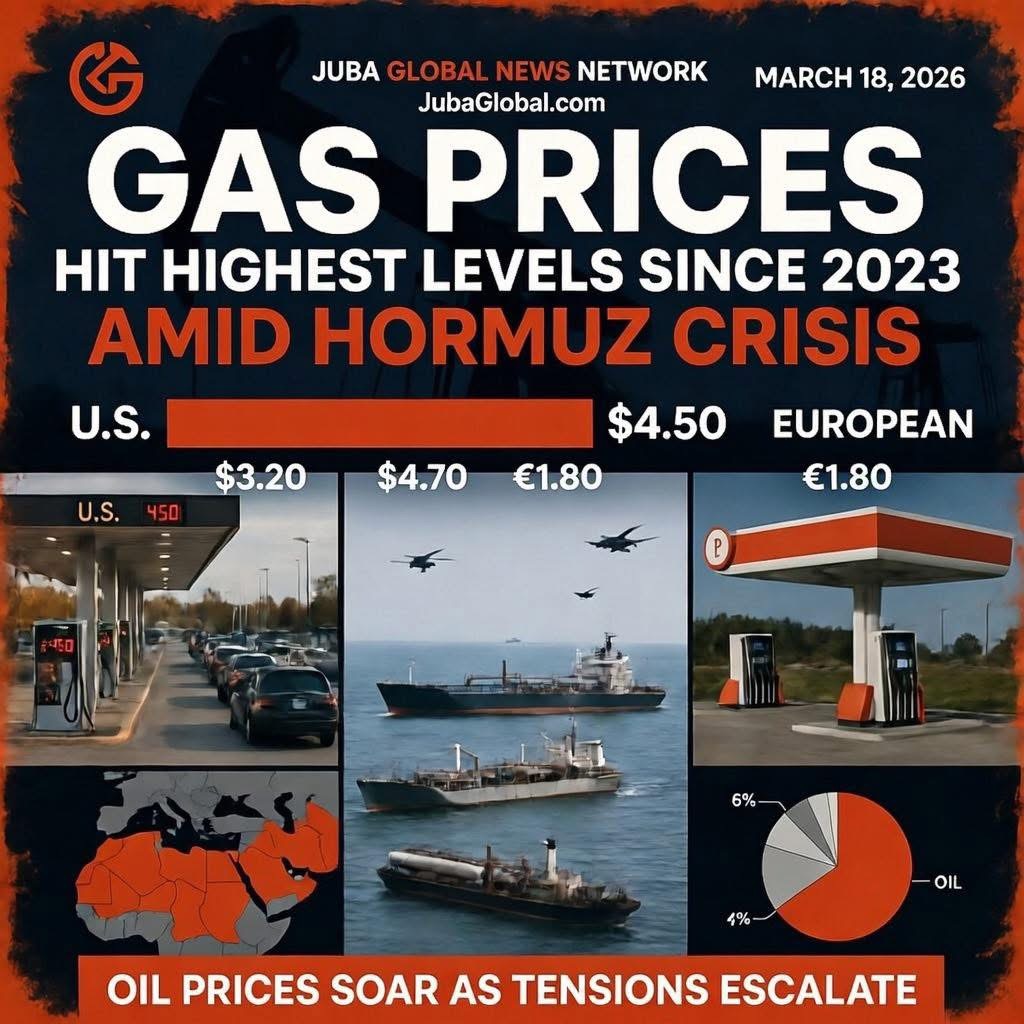
Global gasoline and diesel prices surged to their highest sustained levels since the summer of 2023 this week as the ongoing U.S.-Israel war with Iran entered its third week and the Strait of Hormuz remained a flashpoint of extreme volatility. Retail pump prices in the United States averaged $4.82 per gallon for regular unleaded on Tuesday — up 38 cents in the past seven days — while European markets saw diesel breach €2.10 per liter in several countries and Brent crude futures settled above $132 per barrel for the first time since March 2022.
The sharp escalation stems directly from Iran’s partial blockade tactics in the Strait of Hormuz following U.S. bunker-buster strikes on Iranian missile sites along the waterway. Although the strait has not been completely closed, Iranian Revolutionary Guard fast boats have conducted aggressive boarding inspections, several tankers have been damaged by limpet mines or small-arms fire, and insurance premiums for vessels transiting the chokepoint have skyrocketed to levels not seen since the 2019 tanker crisis. As a result, daily oil flows through Hormuz — which normally carry about 21 million barrels per day (roughly 20–21% of global seaborne crude) — have fallen by an estimated 35–45% in the past ten days, forcing buyers to scramble for alternative supplies.
Major oil companies and trading houses have declared force majeure on a growing number of cargoes, while several Asian refiners (particularly in India, South Korea, and Japan) have reduced throughput or switched to more expensive spot-market purchases from the Atlantic basin. The combination of reduced supply, heightened war-risk premiums, and speculative buying has driven the Brent-WTI spread to its widest level in nearly three years.
In the United States, the national average regular gasoline price reached $4.82/gal according to AAA data released Tuesday afternoon — the highest since September 2023 and up more than $1.10 from the start of March. States on the West Coast and in the Northeast are already seeing regular unleaded prices exceed $5.50/gal, with California stations in the Los Angeles basin routinely posting $6.10–$6.40. Diesel, critical for freight and agriculture, has climbed even faster, averaging $5.38/gal nationally and surpassing $6.00 in many Midwest and Mountain West states.
President Donald Trump addressed the spike during a brief Oval Office appearance Tuesday, blaming Iran’s “piracy” in the strait and reiterating his frustration with NATO allies and other partners for refusing to contribute warships to escort tankers. “We’re protecting the world’s oil lifeline almost alone,” Trump said. “If they don’t want to help, fine — but don’t complain when you pay $7 a gallon in Europe or Asia.” He also reiterated that the U.S. military strikes on Iranian missile infrastructure were necessary to “keep the strait open” and vowed further action if disruptions continued.
European governments are facing acute political pressure. In Germany, diesel at €2.12/liter has reignited protests among truckers and farmers already angry over carbon taxes and net-zero policies. French President Emmanuel Macron convened an emergency energy meeting, while the UK government announced temporary VAT relief on fuel duty — a move quickly criticized as insufficient by opposition parties. Several EU capitals are now openly debating strategic petroleum reserve releases, though analysts warn that coordinated SPR draws could send the wrong signal to producers and speculators.
Developing economies are being hit hardest. In India, petrol and diesel prices rose by ₹8–12 per liter in a single week, pushing inflation expectations higher and straining household budgets ahead of the summer harvest season. Pakistan, already grappling with political instability, saw diesel top PKR 350/liter, further squeezing transport and agriculture. In sub-Saharan Africa and Latin America, where fuel subsidies are already stretched, governments face the grim choice between ballooning fiscal deficits or politically toxic price hikes.
Energy analysts warn that sustained disruption could push Brent toward $150–$180/bbl if Iran escalates to full closure or if U.S./Israeli strikes damage additional export infrastructure. Even partial restrictions lasting another 4–6 weeks could add 50–80 cents per gallon to U.S. pump prices and €0.40–€0.60 per liter in Europe by late April, according to consensus forecasts from Goldman Sachs, JPMorgan, and S&P Global Commodity Insights.
For now, the Hormuz crisis remains the dominant driver of global energy markets — overshadowing seasonal demand patterns, OPEC+ production decisions, and U.S. shale output growth. As long as the war continues without a clear de-escalation path, motorists, truckers, airlines, and consumers worldwide will continue to feel the pain at the pump.
Juba Global News Network will continue tracking oil market movements, diplomatic efforts to reopen the strait, and the impact on households and industries. Stay informed at JubaGlobal.com.
Reporting contributed by energy correspondents in Dubai, London, New York, and New Delhi, with price data cross-verified from AAA, Oil Price Information Service, Platts, and national statistical agencies.
