

Morocco Awarded Africa Cup of Nations Title After CAF Overturns Senegal Win — Shocking Ruling Sparks Outrage and Appeal Threats
By: Juba Global News Network | JubaGlobal.com March 18, 2026 — Cairo, Egypt / Rabat, Morocco / Dakar, Senegal In one of the most controversial decisions in
By: Juba Global News Network | JubaGlobal.com
March 18, 2026 — Cairo, Egypt / Rabat, Morocco / Dakar, Senegal
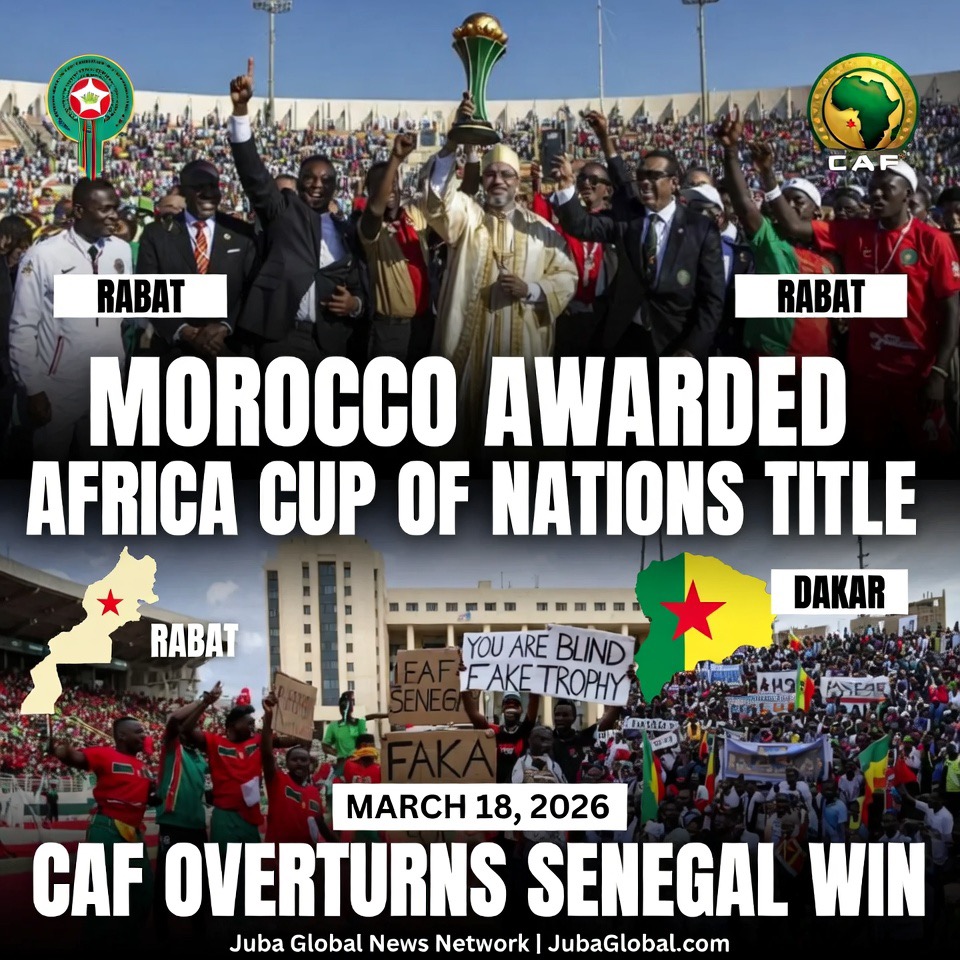
In one of the most controversial decisions in the history of African football, the Confederation of African Football (CAF) has officially stripped Senegal of the 2025 Africa Cup of Nations title and awarded it to Morocco following a dramatic and unprecedented post-tournament review. The ruling, announced late Tuesday evening after weeks of closed-door hearings, has sent shockwaves across the continent, triggered furious reactions from Senegalese officials and fans, and prompted immediate vows of appeal to the Court of Arbitration for Sport (CAS).
The saga began with Senegal’s dramatic 2–1 victory over Morocco in the final on February 9, 2026, in Cairo — a match watched by an estimated 250 million people worldwide. Senegal, led by captain Sadio Mané and coach Aliou Cissé, had appeared to complete a historic back-to-back triumph, becoming only the third nation (after Egypt and Cameroon) to win consecutive AFCON titles. Morocco, the 2022 World Cup semi-finalists, had mounted a spirited campaign but ultimately fell short in the final minute when Mané converted a penalty after a VAR-reviewed handball.
However, Morocco lodged a formal protest within the 48-hour window, alleging multiple irregularities during the tournament — most explosively, that Senegal had fielded an ineligible player in two group-stage matches and the quarter-final. The Moroccan Football Federation (FRMF) claimed that forward Iliman Ndiaye, who scored crucial goals, had failed to serve a one-match suspension carried over from club competition under CAF regulations. They further accused Senegalese officials of submitting falsified documentation regarding Ndiaye’s disciplinary record.
After an initial dismissal by CAF’s disciplinary committee, Morocco escalated the matter to the CAF Appeals Board and reportedly provided new evidence — including leaked correspondence between Senegal’s federation and a European club — that convinced the appeals panel to reopen the case. In a 5–2 decision released Tuesday, the board ruled that Senegal had violated eligibility rules in three matches, including the final, and declared the results null and void for those games. As a result, Morocco — the tournament runners-up — were retroactively declared champions.
CAF President Patrice Motsepe defended the decision in a brief statement: “The integrity of our competitions is paramount. After exhaustive review and legal process, we must uphold the rules that apply to every federation equally. This is a painful but necessary step to protect the credibility of the Africa Cup of Nations.”
Senegal’s response was swift and furious. Federation president Augustin Senghor called the ruling “a scandal unprecedented in the history of African sport” and accused CAF of succumbing to political pressure and Moroccan lobbying. “We won on the field, fairly and squarely,” Senghor declared in a televised address from Dakar. “This is robbery disguised as justice. We will appeal to CAS immediately and we will fight until the title is restored.”
Senegalese President Bassirou Diomaye Faye went further, describing the decision as “an insult to the Senegalese people” and announcing that the government would fund the legal battle “to the end.” Fans in Dakar and across the diaspora took to the streets in protest, burning CAF flags and effigies of Motsepe while chanting “We won! We won!”
Moroccan authorities and fans, meanwhile, celebrated the surprise vindication. King Mohammed VI issued a congratulatory message to the Atlas Lions, and celebrations erupted in Rabat, Casablanca, and Tangier. Coach Walid Regragui, who had been gracious in defeat, now spoke of “justice served” and dedicated the title to “every Moroccan who believed in fair play.”
The ruling has divided African football opinion. Supporters of the decision argue that rules must be enforced consistently, even retrospectively, to deter future violations. Critics, however, call it a dangerous precedent — overturning a major tournament final weeks after the fact based on paperwork disputes — and warn it undermines the credibility of the competition. Several former AFCON winners (Nigeria, Algeria, Egypt) have expressed unease, with some federations quietly signaling support for Senegal’s appeal.
CAS has already confirmed receipt of Senegal’s initial notice of appeal and is expected to fast-track proceedings given the extraordinary nature of the case. A final ruling could come within 3–6 months, but the title remains with Morocco in the interim.
For now, the 2025 AFCON trophy sits in Rabat rather than Dakar, and the continent remains bitterly divided over what should have been a moment of sporting celebration. Whether the decision stands or is overturned, the 2025 final will be remembered not for the goals or the drama on the pitch, but for the unprecedented legal and political battle that followed.
Juba Global News Network will continue to follow the CAS proceedings, reactions across Africa, and any further developments. Stay informed at JubaGlobal.com.
Reporting contributed by correspondents in Cairo, Dakar, Rabat, and Johannesburg, with official statements and legal documents cross-verified from CAF, Senegalese and Moroccan federations, and CAS sources.
