

Cobra Freed: Eritrean Satirical Cartoonist Biniam Solomon Released After 15 Years in Brutal Detention Without Charge
In a rare glimmer of hope from one of Africa’s most repressive regimes, Eritrean satirical cartoonist Biniam Solomon — known to generations as “Cobra” — ha
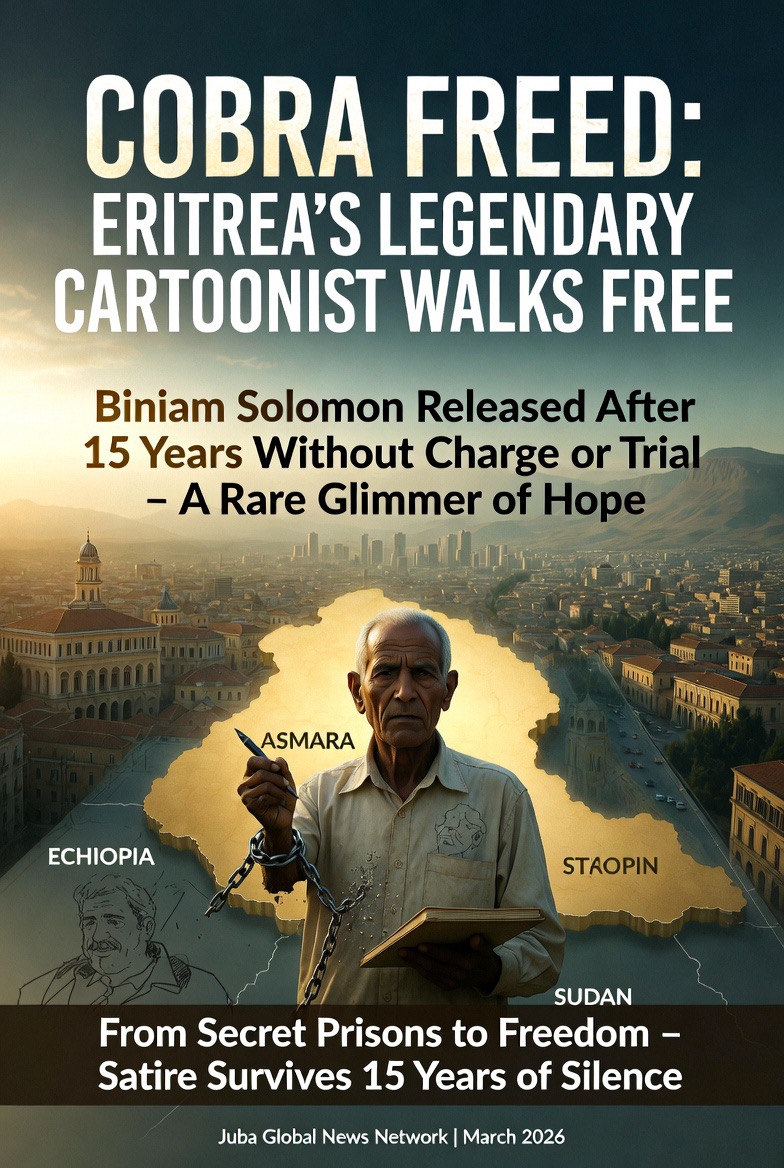
In a rare glimmer of hope from one of Africa’s most repressive regimes, Eritrean satirical cartoonist Biniam Solomon — known to generations as “Cobra” — has walked free after 15 years locked away without ever being charged or tried. The news, confirmed by his family and friends to the BBC and other outlets in mid-March 2026, has sent ripples of cautious celebration through the Eritrean diaspora and human-rights circles worldwide.
Now in his early 60s, Solomon was arrested in the capital Asmara in 2011 and simply vanished into Eritrea’s opaque prison system. For a decade and a half he had no contact with his loved ones, received only sporadic medical care, and was never told why he was being held. His release comes with no explanation from the authorities — just as his imprisonment had none.
The Man Behind the Pen: From Physics Teacher to National Satirist
Born with only one arm after a childhood accident, Biniam Solomon refused to let disability define him. He became both a physics teacher at a secondary school in Asmara and one of Eritrea’s most beloved cartoonists. His sharp, witty drawings first appeared in private newspapers starting in 1997 — just four years after Eritrea won independence from Ethiopia in 1993, during a brief golden window when independent media was tolerated.
He published three popular books collecting his work: Subtle is the Ruler, Conversation with Cobra Number One, and Conversation with Cobra Number Two. Readers loved him for turning everyday frustrations and political absurdities into laugh-out-loud commentary that somehow slipped past the censors — until it didn’t.
43942“LARGE”
One classic cartoon from 2001 perfectly captured the paranoia of the time. It showed a government minister’s wife asking why her husband wasn’t getting up for work. His reply: “I might be frozen [suspended],” while nervously listening to state radio to see if he still had a job. The drawing mocked the sudden purges and uncertainty that gripped senior officials — a satire so precise it still resonates today.
Arrested Without Warning, Vanished Without Trial
In 2011, Cobra was taken. No warrant, no charges, no court date. He simply disappeared. For the next 15 years he was held incommunicado — a fate shared by thousands of Eritreans accused of nothing more than independent thought.
In the later years of his detention he was moved to Asmara’s notorious “crime investigation” prison, a facility widely documented by human-rights groups as holding political prisoners and conscientious objectors under grim conditions. Family members had zero contact. Occasional medical visits were the only lifeline.
Eritrea’s Shadow Prison System: A Nation of Silent Cells
Under President Isaias Afwerki — in power since independence — Eritrea has earned a grim reputation. Private media was crushed in a sweeping 2001 crackdown; journalists, critics and artists were rounded up. Many remain behind bars to this day, some for over two decades.
The country has no functioning constitution, no independent judiciary, and no free press. Indefinite national service, forced labour, and arbitrary arrests are routine. The United Nations has repeatedly called for the release of around 10,000 people held without trial. Human-rights organisations describe prisons where detainees endure inadequate food, medical neglect, and total isolation — exactly the conditions Cobra endured.
Yet in recent months a small wave of long-term detainees has quietly been freed. Cobra’s release is part of that pattern, though authorities have offered no reason and made no announcement.
dsGRZ“LARGE”
T17uz“LARGE”
Asmara: A City of Hidden Pain
The capital where Cobra once taught and drew still looks deceptively calm from above — wide boulevards, Italian colonial architecture, and the highland air. But beneath the surface lies a machinery of fear that swallowed him and countless others.
S6sjf“LARGE”
A Cautious Celebration — and Lingering Questions
For the Eritrean diaspora, the news has brought tears and cautious joy. “He used his pen to draw our daily suffering using humour, and we laughed it off,” one admirer wrote online. Friends and relatives are relieved he survived, but the joy is tempered: thousands of other prisoners remain in the same black hole, still waiting for unexplained freedom.
No one knows why Cobra was released now. Was it international pressure? A quiet policy shift? Simple bureaucratic whim? The Eritrean government has said nothing.
What Cobra’s Freedom Means for Eritrea
In a country where satire itself became a crime, the return of “Cobra” feels symbolic. One voice that dared to laugh at power has survived 15 years of silence and can now — perhaps — speak again.
Yet the bigger story is unchanged. Eritrea remains one of the world’s most closed societies. Until the rule of law replaces the rule of fear, until courts replace secret prisons, and until artists and journalists can create without terror, Cobra’s story will remain not an ending, but a single, fragile chapter in a much longer struggle.
For now, Eritreans at home and abroad are savouring the moment. After 15 years of darkness, the cartoonist who once made a nation smile through gritted teeth is free.
The pen that survived the prison may yet draw again — and that, in Eritrea, is revolutionary.
