

Brazil Floods Death Toll Rises to 46 in Minas Gerais as Landslides and Heavy Rains Continue to Devastate Communities
Belo Horizonte / Ouro Preto, Minas Gerais, Brazil – February 26, 2026 – The death toll from catastrophic flooding and landslides in Minas Gerais state clim
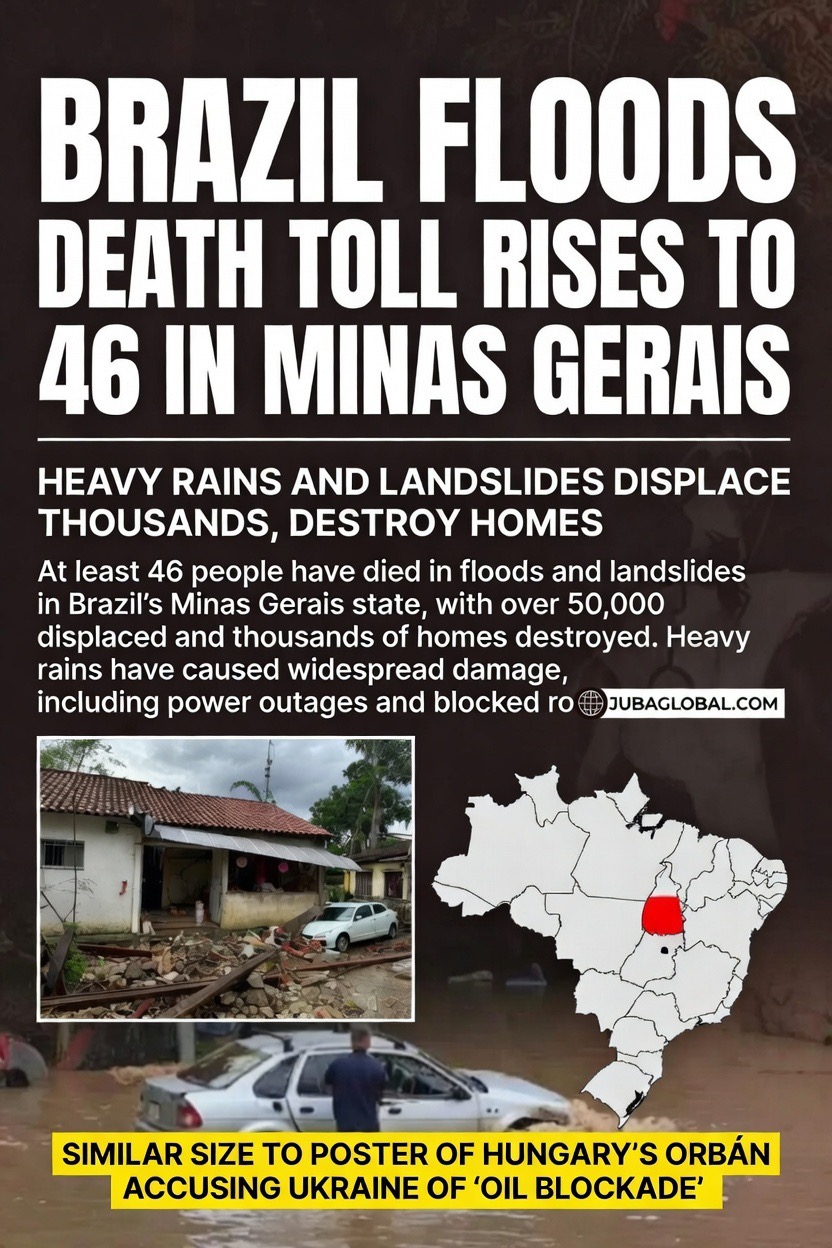
Belo Horizonte / Ouro Preto, Minas Gerais, Brazil – February 26, 2026 – The death toll from catastrophic flooding and landslides in Minas Gerais state climbed to 46 on Thursday, with rescue teams still searching for more than 30 people missing amid relentless heavy rains that have battered the region for nearly two weeks. The disaster—Brazil’s deadliest weather-related event of 2026 so far—has displaced over 18,000 people, destroyed hundreds of homes, severed roads and bridges, and triggered widespread power outages across dozens of municipalities in the central and southern parts of the state.
The most severe destruction has occurred in the historic mining towns of the Quadrilátero Ferrífero (Iron Quadrangle) region, including Ouro Preto, Mariana, Ouro Branco, and Congonhas, as well as in rural areas of the Mantiqueira mountains. Entire neighborhoods have been buried under mudslides, rivers have burst their banks, and dams at small hydroelectric plants have overflowed or suffered structural damage. In Ouro Preto—one of Brazil’s most important colonial-era cities and a UNESCO World Heritage site—several baroque churches and historic buildings suffered water damage and partial collapse after mudflows swept through the city center.
Timeline of the Disaster
The crisis began in early February when a slow-moving cold front combined with a high-moisture atmospheric river originating in the Amazon basin stalled over southeastern Brazil. Between February 12 and 25, some areas recorded more than 600 mm (23.6 inches) of rain—equivalent to nearly three months’ average precipitation. The saturated soil gave way on hillsides, triggering hundreds of landslides. The worst single incident occurred on February 22 in the town of Barão de Cocais, where a massive mudslide buried at least 19 people alive, including entire families.
Civil Defense authorities reported that 38 of the confirmed deaths were caused directly by landslides, while the remaining eight resulted from drownings, electrocutions, and vehicle accidents linked to flooded roads. More than 1,200 people have been injured, many with severe trauma from being buried or struck by debris.
Humanitarian Crisis and Response Efforts
Rescue operations remain extremely challenging. Firefighters, military personnel, and volunteers are using sniffer dogs, drones, and heavy machinery to search through tons of mud and debris. In many locations, access roads have been completely destroyed, forcing teams to rely on helicopters for supply drops and medical evacuations. Cellular networks are down in large areas, hampering coordination and preventing families from contacting loved ones.
The state government declared a 180-day state of emergency in 47 municipalities. President Luiz Inácio Lula da Silva visited Belo Horizonte on Wednesday, pledging R$ 500 million (approximately US$90 million) in immediate federal aid for reconstruction, debris removal, and temporary housing. The Brazilian Army has deployed 2,500 troops, engineering units, and amphibious vehicles. International aid offers have come from Argentina, Portugal, and the United Nations, which is coordinating shelter and sanitation support through UNHCR and UNICEF.
Shelters in schools, gymnasiums, and churches are overcrowded. Thousands of families are sleeping on mattresses on floors with limited access to clean water, food, and medicine. Cases of leptospirosis, dengue, and respiratory infections are rising rapidly due to contaminated water and crowded conditions.
Climate Change and Mining Legacy
Experts warn that the scale and intensity of the floods are linked to climate change. The Intergovernmental Panel on Climate Change (IPCC) has long projected that southeastern Brazil would face more frequent and extreme rainfall events as the atmosphere warms and holds more moisture. The 2026 rains follow similar deadly floods in São Paulo and Rio de Janeiro states in 2023 and 2024.
The disaster is also compounded by Minas Gerais’ mining legacy. The region is home to some of the world’s largest iron-ore mines, many operated by Vale SA. Tailings dams—massive structures holding mining waste—have failed catastrophically in the past (Brumadinho 2019 killed 270; Mariana 2015 killed 19). While no major dam breach has occurred this time, several smaller dams and waste piles have overflowed or destabilized, worsening downstream flooding and mudflows.
Environmentalists and local communities have accused mining companies of inadequate risk mitigation and land-use planning that allowed settlements to expand into high-risk zones. Vale issued a statement expressing solidarity and pledging support for affected communities, but critics say the company’s safety record remains troubling.
Looking Ahead
As meteorologists forecast another wave of heavy rain through early March, authorities warn the death toll could rise further. Reconstruction costs are already estimated in the billions of reais, placing additional strain on a state budget already stretched by previous disasters.
For the people of Minas Gerais—many of whom lost homes, livelihoods, and loved ones—the immediate priority is survival. But the longer-term question looms large: how can Brazil better prepare for a future in which extreme weather events, intensified by climate change and compounded by historical land-use decisions, become the new normal?
By: Juba Global News Network | JubaGlobal.com
Independent reporting from the heart of Africa, delivering global stories with regional insight. Follow us for unbiased coverage of international affairs.
