

US-Israel Target Iranian Security Infrastructure to Weaken Regime in Ongoing War
By Juba Global News Network | JubaGlobal.com March 14, 2026 In a deliberate shift toward undermining the Islamic Republic’s grip on power, US and Israeli f
By Juba Global News Network | JubaGlobal.com
March 14, 2026
In a deliberate shift toward undermining the Islamic Republic’s grip on power, US and Israeli forces have intensified strikes on Iran’s internal security apparatus and repressive institutions as the war enters its third week. The campaign, which began with precision attacks on nuclear sites, missile production, and senior leadership, now increasingly targets the very mechanisms that allow the regime in Tehran to maintain control amid widespread domestic unrest and external pressure.
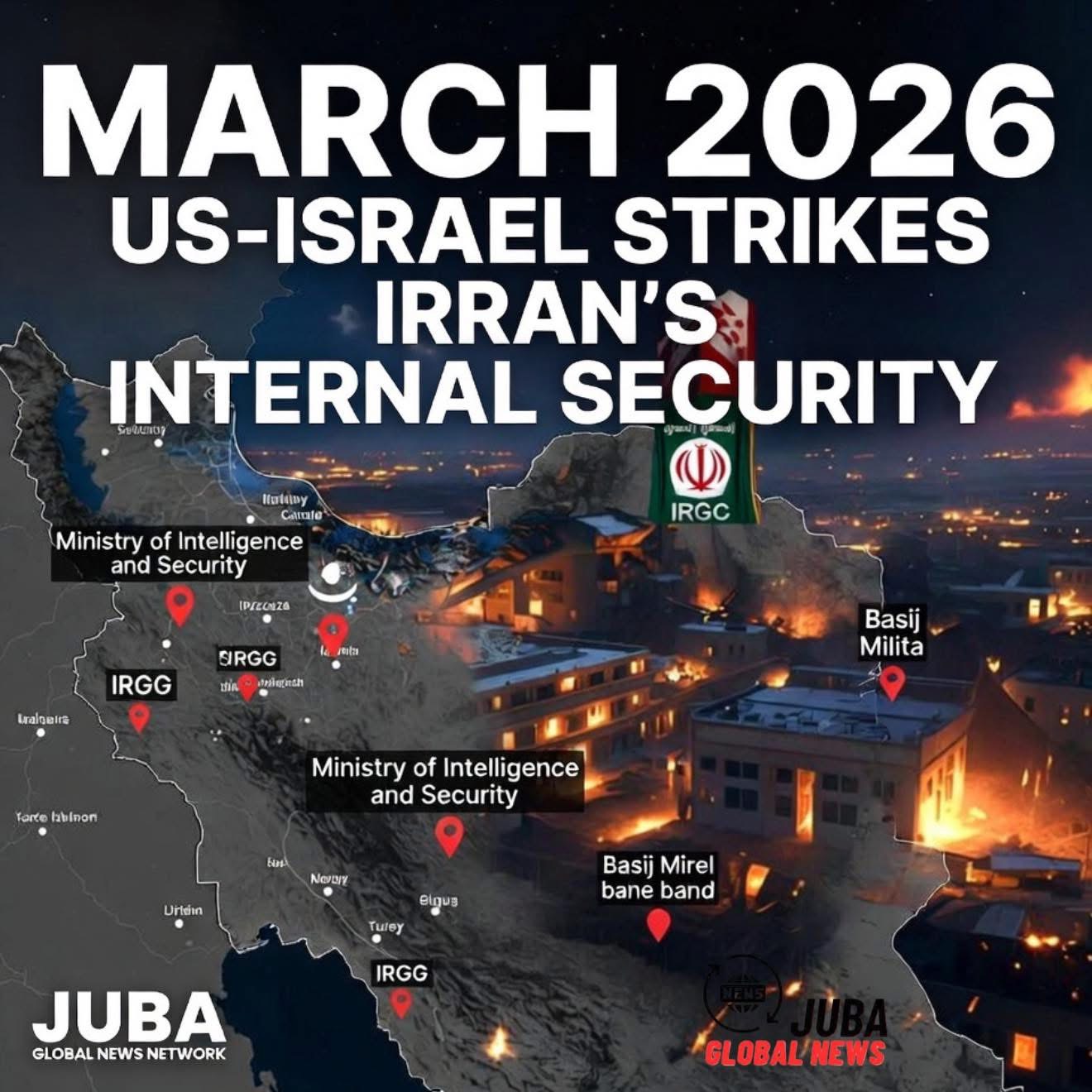
Defense Secretary Pete Hegseth described the expanded targeting as a key pillar of the strategy: “We are degrading not only their ability to project power outward, but also their capacity to repress their own people and maintain regime stability inside Iran.” US Central Command (CENTCOM) and the Israel Defense Forces (IDF) have confirmed multiple waves of airstrikes since early March hitting Ministry of Intelligence facilities, Basij militia bases, IRGC internal security headquarters, riot control equipment depots, and command centers used to coordinate crackdowns on protests.
Key Targets and Reported Damage
Among the most significant strikes:
• Evin Prison and surrounding security complex (Tehran) – Several buildings housing administrative offices and guard barracks were hit. While the main prison cell blocks were reportedly spared to avoid mass civilian casualties, the strikes severely disrupted command-and-control for prisoner management and intelligence operations.
• Basij headquarters and training centers in multiple provinces (Tehran, Isfahan, Mashhad, Shiraz) – Basij paramilitary forces, responsible for street-level repression and rapid mobilization during unrest, suffered heavy losses in personnel, vehicles, and communications infrastructure.
• Ministry of Intelligence (VEVAK) regional offices – Several provincial intelligence directorates were targeted, with satellite imagery showing collapsed structures and secondary explosions consistent with munitions storage.
• IRGC Ground Forces internal security units – Facilities used to coordinate joint operations between the Revolutionary Guards and regular police during demonstrations were hit in at least seven locations.
• Riot control and crowd-suppression equipment depots – Warehouses storing tear gas, rubber bullets, armored vehicles, and water cannons were destroyed in targeted strikes, significantly reducing the regime’s immediate capacity for large-scale crowd control.
Iranian state media has downplayed the damage, claiming most facilities were evacuated in advance and that civilian casualties remain low. Independent reports and opposition groups inside Iran, however, indicate dozens of security personnel killed and hundreds injured, with morale visibly shaken among lower-ranking forces.
Strategic Rationale: Regime Stability as a Target
The decision to hit internal security infrastructure reflects a growing belief in Washington and Jerusalem that weakening the regime’s repressive apparatus could accelerate internal collapse or force concessions. Analysts note that since the death of Supreme Leader Ali Khamenei on February 28 and the rapid appointment of his son Mojtaba Khamenei, public protests—though suppressed—have reemerged in several cities, fueled by war-related economic hardship, power outages, fuel shortages, and anger over civilian casualties from foreign strikes.
By targeting the tools and command nodes of repression, US and Israeli planners aim to:
1. Reduce the regime’s ability to crush dissent quickly and decisively.
2. Increase pressure on mid-level security commanders who may hesitate or defect if they perceive the regime as vulnerable.
3. Create conditions where protests can grow beyond the regime’s capacity to contain them.
4. Signal to the Iranian population and security forces that the campaign is not aimed at ordinary citizens but at the structures that oppress them.
President Donald Trump has alluded to this dimension in public remarks, stating: “The Iranian people have suffered under this regime for far too long. We’re taking out the tools they use to keep the people down.”
Iranian Response and Domestic Fallout
Tehran has responded with defiant rhetoric. New Supreme Leader Mojtaba Khamenei called the strikes “cowardly attacks on Iran’s sovereignty and the dignity of its security forces,” vowing harsher retaliation abroad and tighter internal control. State television has framed the attacks as proof of foreign intent to foment chaos and regime change.
Inside Iran, however, the picture is more complex. Social media videos (shared via VPNs and smuggled out) show growing frustration among ordinary citizens over blackouts, food shortages, and skyrocketing prices—conditions worsened by the war and the partial closure of the Strait of Hormuz. Reports from human rights groups indicate sporadic protests in Tehran, Tabriz, and Isfahan, though security forces have so far managed to contain them.
The degradation of repressive capacity has reportedly led to uneven responses: in some cities police and Basij units appeared hesitant or under-equipped during minor demonstrations, while in others crackdowns remained brutal.
Broader War Context
These strikes occur alongside continued attacks on military targets—including recent B-2 bomber missions against ballistic missile sites and the high-profile raid on Kharg Island’s military facilities. Iranian missile barrages on Israel persist (including a recent impact in the Negev), though at reduced volume and effectiveness. Oil prices remain above $100/barrel due to the Hormuz situation, amplifying global economic pressure.
Casualty figures remain disputed: Iranian officials claim over 1,400 killed (mostly civilians) since the war began, while US and Israeli sources emphasize precision targeting and low collateral damage. Humanitarian organizations warn of worsening conditions, with millions facing food insecurity and medical shortages.
As day 15 passes, the targeting of internal security infrastructure marks a potentially decisive escalation in the strategic aims of the campaign. Whether it accelerates regime instability, provokes fiercer resistance, or forces Tehran toward negotiations remains uncertain—but the war is increasingly being fought on two fronts: one military, the other political and societal.
Juba Global News Network continues to follow developments from multiple sources. The coming weeks will likely reveal whether degrading the tools of repression proves to be a turning point—or merely another chapter in a widening conflict.
