

Oil Prices Hover Above $100 as Hormuz Closure Persists Amid US-Israel-Iran War
By Juba Global News Network | JubaGlobal.com March 14, 2026 Global oil markets remain in turmoil as Brent crude futures hover stubbornly above $100 per bar
By Juba Global News Network | JubaGlobal.com
March 14, 2026
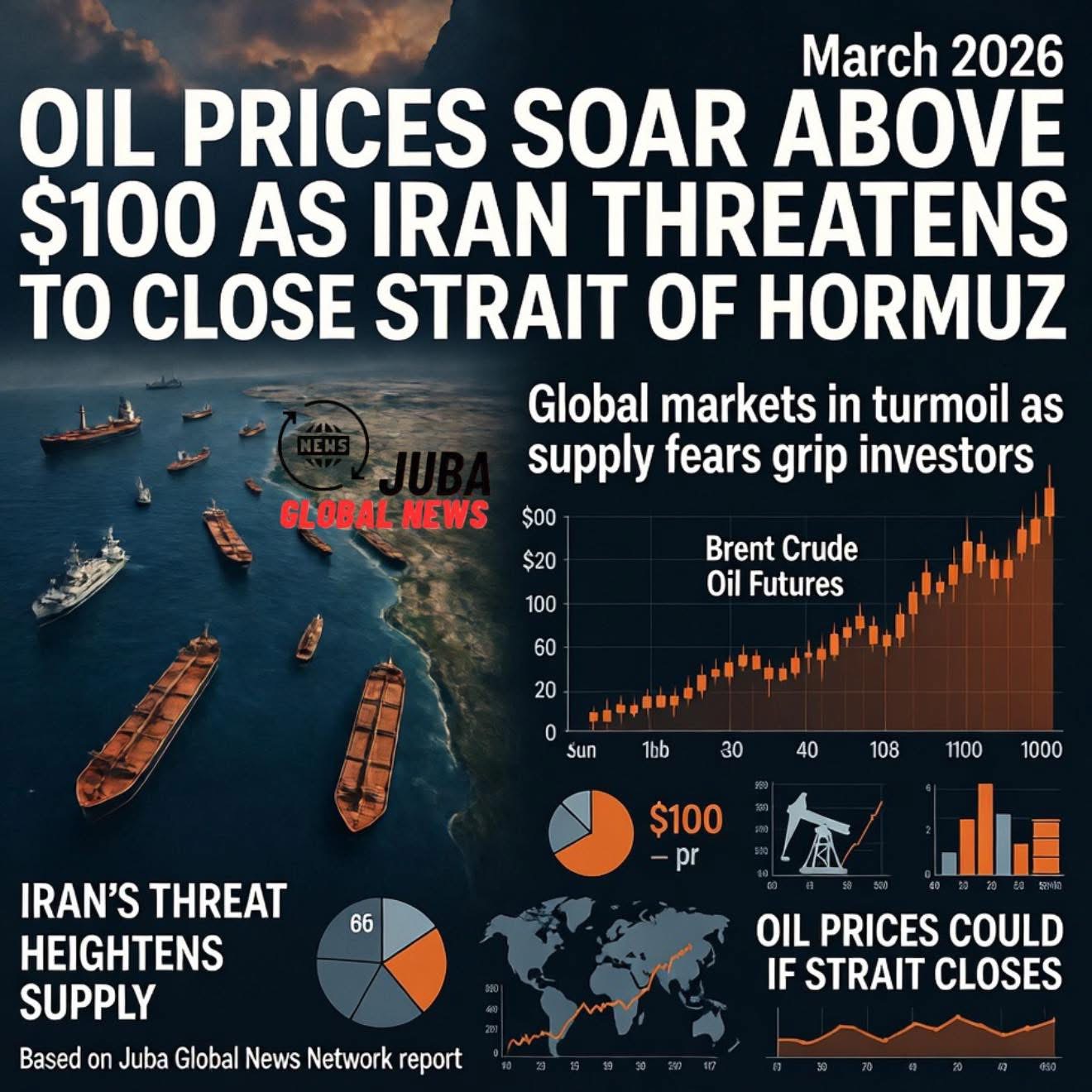
Global oil markets remain in turmoil as Brent crude futures hover stubbornly above $100 per barrel, driven by the near-total disruption of shipping through the Strait of Hormuz—the narrow waterway that carries roughly 20% of the world’s daily oil supply. With the US-Israel campaign against Iran now in its third week, Iran’s effective blockade (or severe restriction) of the strait has triggered one of the most severe energy supply shocks in recent history, pushing prices to multi-year highs and raising alarms about prolonged economic fallout.
As of March 14, 2026, Brent crude—the global benchmark—settled around $103 per barrel after volatile trading sessions, with intraday spikes pushing it toward $104–$105 in recent days. This represents gains of over 40% since the conflict erupted on February 28, when joint US-Israeli strikes eliminated Supreme Leader Ali Khamenei and ignited widespread retaliation. West Texas Intermediate (WTI), the US benchmark, has followed a similar trajectory, trading near $98–$100 amid fears of sustained disruptions.
The surge stems directly from Iran’s decision to keep the Strait of Hormuz closed or heavily contested as leverage against ongoing US and Israeli operations. Iranian Supreme Leader Mojtaba Khamenei has vowed to maintain the blockade, warning of additional fronts if attacks continue. Reports indicate Iranian forces have laid mines, attacked commercial tankers, and threatened further strikes, effectively halting standard maritime traffic. Persian Gulf producers—including Saudi Arabia, UAE, Iraq, Kuwait, and Qatar—have curtailed output by up to 6% as storage facilities fill to capacity without export outlets.
Market Volatility and Supply Shortfalls
Oil prices have exhibited extreme swings: early in the war, Brent briefly topped $119 before paring gains; more recently, futures have stabilized in the $100–$105 range as traders price in a prolonged (but not indefinite) closure. Analysts from Bloomberg Economics and others model scenarios where a full three-month Hormuz shutdown could push Brent toward $150 or higher, though markets currently appear to bet on a disruption lasting through March but easing thereafter—reflected in August futures trading around $90.
The International Energy Agency (IEA) has described the situation as unleashing “the largest oil supply disruption in history,” estimating shortfalls of 8–10 million barrels per day or more in peak disruption periods. In response, the IEA released emergency reserves (up to 400 million barrels in coordinated action), while OPEC+ members have pledged output increases—but rerouting via pipelines or alternative paths offers limited relief given the scale.
US President Donald Trump has repeatedly threatened escalation, including potential Navy escorts for tankers or direct strikes on remaining Iranian oil facilities if the strait remains blocked. Defense Secretary Pete Hegseth confirmed intensified operations to ensure freedom of navigation, yet tankers continue avoiding the route amid mine threats and attacks.
Economic Ripple Effects Worldwide
The sustained high prices are already fueling inflation concerns globally. Gasoline prices in the US have risen sharply (averages up 17% since late February in some reports), with diesel and jet fuel following suit—impacting transportation, manufacturing, and air travel. In Europe and Asia—more dependent on Gulf imports—the pain is acute: higher energy costs threaten to slow growth, exacerbate supply-chain issues, and push central banks toward tighter policy.
Economists warn of recession risks if disruptions extend beyond a few months. Olivier Blanchard and others suggest prices could remain “very high for an extended period,” with $150–$200 scenarios possible under worst-case prolonged closure. Retail sectors face layered pressures: higher fertilizer costs (tied to natural gas and oil) threaten food prices, while plastics, chemicals, and metals shipments face delays.
Despite volatility, some relief signals exist—Trump’s mixed messaging on the war’s end (“way ahead of schedule”) has occasionally tempered spikes—but Iranian defiance and proxy actions keep markets on edge.
Broader War Context
The Hormuz crisis coincides with escalating military actions: recent US B-2 bomber strikes on Iranian missile sites, attacks on Kharg Island military targets, and ongoing Iranian barrages on Israel (including Negev impacts). Civilian casualties mount, humanitarian concerns grow, and diplomatic efforts (including Russian mediation proposals) show little progress.
As day 15 passes with no resolution, oil’s role as the conflict’s economic flashpoint intensifies. Whether diplomacy reopens the strait or escalation widens the crisis will dictate if prices stabilize—or surge further into uncharted territory.
Juba Global News Network tracks energy markets and conflict developments live. The path ahead remains uncertain, with profound implications for global stability, inflation, and growth.
