

US Deploys More Troops to Middle East as Trump Balances Military Pressure with Indirect Talks on Iran
By Juba Global News Network | JubaGlobal.com Published: March 27, 2026 The Pentagon has quietly continued reinforcing its military footprint across the Mid
By Juba Global News Network | JubaGlobal.com
Published: March 27, 2026
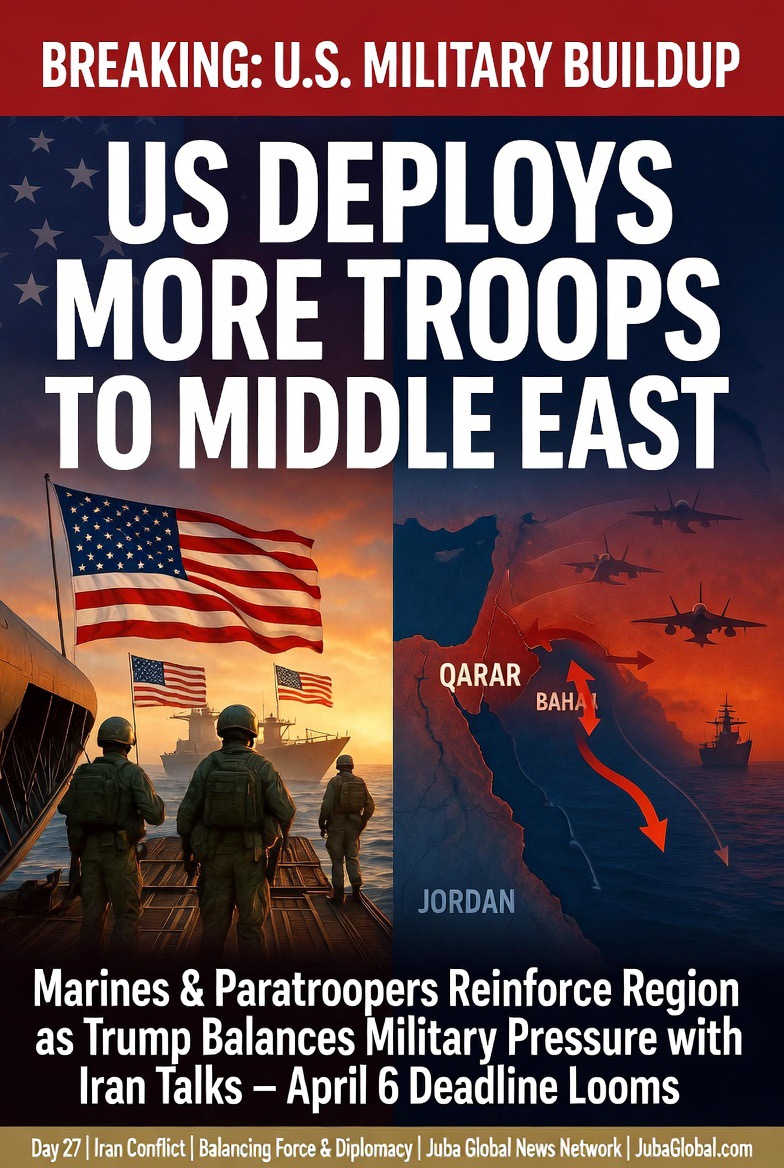
The Pentagon has quietly continued reinforcing its military footprint across the Middle East, deploying additional Marines, paratroopers, and support units even as President Donald Trump extends the pause on strikes against Iranian energy infrastructure until April 6 and claims indirect negotiations with Tehran are “going very well.”
According to defense officials speaking on background, fresh contingents of U.S. Marines and elements of the 82nd and 101st Airborne Divisions have arrived or are en route to key bases in the region, including those in Qatar, Bahrain, Jordan, and the United Arab Emirates. The reinforcements include air defense batteries, logistics units, and special operations forces, aimed at bolstering deterrence, protecting U.S. personnel and assets, and preparing for potential escalation if diplomatic efforts falter.
This buildup occurs on Day 27 of the Iran conflict, as the U.S. pursues a dual-track strategy: maintaining credible military pressure while keeping channels open for indirect talks facilitated through third parties such as Pakistan.
Strategic Buildup Amid Diplomatic Window
President Trump announced the latest 10-day extension of the pause on planned U.S. strikes targeting Iranian power plants and energy facilities, citing a request from the Iranian government and positive movement in backchannel communications. In a Truth Social post, Trump stated that talks are progressing and expressed optimism about reaching “major points of agreement.”
Defense Secretary Pete Hegseth has described the overall approach as “negotiating from a position of strength,” a phrase echoed by senior military leaders. The continued troop deployments signal that Washington is not relying solely on diplomacy and is prepared for multiple contingencies, including a breakdown in talks after the April 6 deadline.
Key objectives of the deployment include:
• Strengthening air and missile defense networks to protect regional allies and U.S. bases from potential Iranian retaliation or proxy attacks.
• Enhancing rapid response capabilities should Iran attempt to further disrupt shipping in the Strait of Hormuz or expand attacks through its network of militias.
• Supporting Israeli operations on multiple fronts while deterring wider regional involvement by groups such as the Houthis or Iraqi militias.
U.S. Central Command (CENTCOM) has not released exact troop numbers, citing operational security, but sources indicate the additional forces bring the total U.S. military presence in the region to levels not seen since the peak of previous Gulf crises.
Parallel Military Developments on Multiple Fronts
The U.S. reinforcement comes as the conflict remains highly active:
• Iran launched its 83rd wave of ballistic missiles targeting Israeli cities including Haifa and Dimona.
• Hezbollah intensified rocket and anti-tank attacks along Israel’s northern border as Israeli forces push to expand a buffer zone in southern Lebanon.
• Israel conducted a precision strike eliminating IRGC Navy Commander Admiral Alireza Tangsiri and other senior naval officers near Bandar Abbas, significantly disrupting Iran’s command structure over Hormuz operations.
Oil markets remain volatile, with Brent crude trading above $100 per barrel due to ongoing disruptions in the Strait of Hormuz. Iran has allowed limited approved transits but maintains pressure on the critical waterway, demanding formal recognition of its sovereignty as part of any resolution.
Diplomatic Context and Iranian Counter-Demands
Indirect talks, believed to involve intermediaries from Pakistan, Egypt, and possibly Oman, continue despite public rejections from Tehran. Iran has dismissed key elements of the U.S. 15-point peace proposal and issued its own counter-demands, including war reparations, guarantees against future strikes, and explicit acknowledgment of its rights over the Strait of Hormuz.
Trump has downplayed the public negativity, insisting that private communications show more flexibility. The April 6 deadline now serves as both a pressure point and a potential off-ramp, depending on whether tangible progress is made on reopening the strait to unrestricted commercial shipping and addressing Iran’s missile and proxy activities.
Reactions from Allies and Adversaries
• Israel: Officials have welcomed the U.S. deployments while continuing aggressive operations to degrade Iranian military capabilities. Prime Minister Benjamin Netanyahu has indicated that Israel will press its advantage before any potential ceasefire.
• Gulf Allies: Saudi Arabia, the UAE, and Bahrain have quietly supported the U.S. presence as a stabilizing factor, while expressing concern over prolonged disruptions to energy exports and shipping.
• Iran: State media portrays the U.S. troop movements as evidence of aggression and weakness, claiming they reflect American fear of Iranian resolve. Tehran continues to project defiance while signaling limited willingness to engage indirectly.
• International Community: China has called for restraint and warned of severe economic consequences from prolonged conflict. European leaders, including Germany’s Defence Minister, have described the situation as an emerging “economic catastrophe.”
The International Atomic Energy Agency (IAEA) has reiterated warnings about radiological risks should military strikes intensify near Iran’s remaining nuclear sites.
Broader Implications for U.S. Strategy
The dual approach of military buildup and diplomatic outreach reflects a calculated risk. By increasing its regional presence, the U.S. aims to deter Iran from escalating further while giving negotiators leverage. Critics argue that additional deployments risk entangling the U.S. in a wider conflict or provoking Iranian proxies. Supporters counter that visible strength is essential to prevent miscalculation by Tehran.
Economically, the conflict’s ripple effects are already being felt in the United States through higher energy prices, increased mortgage rates, and broader market uncertainty. Globally, the diversion of attention and resources toward the Middle East has raised concerns in Ukraine, where officials worry about reduced support against Russia amid Moscow’s recent massive drone assaults.
Looking Ahead to April 6
As the pause clock ticks toward April 6 at 8:00 PM Eastern Time, several key questions remain:
• Will indirect talks produce concrete concessions on the Strait of Hormuz and Iran’s missile program?
• Can the U.S. and its allies maintain unity if the conflict drags on?
• How will additional U.S. troops influence Iranian decision-making in the coming days?
The coming week will likely prove decisive in determining whether the conflict moves toward de-escalation or enters a more dangerous phase of direct confrontation.
Juba Global News Network will continue real-time coverage of U.S. military deployments, diplomatic developments, and battlefield updates from the Middle East. For the latest analysis on the Iran conflict, visit JubaGlobal.com.
