

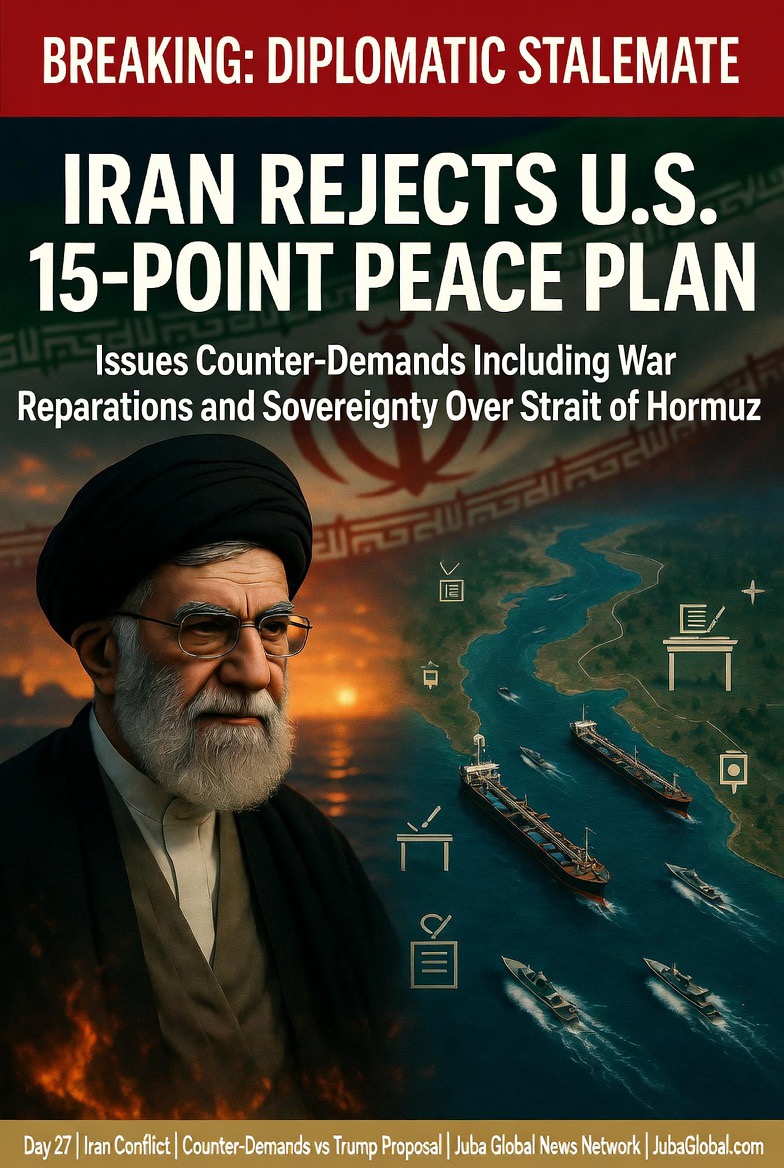
Iran Issues Counter-Demands Including War Reparations and Formal Recognition of Sovereignty Over Strait of Hormuz as It Rejects Key Elements of U.S. 15-Point Peace Proposal
By Juba Global News Network | JubaGlobal.com Published: March 27, 2026 The diplomatic track in the ongoing Middle East conflict hit a significant roadblock
By Juba Global News Network | JubaGlobal.com
Published: March 27, 2026
The diplomatic track in the ongoing Middle East conflict hit a significant roadblock on Day 27 as Iran formally rejected major components of the U.S. 15-point peace proposal and responded with its own set of stringent counter-demands. Tehran’s conditions center on war reparations, guarantees against future U.S.-Israeli attacks, and formal recognition of its “natural and legal right” to control maritime activity in the Strait of Hormuz — the vital chokepoint through which roughly 20% of global oil and gas supplies pass.
Iranian state media, including Press TV, quoted unnamed senior officials stating that Tehran has given a “negative response” to the American framework delivered via Pakistani intermediaries. While dismissing the U.S. plan as “excessive” and “deceptive,” Iran stopped short of completely shutting the door on talks, instead putting forward its own counter-proposal that includes a reported five-point set of conditions for any potential ceasefire.
Details of Iran’s Counter-Demands
According to reports from Iranian state outlets and international media citing diplomatic sources, Tehran’s key requirements include:
• War Reparations: Iran is demanding compensation from the United States and its allies for damages caused by U.S. and Israeli airstrikes on Iranian territory, military infrastructure, and civilian areas since the conflict intensified on February 28, 2026.
• Guarantees Against Future Aggression: Formal assurances and mechanisms to prevent future assassinations, airstrikes, or military operations by the U.S. and Israel against Iranian leadership, nuclear sites, or conventional military assets.
• Recognition of Sovereignty Over the Strait of Hormuz: Tehran insists on explicit acknowledgment of its authority over security and maritime operations in the strategic waterway, framing it as a “natural and legal right.” This demand directly challenges the international community’s long-standing position on freedom of navigation in the Persian Gulf.
• Cessation of Support for Proxy Conflicts: An end to what Iran describes as external interference fueling conflicts involving its regional allies, alongside a broader halt to hostilities across multiple fronts.
• Lifting of Sanctions and Economic Relief: Implicit or explicit calls for sanctions relief as part of any comprehensive deal, though details remain limited in public reporting.
These counter-demands stand in sharp contrast to the core elements of the U.S. 15-point proposal, which reportedly includes:
• Full reopening of the Strait of Hormuz to unrestricted international shipping
• Significant limitations or dismantlement of Iran’s ballistic missile program
• Restrictions on Iran’s nuclear enrichment activities and potential dismantling of related facilities
• Cessation of support for proxy groups such as Hezbollah, Hamas, and the Houthis
• Mechanisms for long-term de-escalation and verification
U.S. Special Envoy Steve Witkoff had described the 15-point list as a framework with “strong signs” of potential progress, while President Donald Trump has maintained an optimistic public tone, claiming indirect talks are “going very well” and extending the pause on strikes against Iranian energy infrastructure until April 6 at Iran’s request.
Public Rejection and Mixed Messaging
Iran’s Foreign Minister and other officials have publicly pushed back against narratives of productive negotiations. Statements emphasize that Iran “does not intend” to engage in direct talks under current conditions and has accused the U.S. of using diplomatic signaling to manipulate global oil markets and domestic opinion.
Despite the rejection, limited gestures have occurred. Reports indicate Iran allowed a small number of oil tankers — including some Pakistan-flagged vessels — to transit the Strait of Hormuz in recent days, which Trump characterized as a positive “gift” or sign of willingness to negotiate. However, Tehran continues to operate what some Gulf officials describe as a de facto “toll booth,” charging fees or requiring coordination for safe passage, further disrupting global shipping.
Strategic Context and Ongoing Military Pressure
The diplomatic stalemate unfolds against a backdrop of sustained military activity:
• Iran launched its 83rd wave of ballistic missiles targeting Israeli cities including Haifa and Dimona.
• Hezbollah has intensified rocket and anti-tank attacks on Israel’s northern border as Israeli forces expand operations in southern Lebanon.
• Israel conducted a targeted strike eliminating IRGC Navy Commander Admiral Alireza Tangsiri and other senior naval leaders near Bandar Abbas, dealing a blow to Iran’s Hormuz operations.
• U.S. forces continue reinforcing their regional presence with additional troop deployments.
Oil markets remain highly volatile, with Brent crude trading above $100 per barrel due to persistent Hormuz disruptions and uncertainty over any potential resolution.
International Reactions
The hardening of positions has raised alarms among global powers:
• China has reiterated calls for restraint and a swift resolution to protect international trade routes and prevent deeper economic damage.
• European leaders, including Germany’s Defence Minister, have labeled the broader conflict an “economic catastrophe.”
• Gulf Cooperation Council (GCC) officials have accused Iran of violating international maritime norms through its selective control of the strait.
• Mediators, including Pakistan and Egypt, are reportedly working to arrange further indirect contacts, warning that the current window may represent one of the last chances to avoid a more devastating escalation.
The International Atomic Energy Agency (IAEA) has also renewed warnings about the risk of a “major radiological accident” if strikes continue or intensify near Iran’s remaining nuclear facilities.
What Happens Next?
With the April 6 deadline for possible U.S. strikes on Iranian energy infrastructure approaching, both sides appear locked in a high-stakes game of brinkmanship. Analysts suggest several possible scenarios:
1. Prolonged Stalemate: Continued missile exchanges, proxy fighting, and Hormuz pressure while backchannel talks inch forward slowly.
2. Limited Tactical Deal: A temporary reopening of the strait in exchange for short-term sanctions relief or pause in strikes, without addressing core issues.
3. Further Escalation: If core demands remain unmet, resumption of U.S. energy infrastructure attacks or expanded Israeli operations.
Critics of the current approach argue that maximalist positions on both sides — U.S. demands for major Iranian concessions versus Tehran’s insistence on reparations and sovereignty recognition — make a comprehensive deal difficult in the short term. Supporters of the Trump administration’s strategy counter that sustained military pressure, combined with calibrated diplomacy, has already forced Iran to the table and degraded key capabilities.
For now, the conflict continues on multiple fronts, with global energy markets, shipping routes, and regional stability hanging in the balance as the clock ticks toward April 6.
Juba Global News Network will provide ongoing coverage of diplomatic developments, military actions, and economic impacts. For the latest updates on the Iran conflict, U.S.-Iran indirect talks, and the Strait of Hormuz crisis, visit JubaGlobal.com.
