

UN Condemns Uganda’s Violent Suppression of Anti-Corruption Demonstrations: A Grim Prelude to the 2026 Elections
By: Juba Global News Network Kampala, 8 December 2025 Under Kampala’s sweltering sun, where matatus jam up the cracked roads and vendors push roasted maize
By: Juba Global News Network
Kampala, 8 December 2025
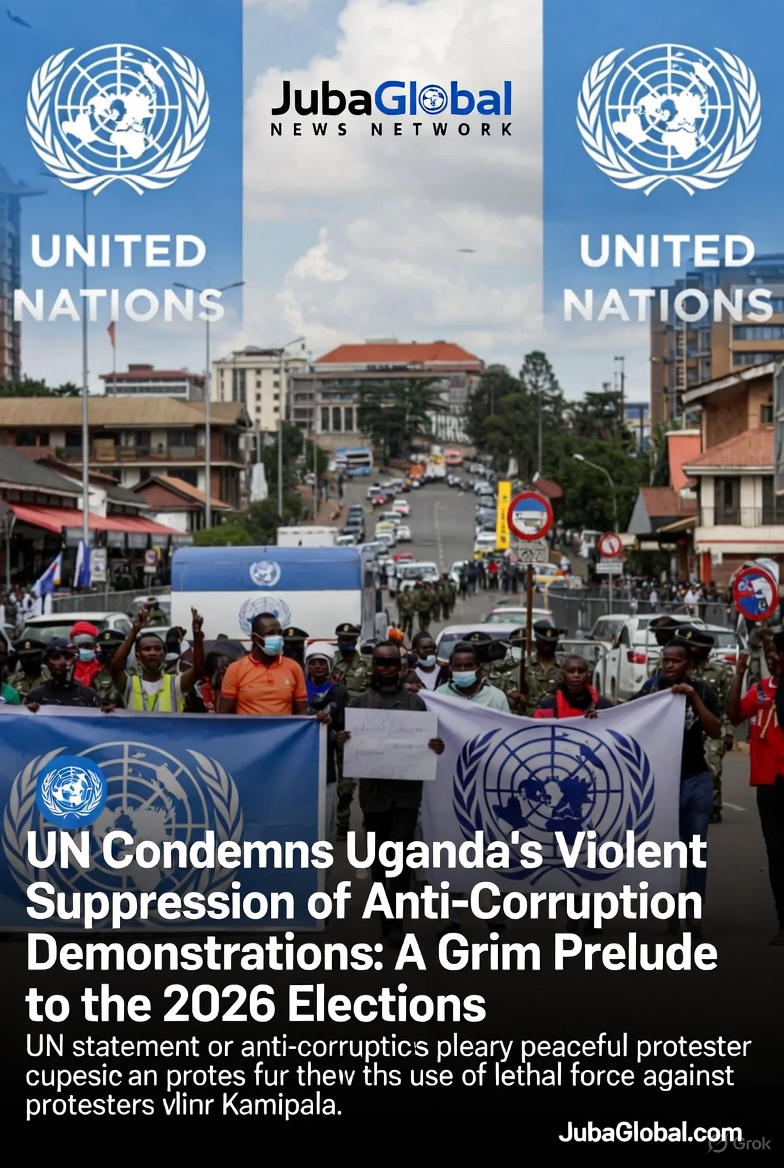
Under Kampala’s sweltering sun, where matatus jam up the cracked roads and vendors push roasted maize from roadside grills, a new wave of outrage took hold last week. A decentralized cry for accountability—echoed in encrypted WhatsApp messages and contagious TikTok clips—quickly spread into massive anti-corruption protests not only in Uganda’s capital but spilling out to other main towns as well. By the time midday hit on December 5, thousands—mostly Ugandans in their twenties and thirties—had flooded the city’s hotspots: outside Parliament, at the State House, and across key intersections snaking toward the Central Business District. Placards floated above the restless crowd, slogans like “Parliament: Den of Thieves” and “End the Looting – 2026 Demands Justice,” weaving together a picture of mounting frustration against a government long accused of pilfering public coffers.
Uganda’s security forces wasted no time. Almost instantly, the air filled with the screech and hiss of tear gas, rubber bullets snapped past heads, and riot police wielding batons stormed forward with the brutal precision of a force that’s done this before. When evening finally rolled in and the smoke drifted away, the aftermath was stark: dozens arrested, several landed in the hospital with broken bones and deep cuts, and at least two had died—one shot, another trampled in the panic. Eyewitnesses and viral videos told it all: a young woman dragged by her braids into a van, a man in a wheelchair beaten as he tried desperately to escape, journalists battered and shoved while still live-streaming the chaos.
This wasn’t just a random flare-up. The events mark another episode in a year’s worth of rising tensions, where demands for transparency keep colliding with a regime that holds fast to its power. Now, the United Nations Human Rights Council has blasted the situation with a harsh condemnation, warning that Uganda’s “deepening crackdown” could derail democracy just as the January 2026 general elections approach.
From Geneva on December 4, UN High Commissioner for Human Rights Volker Türk condemned the government’s “use of unnecessary or disproportionate force,” calling urgently for investigations into allegations of arbitrary detentions, disappearances, and torture. “The Ugandan authorities must halt all violence against protesters and act fully in accordance with their obligations under international human rights law,” Türk pressed, echoing the frustration of a generation that’s starting to see the ballot box as their last hope.
The Spark: A Nation’s Simmering Rage Against Corruption
If you really want to get why people took to the streets, you’d have to rewind through 2025—a year stained by economic struggle and scandal after scandal. Uganda’s economy, battered by a stunted post-pandemic recovery, droughts in the north, and swelling public debt, has left over 40% of the population scraping by on less than $2.15 a day (or so the World Bank figures say). All the while, as families in places like Karamoja scrounge for wild roots after failed harvests, the headlines keep shouting about elite corruption: a $1.2 billion “ghost ship” procurement scam in the Uganda People’s Defence Forces (UPDF), $500 million in COVID-19 relief funds supposedly snatched by parliamentary officials, and the notorious “Service Awards” fiasco, with lawmakers pocketing $57 million in “appreciation bonuses” while famine raged.
These protests didn’t just appear out of thin air. They were organized with intention through social media—Uganda’s youth have really made these platforms their organizing home. By late November, a network of activists under the #UgandaParliamentExhibition banner kicked off a digital “exhibition,” leaking redacted files that laid bare MPs’ lavish travels and secret offshore accounts. Hashtags like #StopTheLooting and #MuseveniMustGo shot around the globe, pulling in millions of interactions. Inspired by Kenya’s Gen-Z protests earlier this year, Ugandan organizers tagged the December 5 demonstration as a “March for Accountability.” “We’re not looking for handouts,” an activist told Juba Global News Network. “What we want is our stolen future returned.”
The protests rolled out in surges: by 10 a.m., groups—many with black armbands for national mourning—gathered at Makerere University, shouting “No More Thieves!” and blocking Bombo Road. By noon, similar scenes popped up in Gulu and Mbale. Kampala, the beating heart, saw nearly 5,000 pour onto Parliamentary Avenue, waving opposition National Unity Platform (NUP) flags alongside placards citing Article 29 of the Constitution, which is supposed to guarantee peaceful assembly.
The State’s Iron Fist: A Pattern of Repression
President Yoweri Museveni’s government—still standing after nearly forty years—moved quickly to brand the protests a “foreign-sponsored insurrection.” In a TV address on December 4, Museveni warned that “hooligans masquerading as patriots will face the full wrath of the law.” Security Minister Maj. Gen. Jim Muhwezi chimed in, claiming the demonstrations were part of some plot to destabilize peace.
The crackdown followed a familiar script: pre-dawn raids, slowed-down internet, and rapid deployment of elite units. Witnesses say there were attack dogs, live bullets, and ruthless beatings. Over 150 were reportedly arrested by December 7, many held without any communication. Human Rights Watch has tracked reports of disappearances and torture. Among those detained were NUP leaders, journalists, and even a few foreign observers.
This violence fits a well-known pattern. The entire year has seen anti-corruption protests get crushed brutally. The message is clear: gather in protest, and you’re called a rebel; demand press freedom, and it’s labeled sedition; ask for accountability, and you’re accused of anarchy.
The UN’s Rebuke: A Call for Global Accountability
The UN’s intervention pulled the crisis into the international spotlight. Volker Türk’s office documented hundreds of arbitrary arrests, disappearances, torture cases, and clampdowns on media. “It is deeply regrettable that election campaigns have once again been marked by widespread arbitrary arrests, detentions and the use of unnecessary or disproportionate force against the opposition,” he wrote. The statement demanded impartial investigations, freedom for detainees, and reparations. Amnesty International and the African Commission on Human and Peoples’ Rights echoed the call. Meanwhile, Kampala dismissed it all as “neo-colonial meddling.”
Voices from the Frontlines: The Human Toll
It’s not just numbers—it’s real people. Released detainees speak of beatings, humiliation, and relentless threats. Opposition leader Bobi Wine is basically under house arrest. Journalists have faced assaults and had their equipment snatched. Women protesters talk about sexual abuse. Uganda’s youth—who make up 78% of the population—endure the worst of it, but somehow, they refuse to be silenced.
Historical Shadows: From 1986 to 2026
Museveni’s long rule has chipped away at Uganda’s democracy for decades. Term limits, scrapped. Elections, tainted with violence and fraud. Now, with talk swirling about his son Muhoozi Kainerugaba possibly taking over, the stakes seem even higher. Laws giving the military expanded power over civilians only underline Uganda’s slide into deeper authoritarianism.
International Echoes: A Diplomatic Tightrope
Western nations have responded with sanctions, freezing aid, and putting out travel warnings. But with China’s unconditional loans flowing in, the impact is blunted. Most regional leaders stay mostly silent. Right now, the UN’s condemnation stands out as one of the harshest rebukes from the international community.
A Bleak Horizon? Pathways to Redemption
With 2026 on the horizon, Uganda’s standing at a fork in the road. The Electoral Commission keeps assuring everyone of peace, yet hardly anyone trusts them anymore. Young people are still busy organizing online. Meanwhile, interfaith leaders are urging everyone to stay calm. But honestly, the spirit of resistance isn’t going anywhere. The United Nations hasn’t minced words: investigate, release, and reform. Uganda’s at a crossroads—either move toward pluralism or slip even deeper into repression. Juba Global News Network will stay on the ground, bringing updates as the country approaches this pivotal election. © 2025 Juba Global News Network – All Rights Reserved JubaGlobal.com
