

BREAKING: Burkina Faso Grounds Nigerian Military Aircraft Over Airspace Violation – A Tense Escalation in West African Regional Tensions
By Dr. Elena K. Mwangi, Senior Correspondent for African Security Affairs December 8, 2025 – Ouagadougou, Burkina Faso / Abuja, Nigeria In a dramatic escal
By Dr. Elena K. Mwangi, Senior Correspondent for African Security Affairs
December 8, 2025 – Ouagadougou, Burkina Faso / Abuja, Nigeria
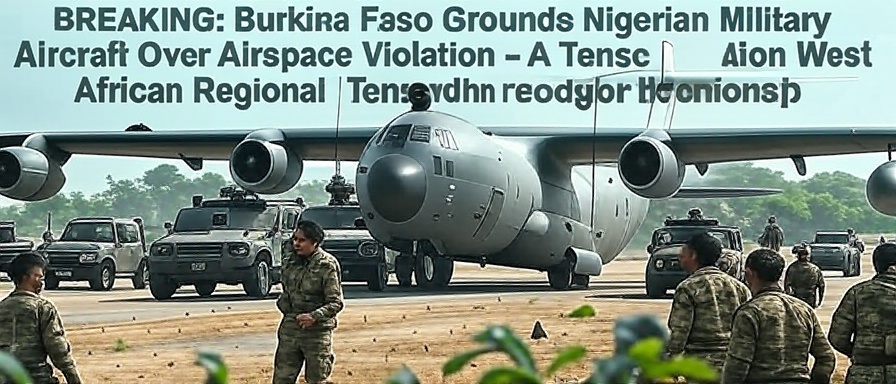
In a dramatic escalation of regional frictions, Burkina Faso’s military regime announced on Monday that it had intercepted and grounded a Nigerian Air Force (NAF) C-130 transport aircraft in the southwestern city of Bobo-Dioulasso, detaining all 11 military personnel aboard. The incident, described by the Confederation of Sahel States (AES) – comprising Burkina Faso, Mali, and Niger – as a “grave violation of confederal airspace,” has ignited fresh concerns over sovereignty, military adventurism, and the fraying fabric of West African security cooperation. Coming just one day after Nigeria’s air forces played a pivotal role in thwarting a coup attempt in neighboring Benin Republic, the grounding underscores the deepening divide between ECOWAS-aligned states and the AES bloc, amid a backdrop of jihadist insurgencies, economic strains, and shifting geopolitical alliances.
State media in Burkina Faso, echoing an official communiqué from AES President and Malian transitional leader Army General Assimi Goïta, confirmed that the aircraft was forced to make an emergency landing following an in-flight issue while transiting Burkinabè airspace without prior authorization. “The Confederation of the Sahel States most strongly condemns this violation of its airspace and the sovereignty of its member states,” the statement declared, emphasizing that an immediate investigation by Burkinabè aviation and security services revealed no flight clearance had been granted. 36 The 11 individuals on board – comprising two crew members and nine passengers, all identified as Nigerian military personnel – were promptly detained for further questioning, with the aircraft impounded at Bobo-Dioulasso International Airport.
This development arrives at a precarious juncture for West Africa, where military juntas in the Sahel have increasingly asserted autonomy from traditional regional bodies like the Economic Community of West African States (ECOWAS). The AES, formed in September 2023 as a mutual defense pact in response to ECOWAS sanctions following coups in its member states, has positioned itself as a bulwark against perceived Western interference while grappling with rampant jihadist violence. Burkina Faso, under Captain Ibrahim Traoré’s leadership since his 2022 coup, has been particularly vocal in decrying airspace incursions as acts of aggression, a sensitivity heightened by past allegations of foreign drone strikes and surveillance flights. 41
The Incident: From Emergency Landing to Diplomatic Standoff
Eyewitness accounts from Bobo-Dioulasso, a bustling commercial hub and key military outpost in Burkina Faso’s Hauts-Bassins region, paint a picture of swift and coordinated action by local forces. The C-130 Hercules – a versatile, four-engine turboprop long synonymous with Nigerian military logistics for troop transport and humanitarian aid – reportedly signaled a “mayday” distress call around midday local time, prompting its diversion to the nearest suitable runway. However, upon touchdown, Burkinabè air defense radars, operating under heightened alert protocols established by the AES in late 2024, flagged the flight as unauthorized. 38
The AES communiqué, signed by Goïta in his dual capacity as Malian head of state and confederation president, detailed that the aircraft originated from an undisclosed location but was en route through AES-controlled airspace without adhering to international civil or military aviation norms. “Measures have been taken to ensure the security of the Confederation’s airspace, the sovereignty and territorial integrity of its member states, and the safety of the populations,” it warned, explicitly authorizing air defense systems to “neutralize any aircraft that violates the confederal space.” 37 This stark language echoes a December 2024 declaration by AES heads of state, which ramped up anti-air defenses in response to alleged incursions linked to counter-terrorism operations in the region.
Social media footage circulating on platforms like X (formerly Twitter) captured the tense aftermath: the hulking C-130, emblazoned with Nigerian Air Force insignia, surrounded by Burkinabè military vehicles on the tarmac, while personnel in fatigues secured the perimeter. 2 Local reports from Bobo-Dioulasso residents described a brief airspace lockdown, with commercial flights delayed as authorities conducted a thorough sweep of the aircraft. One X user, posting under the handle @CitizenObs, shared a video clip of the scene, captioning it: “A military aircraft of the Nigerian army in violation of the AES airspace was immobilized today… The Zoo is finished.” 6 The post, which garnered hundreds of views within hours, reflects the charged anti-ECOWAS rhetoric prevalent in Sahel online discourse.
As of late Monday, the 11 detainees were reported to be held in secure facilities in Bobo-Dioulasso, with AES officials promising “in-depth investigations” into the flight’s purpose. Nigerian sources, speaking anonymously to this correspondent, suggested the aircraft may have been on a routine logistics run supporting multinational counter-terrorism efforts, potentially diverted due to mechanical failure. However, no official confirmation has emerged from Abuja, where the Ministry of Defence and the Nigerian Air Force headquarters in Abuja remained tight-lipped, citing an ongoing review.
Contextualizing the Crisis: Benin’s Foiled Coup and Nigeria’s Regional Role
To fully grasp this airspace skirmish, one must rewind to Sunday’s chaotic events in Benin Republic, where a group of mutinous soldiers briefly seized state television in Cotonou to announce the overthrow of President Patrice Talon’s government. The plotters, led by mid-level officers citing deteriorating security in Benin’s jihadist-plagued north and neglect of fallen comrades, dissolved constitutional institutions and called for a “return to republican order.” 40 Within hours, however, the bid unraveled – thanks in no small part to rapid intervention by Benin’s loyalist forces, bolstered by ECOWAS allies.
Nigeria emerged as the linchpin of the response. Acting on two formal requests from Talon’s administration, President Bola Tinubu authorized the deployment of NAF fighter jets to seize control of Benin’s airspace, conduct surveillance, and execute precision strikes on mutineer positions. 43 Presidential spokesperson Bayo Onanuga confirmed that the jets targeted armored vehicles and escape routes used by the fleeing plotters, describing the operation as “non-offensive, intelligence-driven” to prevent regrouping along the porous Nigeria-Benin border. 40 Ground troops from Nigerian battalions in Ikorodu, Badagry, and Owode (Ogun State) were also mobilized, alongside contingents from Ghana, Ivory Coast, and Sierra Leone under ECOWAS’s standby force framework.
The operation’s success – with the coup leaders surrendering by evening – highlighted Nigeria’s enduring role as West Africa’s de facto security guarantor. As the continent’s most populous nation and largest economy, Abuja has invested heavily in regional stability, contributing over 70% of troops to ECOWAS peacekeeping missions and maintaining a fleet of over 100 combat aircraft, including Alpha Jets and Super Tucanos acquired in recent years. 42 Yet, this assertiveness has irked the AES, whose leaders accuse ECOWAS of serving as a proxy for French and Western interests in perpetuating neocolonial influence.
Speculation swirls that the grounded C-130 was peripherally linked to the Benin operation – perhaps ferrying supplies or personnel from Nigeria’s northern bases toward Cotonou via a southern corridor that inadvertently skirted Burkinabè airspace. Flight tracking data shared on X by aviation enthusiasts showed multiple Nigerian-registered aircraft active over Benin on Sunday, including unmarked jets from Lagos, Kwara, and Abuja, though none were publicly tied to the C-130 incident. 23 One analyst, posting as @BrantPhilip_, noted a tactical transport from Abidjan making a “short visit” to Cotonou, possibly dropping ECOWAS reinforcements – a detail that AES hardliners might interpret as encirclement. 12
Broader Geopolitical Fault Lines: AES vs. ECOWAS in the Sahel
The grounding is more than a procedural aviation dispute; it is a flashpoint in the Sahel’s geopolitical reconfiguration. Since the 2020-2023 wave of coups in Mali (twice), Burkina Faso, and Niger, the AES has evolved from a loose alliance into a defiant counterweight to ECOWAS. The bloc’s withdrawal from ECOWAS in January 2025, coupled with joint military exercises and a shared currency proposal, signals a push for Sahelian self-reliance – one increasingly aligned with non-Western partners like Russia and Turkey. 36
Airspace has become a symbolic battleground. Burkina Faso, which ceded en-route control of much of its airspace to Niger’s Niamey FIR under pre-coup arrangements, has since reclaimed full sovereignty, issuing NOTAMs that restrict overflights by “hostile” entities. 44 Similar closures plagued Niger post-2023 coup, forcing reroutes via Mali or Senegal and disrupting trans-Saharan trade routes. 45 The AES’s latest alert – authorizing neutralization of violators – evokes memories of 2023 incidents where Burkinabè forces downed suspected French surveillance drones, amid accusations of “international coalitions” undermining junta rule. 41
From Nigeria’s vantage, such postures threaten the hard-won gains of the Multinational Joint Task Force (MNJTF) against Boko Haram and ISWAP, where cross-border air ops are routine. Abuja’s $2.5 billion defense budget in 2025 funds these efforts, but strained relations with AES states have hampered intelligence-sharing and fuel logistics. 43 Critics in Lagos argue that AES intransigence emboldens jihadists, who exploit the ungoverned spaces along the Burkina-Niger-Benin trijunction – a corridor responsible for over 1,200 deaths in cross-border raids this year alone.
Public reactions, amplified on X, reveal a polarized narrative. Pro-AES voices in Ouagadougou hailed the interception as a “sovereign triumph,” with hashtags like #AESStrong trending alongside memes depicting Nigerian jets as “ECOWAS puppets.” 14 In Abuja, netizens decried it as “junta paranoia,” pointing to Benin’s successful stabilization as evidence of collaborative necessity. 30 One viral thread by @amkareto emphasized the distinction: “Nigeria and France came in with approval… U don’t enter another country’s airspace without approval,” drawing parallels to U.S. overflights during Nigeria’s own security ops. 19
Implications for Regional Stability and International Norms
The immediate fallout could ripple across multiple fronts. Diplomatically, expect heated exchanges at the next ECOWAS summit, where Nigeria – holding the rotating chair – may push for sanctions or mediation. The African Union, which condemned Benin’s coup but urged restraint, has yet to comment on the Burkina incident, though its Peace and Security Council could convene urgently. 29
Economically, airspace closures exacerbate Sahel vulnerabilities. Burkina Faso’s gold-dependent economy relies on overflights for exports, while Nigeria’s oil and agricultural shipments to Europe face detours costing millions in fuel. Humanitarian corridors, vital for aid to 2.5 million displaced Sahelians, are at risk; the UN’s World Food Programme has already flagged delays in Niger deliveries. 45
Militarily, the AES’s neutralization threat raises the specter of inadvertent escalation. With Russian-supplied Pantsir systems bolstering Burkinabè defenses, a misidentified ECOWAS flight could spark unintended conflict – reminiscent of the 2020 Mali drone downing that nearly derailed MNJTF ops. Experts like those at the Institute for Security Studies warn that such incidents erode trust in the Chicago Convention on International Civil Aviation, complicating joint patrols against shared threats like JNIM. 38
For the 11 detained Nigerians, the human cost looms large. Families in Abuja and Kaduna await news, while advocacy groups call for consular access under the Vienna Convention. If the flight proves benign – say, a genuine emergency sans malice – quiet repatriation via backchannels remains feasible. But should AES probes uncover ties to Benin ops, it could prolong detentions, fueling domestic backlash in Nigeria against Tinubu’s Sahel policy.
Pathways Forward: De-escalation or Deepening Divide?
As night falls over Bobo-Dioulasso, the grounded C-130 stands as a metallic monument to West Africa’s fractious present. Resolving this requires more than communiqués; it demands renewed dialogue. ECOWAS could extend olive branches – perhaps joint airspace protocols or AES inclusion in MNJTF – while AES leaders temper rhetoric to avoid alienating potential allies against terror.
Nigeria, for its part, must navigate its giant’s burden: robust intervention without overreach. Tinubu’s administration, already contending with domestic insecurity and electoral pressures, cannot afford a Sahel quagmire. International actors – from the EU, wary of migration spikes, to Russia, eyeing Wagner’s Sahel footprint – should prioritize shuttle diplomacy over saber-rattling.
In the end, this incident is a stark reminder that Africa’s skies, like its sands, are shared battlegrounds. Violating them risks not just aircraft, but the fragile peace holding back the jihadist tide. As AES forces secure their prize in Bobo-Dioulasso, the region holds its breath – hoping for clearance, not confrontation.
Dr. Elena K. Mwangi is a fellow at the African Centre for Strategic Studies. This article draws on on-the-ground reporting, official statements, and open-source intelligence. Updates will follow as the situation evolves.
