

Ukraine’s Bold Drone Offensive: A Strategic Escalation Deep into Russian Territory
By Juba Global News Network | December 10, 2025 In the murky darkness before dawn on December 10, 2025, chaos erupted over western Russia. What started off
By Juba Global News Network | December 10, 2025
In the murky darkness before dawn on December 10, 2025, chaos erupted over western Russia. What started off as just some distant hums soon turned into a blaring symphony—air raid sirens screaming, fighter jets scrambled to the skies, and anti-aircraft fire crackling in jagged bursts. Ukraine had just pulled off one of its boldest operations so far: a massive wave of long-range drones that hit more than 15 regions, from the industrial Volga heartlands to the busy Black Sea ports. Even Moscow, the nerve center of Russian power, ended up locking down its airspace—major airports shut their doors, dozens of flights got rerouted, and, for a few tense hours, the country’s air traffic was almost entirely grounded.
This assault marks a huge step up in the almost four-year-old conflict. It’s a big shift away from the grinding trench warfare on the Donbas frontlines; now, these drones have managed to cut deep—hundreds of kilometers—into Russian territory. And it wasn’t just military targets in the crosshairs. Ukraine’s drones struck at the arteries of Moscow’s war machine: oil refineries, ports, and airbases. Satellite images and verified footage captured thick black smoke rising from critical sites—hard proof of just how far Ukraine’s drone war tech has come. As President Volodymyr Zelenskyy tries to balance fragile peace efforts with the incoming Trump administration, this operation basically shouts that Kyiv won’t negotiate from a place of weakness—no way.
The Anatomy of the Assault: Targets and Tactics
The sheer scale of the December 10 strike is almost hard to wrap your head around. Ukrainian military insiders say somewhere between 200 and 300 drones—mostly homegrown models with over 2,000 kilometers of range and souped-up payloads—were launched in swarms. These drones took off from mobile launchers scattered around western Ukraine, then swooped through central Russia, skimming low and using electronic warfare tricks to stay off the radar.
Some of the biggest targets included:
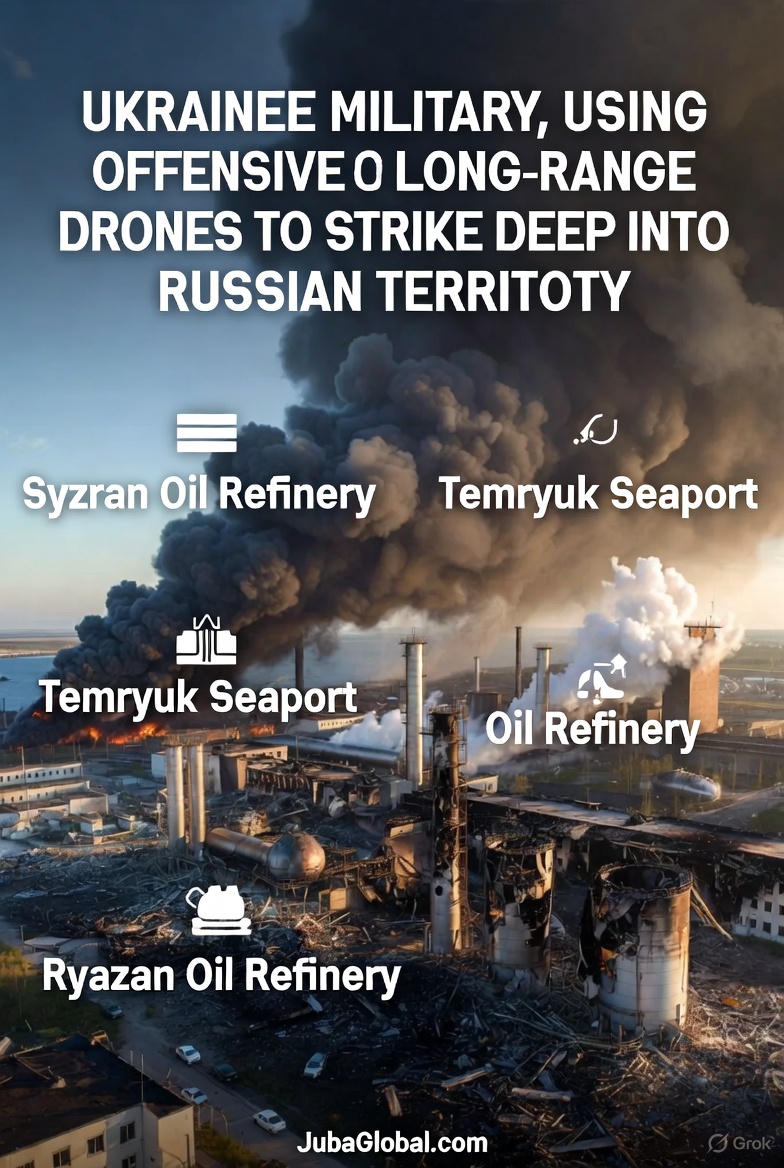
Syzran Oil Refinery (Samara Oblast): Operations at this key refinery, one of Russia’s biggest, were completely knocked out after repeated drone hits set fires that raged for hours. Satellite pictures show persistent heat spots, and early figures suggest output could be slashed by 20–30% for weeks.
Temryuk Seaport (Krasnodar Krai): Here, fuel tanks got blasted, sparking an intense blaze. The strike hit a crucial hub for both grain and oil exports, and even targeted ships from Russia’s sanction-busting shadow fleet.
Ryazan Oil Refinery (Ryazan Oblast): This facility got hit for the ninth time just in 2025. Distillation towers were damaged, and independent analysts point out that repeated attacks have already knocked out about 10% of Russia’s total refining ability so far this year.
Other targets included airbases for strategic aircraft, with blasts reported near Moscow itself. Russia’s Ministry of Defense said they shot down dozens of drones—but, well, the numbers from officials and what eyewitnesses saw just don’t quite line up. It’s clear a good chunk of drones got through. This latest operation is really the crescendo of a relentless campaign throughout 2025, with Ukraine logging more than 58 strikes on Russian energy infrastructure already. The combined impact? Fuel shortages across Russian cities, gas prices climbing, and a visible dip in oil exports by sea.
A Weapon Born of Necessity: Ukraine’s Drone Revolution
Ukraine’s expertise in long-range drone warfare didn’t just happen overnight; it came out of sheer necessity. With Western military aid swinging like a pendulum and American politics uncertain, Kyiv threw everything it had into building drones at home. Now, locally made drones dominate the battlefield, turned out in numbers by both state enterprises and scrappy private startups.
Their approach? Swarming—throwing huge numbers of cheap drones at a target to overwhelm even top-tier air defenses, with electronic jamming layered in for good measure. The logic is pretty clear. Russia’s economy is still shackled to hydrocarbon exports—those make up about 40% of the federal budget, even with sanctions biting. Hitting refineries and export points isn’t just military tactics; it directly saps the financial core of Moscow’s war machine, and, at the same time, stirs public frustration back in Russia as fuel becomes scarce and prices jump.
Moscow’s Response and the Escalation Cycle
Russia hit back right away, though its options were a bit limited. Air raid sirens blared through several regions, and President Vladimir Putin called an emergency Security Council meeting. State media called the strikes “terrorist acts,” and regional leaders tried to play down the scale of damage. Within hours, Russia unleashed its own barrages of missiles and drones at Ukrainian cities and infrastructure—just continuing the grim tit-for-tat that’s defined the conflict this winter.
Notably, Zelenskyy had proposed a kind of “energy ceasefire” to stop attacks on civilian grids and fuel sites. The Kremlin flatly rejected that, calling it a ploy—even as Ukraine pressed its refinery offensive.
Broader Implications: Leverage on the Negotiating Table
With U.S.-mediated talks ramping up and Zelenskyy pushing to hammer out a broad peace deal, the timing of this drone blitz is anything but accidental. Ukraine’s signaling that, no matter how fast diplomacy moves, it can keep ramping up the cost for Russia. For Kyiv, the message seems loud and clear: any deal has to reflect the new facts on the battlefield—not the frozen front lines of 2022 or 2023.
The attacks have already hit energy markets, with Brent crude futures jumping nearly 2% in early trading as traders braced for possible supply snags. More importantly, though, Ukraine’s shown it can punch above its weight—using ingenuity and grit to carve out unexpected leverage.
In the end, what happened on December 10, 2025, is way more than just a single, dramatic night of blasts over Russian territory. It’s a statement—Ukraine, no matter the hardship, has morphed into a modern military force that can strike deep, right where it hurts. Whether this latest escalation nudges both sides closer to real talks or just drags out the bloody stalemate, well, that’s still up in the air. But one thing’s certain: the skies over Russia won’t ever feel quite as safe again.
