

U.S. Seizure of the Skipper Oil Tanker: Escalation in the Venezuela Sanctions Saga
Introduction On December 10, 2025, a dramatic confrontation unfolded in the waters off Venezuela’s coast, marking a bold escalation in the long-stand
Introduction
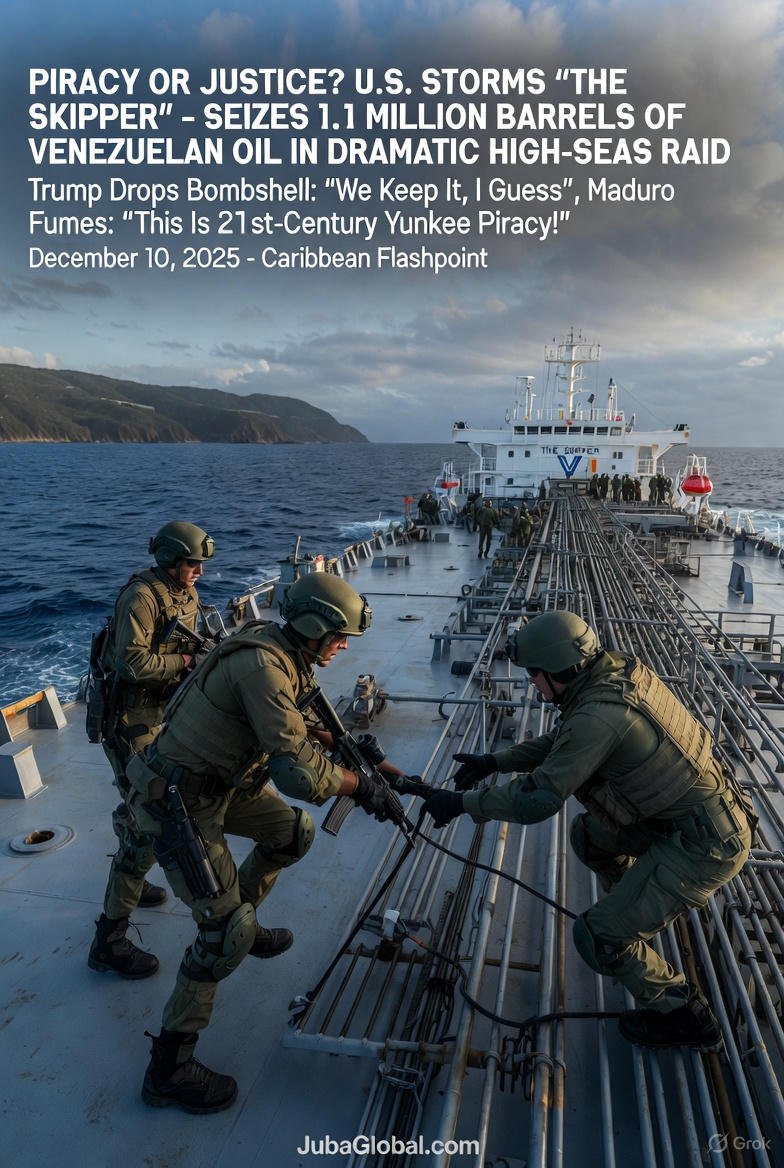
On December 10, 2025, a dramatic confrontation unfolded in the waters off Venezuela’s coast, marking a bold escalation in the long-standing U.S. campaign against President Nicolás Maduro’s regime. U.S. forces, in a meticulously coordinated operation, boarded and seized a 20-year-old very large crude carrier (VLCC) named The Skipper, laden with approximately 1.1 million barrels of Venezuelan heavy crude oil. The tanker, flagged under Guyana but previously sanctioned by the U.S. Treasury Department, was intercepted shortly after departing Venezuela’s primary oil export terminal at Puerto José.
The operation, confirmed by President Donald Trump during a White House roundtable, has ignited a firestorm of international condemnation from Caracas, which branded the action a “shameless robbery and an act of international piracy.” This incident not only underscores the intensifying U.S.-Venezuela tensions but also highlights the intricate web of global sanctions evasion involving shadow fleets, illicit oil trade, and alleged ties to terrorist networks. As oil prices surged in response—Brent crude futures climbing over 2% in early trading—the seizure raises profound questions about maritime law, economic warfare, and the potential for broader conflict in the Western Hemisphere. 3 4 5
Background: A History of Sanctions and Shadow Fleets
Venezuela, home to the world’s largest proven oil reserves—estimated at over 300 billion barrels—has long been a geopolitical flashpoint. Under Maduro’s leadership since 2013, the country has grappled with hyperinflation, widespread shortages, and a humanitarian crisis that has driven millions to flee. The U.S. response has evolved from diplomatic isolation to crippling economic sanctions, first imposed in 2017 and intensified under the Trump administration. These measures target Petróleos de Venezuela S.A. (PDVSA), the state-owned oil giant, aiming to choke off the regime’s primary revenue stream and force political change.
To circumvent these restrictions, Venezuela has relied on a clandestine network of “shadow tankers”—vessels that disable their automatic identification systems (AIS), falsify locations, or conduct ship-to-ship transfers at sea. This dark fleet often intersects with similar evasion tactics employed by Iran, another U.S. adversary. The Skipper, originally launched in 2005 as The Toyo and later renamed Adisa, exemplifies this shadowy ecosystem. Sanctioned by the U.S. in 2022, it was accused of ferrying Iranian crude on behalf of the Islamic Revolutionary Guard Corps (IRGC) and Hezbollah, the Lebanon-based militant group designated as a terrorist organization by Washington. 6 10
Tracking data from firms like TankerTrackers.com and Kpler reveals The Skipper‘s recent movements: It loaded its cargo of Merey heavy crude at Puerto José between December 4 and 5, 2025, before vanishing from commercial radar—likely with AIS turned off. Analysts believe the tanker was en route to Cuba, where state importer Cubametales planned to broker the oil onward to Asian buyers, a common route for sanctioned Venezuelan exports. Roughly half of the cargo was reportedly earmarked for Cuban energy needs, exacerbating the island’s chronic blackouts amid its own economic woes. 8 9
This seizure occurs against a backdrop of heightened U.S. military posturing in the Caribbean. Since late 2025, the Trump administration has deployed over 15,000 troops, a dozen warships—including the aircraft carrier USS Gerald R. Ford—and conducted airstrikes on suspected drug-running vessels. Officially framed as counter-narcotics operations, critics argue these moves signal preparation for regime change, echoing Trump’s past rhetoric about liberating Venezuela from “socialist disaster.” 4 13
The Seizure Operation: A High-Seas Raid
The interdiction of The Skipper commenced at approximately 6 a.m. local time on December 10, in international waters northeast of Caracas. Launched from the USS Gerald R. Ford, the operation involved two MH-60 Seahawk helicopters, elite personnel from the Coast Guard’s Maritime Security and Response Team (MSRT), 10 Marines, and special operations forces. Video footage released by Attorney General Pam Bondi—depicting armed boarders fast-roping onto the tanker’s deck—captured the precision of the raid, which proceeded without resistance or casualties. 10 11
Bondi, in a statement posted to X (formerly Twitter), emphasized the legal foundation: “Today, the Federal Bureau of Investigation, Homeland Security Investigations, and the United States Coast Guard, with support from the Department of Defense, executed a seizure warrant for a crude oil tanker used to transport sanctioned oil from Venezuela and Iran.” 20 The warrant stemmed from violations of U.S. sanctions under the International Emergency Economic Powers Act, targeting the vessel’s role in an “illicit oil shipping network supporting foreign terrorist organizations.” The Skipper was registered to Triton Navigation, a Marshall Islands-based entity previously flagged by the Treasury for facilitating Iranian oil smuggling. 8
Guyana’s government swiftly disavowed any connection, stating the tanker falsely flew its flag despite lacking registration—a common ploy in the shadow fleet to evade scrutiny. 10 The crew, numbering around 25 (primarily from India and the Philippines, per maritime records), was detained for questioning but reported no injuries. The vessel, measuring 333 meters in length and capable of holding 2 million barrels at full capacity, now sits under U.S. control, its cargo impounded pending forfeiture proceedings.
Venezuela’s Fiery Rebuttal: “International Piracy”
Caracas wasted no time in decrying the seizure. In an official statement released hours after Trump’s announcement, the Venezuelan Foreign Ministry “strongly denounces and repudiates what constitutes a shameless robbery and an act of international piracy.” 14 15 The communiqué pierced the veil of U.S. justifications, asserting that the true motive was not counter-terrorism but “a deliberate plan to plunder our energy resources.” It continued: “It’s not migration. It’s not drug trafficking. It’s not democracy. It’s not human rights. It was always about our natural wealth, our oil, our energy, the resources that belong exclusively to the Venezuelan people.”
Maduro himself, addressing a rally in Caracas commemorating the 19th-century Battle of Santa Inés, sidestepped direct mention of the incident but issued a veiled threat: Venezuela stands “prepared to break the teeth of the North American empire if necessary.” The government vowed to haul the matter before international forums, including the United Nations and the International Maritime Organization, accusing Washington of violating the United Nations Convention on the Law of the Sea (UNCLOS). Venezuelan officials framed the raid as an imperial overreach, likening it to historical U.S. interventions in Latin America and warning of retaliatory measures against American assets. 16 17
Allies like Russia and Iran echoed the outrage. Moscow’s Foreign Ministry called the seizure “economic banditry,” while Tehran decried it as evidence of “U.S. hegemony in global energy markets.” Cuba, the apparent intended recipient, remained mum, though the loss exacerbates its fuel crisis, with rolling blackouts already plaguing the nation. 9
Trump’s Remarks: “We Keep It, I Guess”
President Trump broke the news casually during a Roosevelt Room discussion on economic policy, injecting his signature bravado into the revelation. “As you probably know, we’ve just seized a tanker on the coast of Venezuela—a large tanker, very large, the largest one ever seized actually,” he declared, pausing for effect before adding, “and other things are happening.” 23 25 Pressed for details on ownership or destination, Trump demurred: “It was seized for a very good reason.” When a reporter inquired about the fate of the oil cargo, his response was quintessentially off-the-cuff: “Well, we keep it, I guess.”
Later, in an exchange with CNN’s Kristen Holmes, Trump dismissed recent contact with Maduro and hinted at forthcoming disclosures. His comments, while light on specifics, aligned with the administration’s broader narrative of maximum pressure. Trump has repeatedly labeled Maduro’s ouster as imminent, tying the seizure to a multifaceted strategy encompassing sanctions, military deterrence, and covert actions. “His days are numbered,” Trump remarked in a recent interview, refusing to rule out ground troops—a prospect that has alarmed regional partners like Brazil and Colombia. 28 31
Broader Implications: Oil Markets, Alliances, and Geopolitical Ripples
The seizure’s immediate economic ripple was felt in global energy markets. With The Skipper‘s cargo representing a modest but symbolically potent slice of Venezuela’s 700,000 barrels-per-day exports (down from 2.5 million pre-sanctions), traders fretted over supply disruptions. Heavy crude benchmarks like Western Canadian Select rose sharply, benefiting U.S. Gulf Coast refiners while pressuring Asian importers reliant on discounted Venezuelan grades routed via Cuba or Malaysia. 3 5
Geopolitically, the move strains hemispheric relations. The Biden-era thaw in U.S.-Venezuela ties—eased sanctions in exchange for electoral concessions—has evaporated under Trump’s return, reviving “Operation Liberty Hawk,” a classified contingency for Maduro’s removal. Democratic critics, including Sen. Chris Van Hollen (D-Md.), lambasted the action as a “big lie” masking regime-change ambitions, while Republicans hailed it as a strike against “narco-terrorists.” 6 32
For Venezuela, the hit is acute: Oil accounts for 95% of export revenues, funding everything from social programs to military loyalty. Further seizures, as hinted by U.S. officials, could accelerate PDVSA’s collapse, potentially sparking unrest or migration surges. Yet Maduro’s resilience—bolstered by Chinese loans and Russian arms—suggests no easy capitulation.
On X, reactions ranged from Venezuelan expatriates celebrating the blow to Maduro to conspiracy theorists decrying U.S. “oil theft.” One post from maritime analyst @WorldWarAgain succinctly captured the stakes: “Venezuela condemns seizure… alleged Iran-linked vessel… under sanction for ties to Hezbollah.” 2
Conclusion: Navigating the Tempest
The seizure of The Skipper is more than a tactical interdiction; it is a gauntlet thrown into the churning waters of U.S.-Latin American relations. By framing the operation as a bulwark against terrorism, the Trump administration justifies its muscular approach, but Venezuela’s “piracy” charge resonates in a region scarred by Yankee interventions. As Maduro vows defiance and Trump teases “other things,” the Caribbean teeters on the edge of crisis.
Will this spark diplomatic breakthroughs, economic freefalls, or something more volatile? History cautions against underestimating the volatility of oil-fueled geopolitics. For now, the Skipper drifts under stars and stripes, a floating testament to clashing visions of sovereignty and power. International observers urge de-escalation, but in this high-stakes game, the next move could reshape the hemisphere for decades.
