

U.S. Coast Guard Sinks Suspected Drug-Smuggling Vessel in Eastern Pacific: Two Dead, One Survivor in Lethal Interdiction Amid Escalating Trump-Era Maritime Crackdown
By Juba Global News Network Staff JubaGlobal.com February 15, 2026 – Juba, South Sudan In the pre-dawn darkness of February 11, 2026, approximately 320 nau
By Juba Global News Network Staff
JubaGlobal.com
February 15, 2026 – Juba, South Sudan
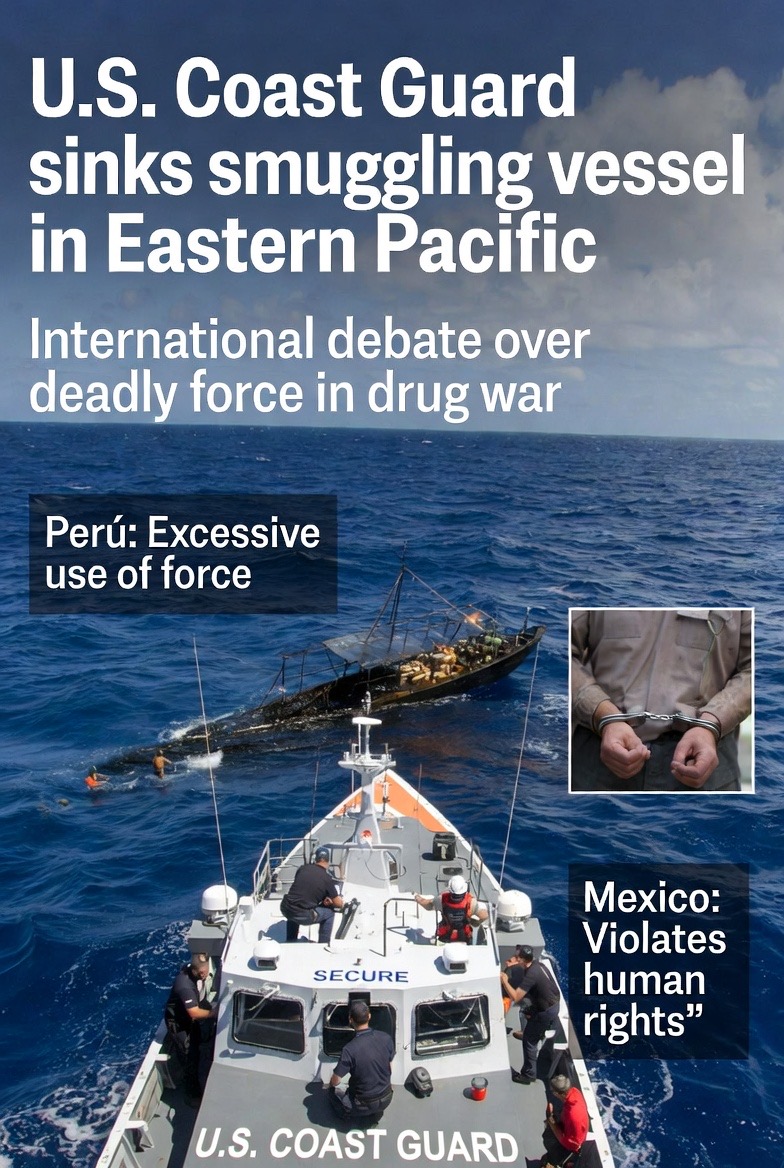
In the pre-dawn darkness of February 11, 2026, approximately 320 nautical miles southwest of Acapulco, Mexico, a U.S. Coast Guard cutter opened fire on a fast-moving 40-foot panga-style vessel suspected of drug smuggling. The engagement ended with the small open-hull boat sinking within minutes, two individuals dead, and one survivor recovered from the water. The incident — confirmed by U.S. Southern Command (SOUTHCOM) late on February 12 — marks the most lethal outcome yet in a dramatic escalation of maritime interdiction operations under the second Trump administration and has reignited fierce debate over the use of deadly force in drug-enforcement actions on the high seas.
Official U.S. Account of the Incident
According to SOUTHCOM’s public statement and follow-up briefings provided to select media:
- At approximately 03:17 local time (Eastern Pacific Time), the crew of the USCGC Active (a 378-foot Hamilton-class high-endurance cutter) detected the panga traveling at high speed on a northerly course in international waters.
- The vessel failed to respond to repeated radio hails, visual signals (flares, searchlights), and bridge-to-bridge commands to stop.
- As the cutter closed distance for a boarding, personnel on the panga were observed jettisoning multiple large bales (presumed to be cocaine or other contraband).
- The suspect vessel then executed what SOUTHCOM described as “an aggressive and threatening maneuver” directly toward the cutter.
- Warning shots were fired across the bow; when the panga continued its approach, the cutter’s crew engaged with .50-caliber machine-gun fire aimed at the vessel’s hull and engine compartment.
- The panga rapidly took on water and sank. USCG boarding teams recovered one survivor suffering from hypothermia and minor gunshot wounds; two bodies were located in the water but could not be retrieved due to deteriorating sea state and safety concerns for the rescue swimmers.
- No U.S. personnel were injured. The survivor was medically stabilized aboard the cutter and transferred to federal custody for prosecution.
SOUTHCOM emphasized that the use of force was authorized under the right of self-defense (both inherent and under international maritime law) after the vessel demonstrated hostile intent. The command declined to release the nationality of the deceased or survivor pending identification and consular notification.
Broader Context: The Eastern Pacific Transit Zone
The incident occurred in the heart of the Eastern Pacific maritime corridor — one of the primary routes for cocaine and other narcotics moving from Colombia, Ecuador, and Mexico toward the United States. According to the U.S. Drug Enforcement Administration (DEA) and Joint Interagency Task Force South (JIATF-S), approximately 80–85% of the cocaine entering the U.S. transits this zone aboard pangas, low-profile semi-submersibles, fishing vessels, and increasingly containerized shipments.
Since President Trump’s January 20, 2026 inauguration, maritime interdiction operations have intensified significantly:
- The Eastern Pacific has been re-designated a “transit zone priority” in the new National Defense Strategy implementation guidance.
- Rules of engagement have been adjusted to allow lethal force when vessels demonstrate clear hostile intent toward U.S. units (a change from the more restrained posture of the previous administration).
- Armed MQ-9 Reaper drones now provide persistent wide-area surveillance and target identification.
- Bilateral ship-rider agreements with Colombia, Ecuador, Panama, and Costa Rica have been expanded, allowing U.S. law-enforcement personnel to board and search partner-nation-flagged vessels.
- U.S. Coast Guard cutter deployments in the region increased by ≈40% in the first month of the new term.
Admiral Craig Faller (ret.), former SOUTHCOM commander, commented in a recent interview: “This administration is sending an unmistakable message: the days of observing smugglers dump bales and sail away are over. When vessels endanger U.S. personnel or demonstrate hostile intent, commanders now have clearer authority to end the threat decisively.”
Human-Rights and Legal Controversy
The lethal outcome has drawn immediate criticism from human-rights organizations and several Latin American governments.
Human Rights Watch issued a statement calling for an independent investigation:
“Even in international waters, the use of lethal force against suspected smugglers must be strictly necessary and proportionate. The reported facts — a small open-hull vessel allegedly maneuvering toward a heavily armed cutter — raise serious questions about whether less-lethal options (such as disabling fire aimed solely at engines) were exhausted before deadly force was employed.”
Colombia’s Foreign Ministry expressed “profound concern” over the loss of life and requested consular access if any of the deceased or survivor are confirmed Colombian nationals. Mexico has remained publicly silent, though informal sources in Mexico City indicate irritation over the operation occurring relatively close to its exclusive economic zone.
Legal scholars are divided. Proponents of the action argue it falls squarely within the right of self-defense under Article 51 of the UN Charter and customary maritime law (the “right of approach” and “right of visit” in international waters). Critics contend that the threat posed by a small fiberglass panga — even one executing an aggressive maneuver — may not have risen to the level justifying lethal force, particularly when non-lethal options were potentially available.
Strategic and Political Implications
The incident underscores several broader trends under the current U.S. administration:
- Linkage to national-security priorities — Senior officials have repeatedly tied the drug trade to homeland-security threats, citing fentanyl overdoses (over 72,000 U.S. deaths in 2025) and the financing of armed groups that destabilize partner nations.
- Escalation of force posture — The willingness to use lethal force in interdictions represents a sharp departure from the more restraint-oriented approach of 2021–2025.
- Diplomatic ripple effects — Several Latin American governments have privately expressed unease over the risk of escalation and civilian casualties in international waters.
The survivor is expected to face federal charges in a U.S. district court — likely conspiracy to distribute controlled substances, maritime drug trafficking, and related offenses. SOUTHCOM has promised a full after-action review, though such reviews are rarely released in unredacted form.
Outlook: A New, More Lethal Phase?
For now, the Eastern Pacific remains a high-threat operating environment. U.S. Coast Guard and Navy units continue daily patrols, supported by allied maritime forces and persistent overhead surveillance. Whether this incident proves to be an isolated escalation or the opening of a new, more lethal chapter in the drug-interdiction mission remains uncertain.
Human-rights advocates and regional governments are calling for greater transparency and restraint; U.S. officials insist the operation was lawful and necessary to protect personnel and disrupt trafficking networks.
Juba Global News Network will continue monitoring developments in the Eastern Pacific interdiction campaign, the legal aftermath of this incident, and its diplomatic ripples across the Americas, providing balanced coverage from our vantage point in East Africa.
