Netanyahu-Trump Summit Ends with Dramatic U.S. Policy Shift: America Open to Recognizing Israeli Sovereignty Over Major West Bank Settlement Blocs
By Juba Global News Network Staff
JubaGlobal.com
February 15, 2026 – Juba, South Sudan
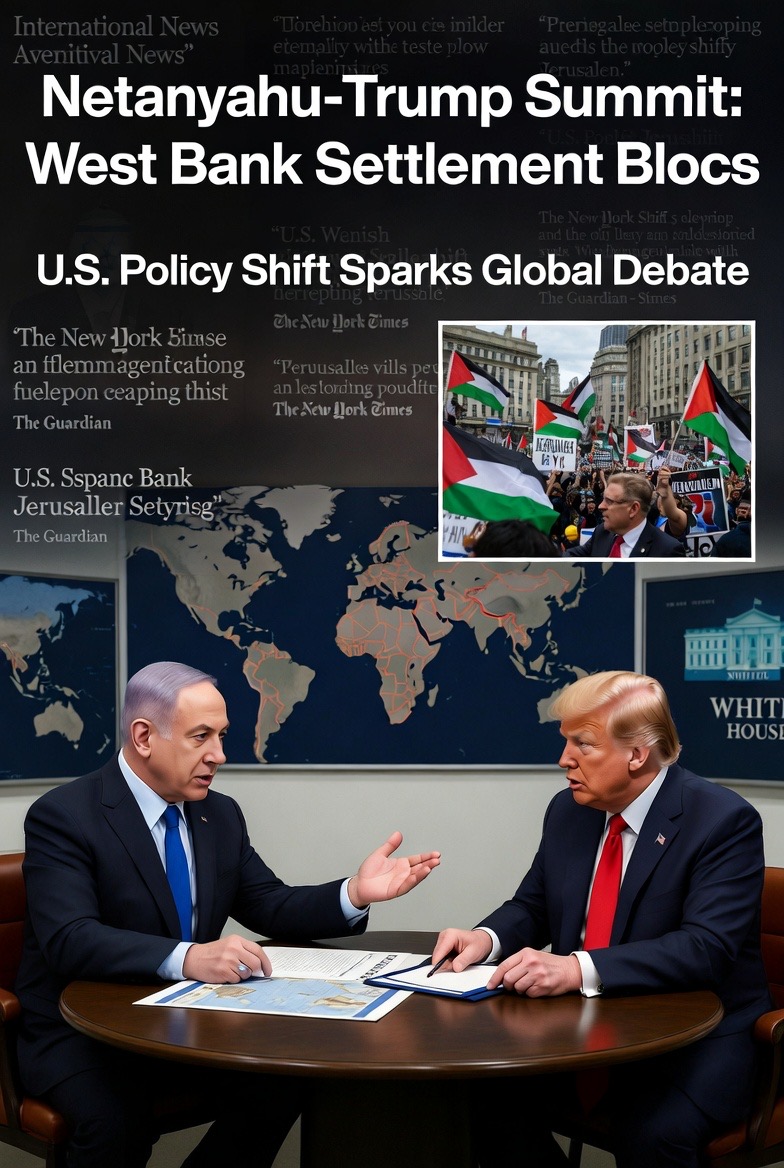
The four-hour White House meeting between Israeli Prime Minister Benjamin Netanyahu and U.S. President Donald Trump on February 13, 2026, concluded with one of the most consequential realignments in American policy toward the Israeli-Palestinian conflict in a generation. While the official joint statement released afterward used measured diplomatic language, senior Israeli officials quickly briefed reporters that President Trump had explicitly expressed readiness — subject to future negotiations — to recognize the major Israeli settlement blocs in the West Bank (Judea and Samaria) as sovereign Israeli territory as part of any permanent-status agreement.
The reported position, if formally adopted, would effectively overturn more than five decades of U.S. policy that has treated Israeli settlements beyond the 1967 lines as illegitimate under international law and an obstacle to a negotiated two-state solution. It also marks a sharp departure from the Obama and Biden administrations’ insistence that final borders must be based on the 1967 lines with mutually agreed land swaps.
Core Elements of the Joint Statement and Off-the-Record Readouts
The public readout from the White House and the Israeli Prime Minister’s Office included the following headline commitments:
- West Bank settlements
The United States “will give serious consideration to recognizing major Israeli population centers in Judea and Samaria as part of the State of Israel” within the framework of a negotiated agreement that ensures Israeli security and provides Palestinians with dignity and economic opportunity. No timetable was announced, but Israeli officials indicated movement could occur before the end of 2026 if certain benchmarks are met. - Gaza reconstruction mechanism
A new U.S.-led international fund and governance structure will be created to finance rebuilding Gaza. Funding and implementation are conditioned on:
(a) complete dismantlement of Hamas’s military capabilities,
(b) permanent removal of Hamas political leadership from Gaza, and
(c) establishment of a technocratic Palestinian administration acceptable to Israel and the United States. - Iran policy reaffirmation
Both leaders reiterated “maximum pressure” on Iran’s nuclear and ballistic-missile programs, with Trump reportedly telling Netanyahu that “all options remain on the table.” New sanctions targeting IRGC-linked shipping networks are expected in the coming weeks. - Abraham Accords expansion
Discussions focused on accelerating normalization with Saudi Arabia, potentially linked to a U.S. bilateral security guarantee for Riyadh and limited Palestinian concessions short of full statehood. - U.S. diplomatic presence
Trump directed the State Department to prepare plans for opening a consular section in East Jerusalem to serve Palestinians, while keeping the main embassy in West Jerusalem.
Off-the-record Israeli briefings were far more explicit. One senior official close to Netanyahu told international media:
“The president made it very clear: the major blocs — Ma’ale Adumim, Ariel, Gush Etzion, Kiryat Arba, Modi’in Illit — are not bargaining chips. They are permanent parts of Israel. No future Israeli government can evacuate 400,000–500,000 citizens from these communities and survive. Trump understands that reality.”
U.S. officials speaking on background confirmed the president’s openness but emphasized that recognition would only occur “as part of a broader, sustainable agreement” and not as a unilateral act.
Immediate Domestic and Regional Reactions
Inside Israel
The settler movement and right-wing coalition partners celebrated the reported shift as historic vindication. Yesha Council chairman Israel Ganz stated: “After decades of being treated as temporary trespassers in our own land, the leader of the free world has finally acknowledged the facts on the ground.” Opposition leader Yair Lapid warned that any U.S. recognition without Palestinian agreement would “ignite the West Bank, destroy Israel’s international standing, and make a two-state solution impossible for a generation.”
Palestinian Authority
President Mahmoud Abbas issued a strongly worded statement rejecting “any attempt to legitimize colonial settlements” and announced a temporary suspension of security coordination with Israel (largely symbolic given existing strains). Hamas called the U.S. position “a declaration of war on the Palestinian people and their rights.”
Gulf States
Saudi Arabia and the UAE have remained publicly silent but privately conveyed to Washington that formal recognition of settlement blocs would make Saudi normalization politically untenable in the near term. Behind-the-scenes talks now reportedly focus on a more limited “economic peace” package for Palestinians rather than statehood.
Iran and Axis of Resistance
Tehran framed the summit as proof of “U.S.–Zionist collusion against the resistance axis.” Hezbollah, the Houthis, and Iraqi militias issued statements raising readiness levels, though no immediate military escalation has occurred.
European Union & United Nations
The EU External Action Service reiterated that the bloc “does not recognize Israeli sovereignty over territories occupied in 1967” and will continue labeling settlement products accordingly. UN Secretary-General António Guterres expressed “deep concern” over any unilateral moves that prejudge final-status issues.
Legal and Diplomatic Consequences
If the United States formally recognizes Israeli sovereignty over the major settlement blocs:
- It would reverse 50 years of U.S. policy rooted in UN Security Council Resolution 242 and subsequent agreements.
- It would likely trigger (ultimately unsuccessful) snapback attempts at the UN Security Council, blocked by the U.S. veto.
- It would accelerate EU sanctions on settlement products and possible ICC action.
- It could embolden Israel to advance domestic annexation legislation for Area C (60% of the West Bank), although Netanyahu has repeatedly stated he prefers U.S. coordination before any unilateral step.
Outlook: Diplomacy, Deadlock, or Escalation?
The Netanyahu–Trump meeting has dramatically narrowed the space for a traditional two-state solution based on the 1967 lines while opening the door to alternative models: confederation, autonomy-plus-economic incentives, or managed conflict with partial recognition of facts on the ground.
The immediate diplomatic test will be whether Saudi Arabia is willing to advance normalization despite the reported U.S. position on settlements — or whether Riyadh insists on a firm Palestinian statehood commitment as the price of a deal. For now, the most likely near-term outcome is continued indirect talks, incremental confidence-building measures, and heightened risk of violence in the West Bank if Palestinian hopes for statehood continue to recede.
Juba Global News Network will continue to track developments in Washington, Jerusalem, Ramallah, Riyadh, and Tehran as the Israeli–Palestinian file enters what may prove to be its most consequential — and dangerous — phase in decades.