

Trump Weighs Pakistan’s Request for Two-Week Extension on Iran Deadline as Islamabad Emerges as Key Mediator
By Juba Global News Network | JubaGlobal.com Published: April 8, 2026 In a pivotal diplomatic maneuver that helped avert immediate escalation, President Do
By Juba Global News Network | JubaGlobal.com
Published: April 8, 2026
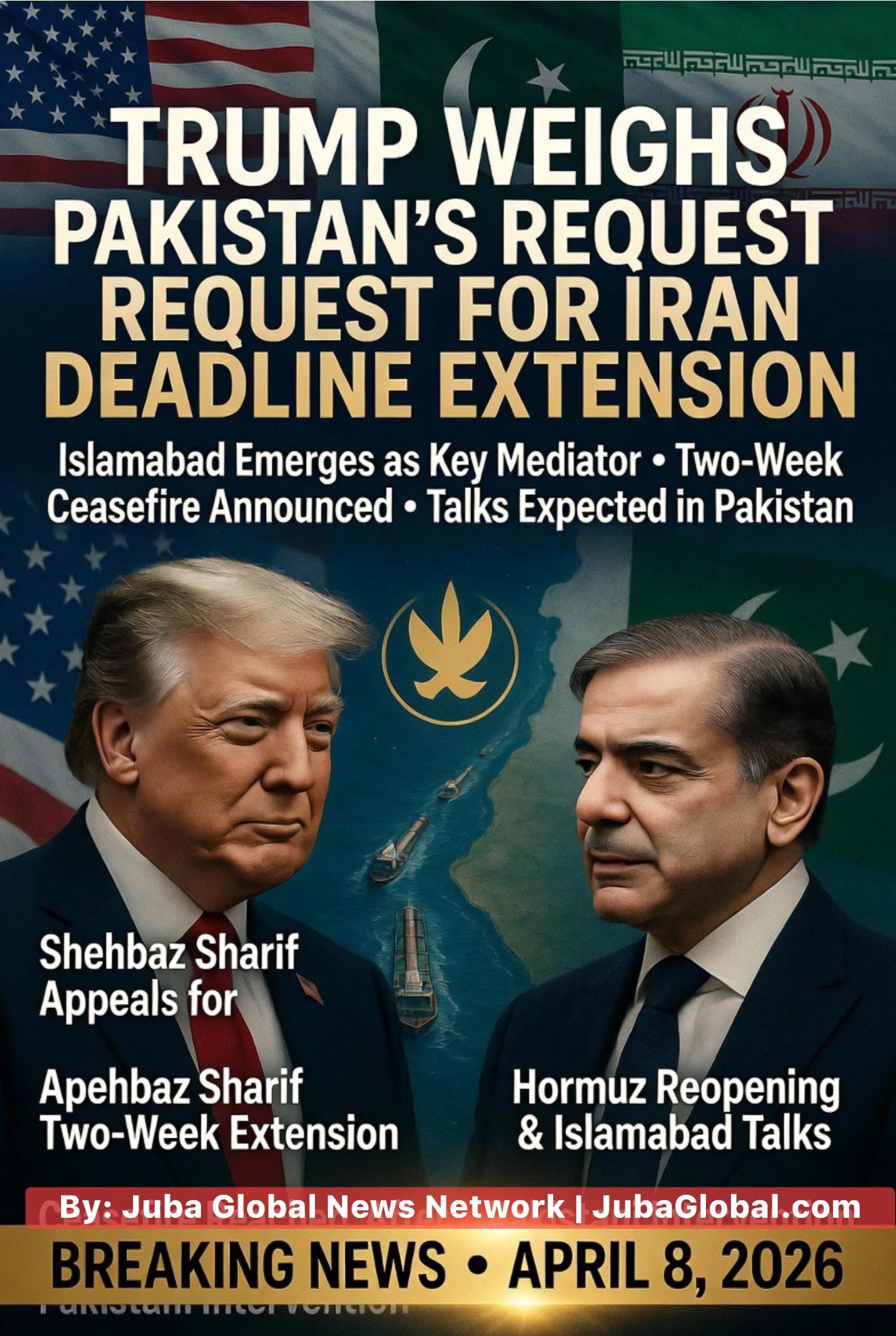
In a pivotal diplomatic maneuver that helped avert immediate escalation, President Donald Trump is actively weighing a formal request from Pakistan to extend his self-imposed deadline for Iran by two weeks. The plea, delivered publicly and through back channels by Pakistani Prime Minister Shehbaz Sharif and supported by Field Marshal Asim Munir, played a crucial role in the surprise announcement of a conditional two-week ceasefire late on April 7, 2026.
The extension request came as the clock ticked toward Trump’s 8 p.m. ET deadline on Tuesday, after which the US president had threatened severe strikes on Iranian infrastructure, including power plants and bridges. Pakistan’s intervention provided a timely off-ramp, leading Trump to announce a “double-sided ceasefire” conditional on Iran allowing the complete, immediate, and safe reopening of the Strait of Hormuz.
Pakistan’s 11th-Hour Plea
On Tuesday, Prime Minister Shehbaz Sharif took to X (formerly Twitter) with a direct appeal:
“To allow diplomacy to run its course, I earnestly request President Trump to extend the deadline for two weeks. Pakistan, in all sincerity, requests the Iranian brothers to open the Strait of Hormuz for a corresponding period of two weeks as a goodwill gesture. We also urge all warring parties to observe a ceasefire everywhere for two weeks to allow diplomacy to achieve conclusive termination of war, in the interest of long-term peace and stability in the region.”
The statement reflected Islamabad’s delicate balancing act: maintaining close ties with both Washington and Tehran while leveraging its geographic proximity to Iran and its strategic partnership with the United States and Gulf states.
White House officials confirmed that Trump was “aware” of the Pakistani proposal and described the negotiations as “heated” in the final hours. In his announcement on Truth Social, Trump explicitly credited conversations with Prime Minister Sharif and Field Marshal Munir for his decision to suspend planned strikes for two weeks, subject to Iran’s compliance on Hormuz.
Pakistan’s Growing Role as Mediator
Pakistan has positioned itself aggressively as a neutral facilitator in the US-Iran conflict over recent weeks. Islamabad has offered to host direct talks between the two sides, with preliminary indications that negotiations could begin as early as Friday in the Pakistani capital.
Analysts point to several factors behind Pakistan’s emergence as mediator:
• Geographic and Historical Ties: Sharing a long border with Iran, Pakistan has deep cultural, religious, and economic links with its western neighbor.
• Relations with the US: Longstanding military and intelligence cooperation, including during the post-9/11 era, gives Islamabad credibility in Washington.
• Balancing Act with Gulf Allies: While close to Saudi Arabia and other Gulf states affected by Hormuz disruptions, Pakistan has avoided alienating Tehran.
• Domestic and Strategic Interests: A wider war involving Iran could send millions of refugees toward Pakistan and destabilize the region further, threatening CPEC (China-Pakistan Economic Corridor) projects and internal security.
Iran’s Foreign Minister Abbas Araghchi has publicly thanked Pakistan for its efforts and stated that Tehran has “never refused to go to Islamabad,” signaling openness to talks hosted there. However, Iran continues to emphasize that any dialogue must aim for a “conclusive and lasting end” to hostilities.
The Ceasefire Framework and Next Steps
The two-week truce, now in effect, includes:
• Suspension of US and Israeli strikes on Iranian territory.
• Iran’s commitment to reopen the Strait of Hormuz for safe commercial shipping.
• Planned direct US-Iran negotiations in Islamabad.
Trump has described Iran’s earlier 10-point proposal as offering a “workable basis” for longer-term discussions. Key sticking points likely to dominate talks include Iran’s nuclear program, its support for regional proxies such as Hezbollah, potential transit fees on Hormuz shipping, and security guarantees for all parties.
Pakistani officials have expressed confidence that hosting the talks will give diplomacy the best chance of success. Security sources in Islamabad indicate that messages continue to be exchanged through Pakistani channels, with Tehran showing some flexibility while maintaining firm positions on core demands.
Challenges and Risks Ahead
Despite the positive momentum, significant hurdles remain:
• Scope of the Truce: Israeli operations in southern Lebanon appear to continue, raising questions about whether the ceasefire fully covers all fronts.
• Implementation Details: How quickly and under what conditions Hormuz shipping will resume, including any toll mechanisms proposed by Iran.
• Verification: Both sides will need credible mechanisms to monitor compliance during the two-week window.
• Domestic Pressures: Hardliners in Tehran and Washington may resist concessions, while Gulf states watch nervously for any signs of renewed disruption.
Oil markets have already reacted positively to the news, with prices plunging as fears of prolonged blockade ease. However, analysts warn that any violation or breakdown in Islamabad talks could trigger a rapid rebound in volatility.
Broader Regional and Global Implications
Pakistan’s successful mediation push has earned cautious praise from multiple quarters. It demonstrates Islamabad’s ambition to play a larger role in regional diplomacy at a time when traditional mediators have faced setbacks.
For the United States, accepting Pakistan’s extension request allowed Trump to de-escalate without appearing weak, while keeping maximum pressure on Iran through the conditional nature of the deal.
For Iran, the pause provides breathing room and an opportunity to present its 10-point plan in a structured forum. For the global economy, successful reopening of Hormuz offers hope of stabilized energy supplies and lower fuel costs in the coming weeks.
Pope Leo XIV and other international figures have welcomed the development, urging all parties to use the two-week period for genuine dialogue rather than tactical maneuvering.
Outlook: A Fragile Window for Diplomacy
As preparations accelerate for talks in Islamabad, the coming days will test Pakistan’s diplomatic skills and the willingness of Washington and Tehran to compromise.
Juba Global News Network will continue to monitor developments closely from Islamabad, Washington, Tehran, and other key capitals. Whether Pakistan’s mediation can transform this temporary ceasefire into a lasting resolution remains one of the most critical questions in the evolving Middle East crisis.
