

Russia and China Veto UN Resolution on Protecting Hormuz Shipping Amid Fragile Ceasefire Hopes
By Juba Global News Network | JubaGlobal.com Published: April 8, 2026 In a significant diplomatic setback at the United Nations, Russia and China exercised
By Juba Global News Network | JubaGlobal.com
Published: April 8, 2026
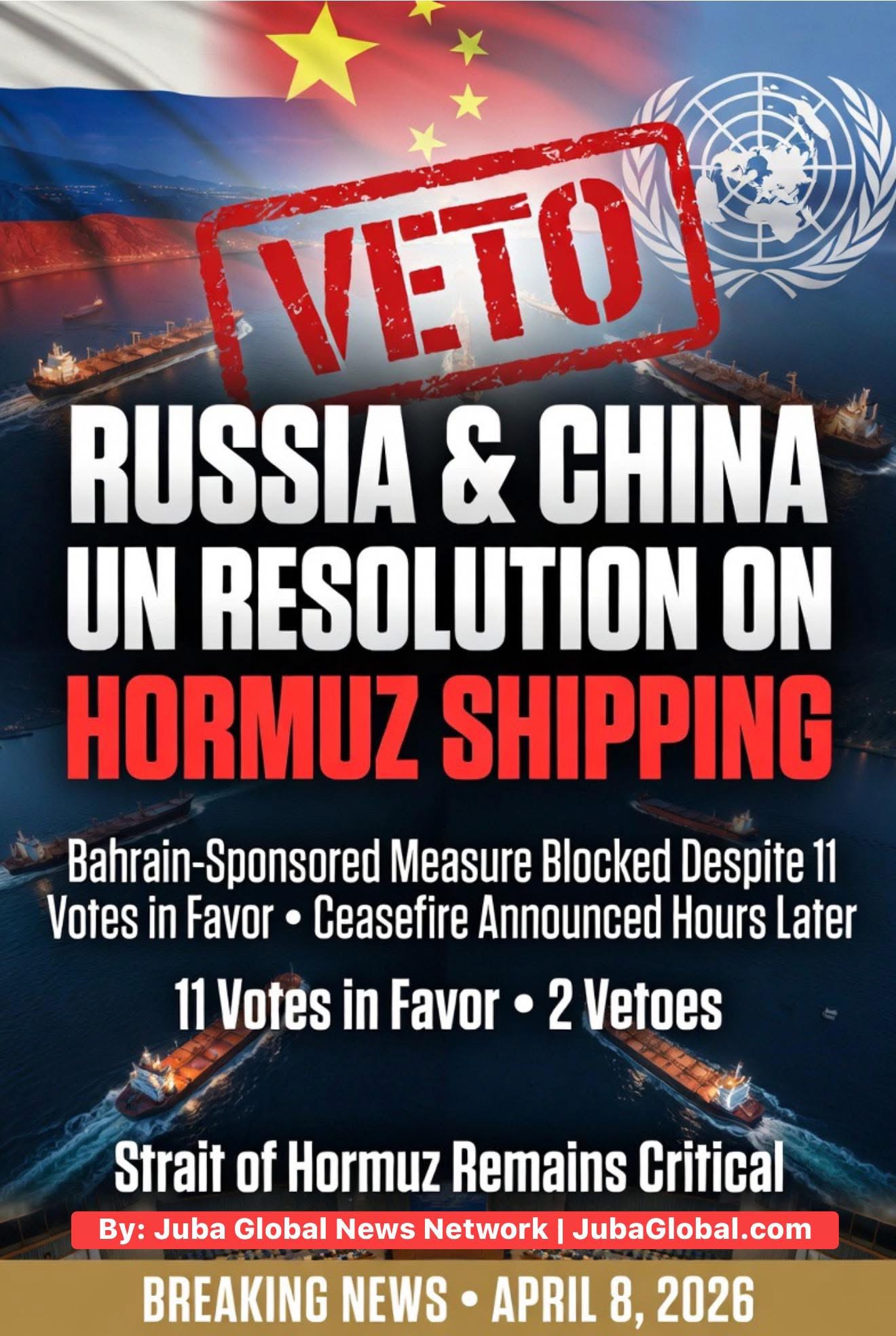
In a significant diplomatic setback at the United Nations, Russia and China exercised their veto power on Tuesday to block a Bahrain-sponsored UN Security Council resolution aimed at coordinating international efforts to protect and reopen commercial shipping through the Strait of Hormuz. The vote, which occurred just hours before US President Donald Trump’s self-imposed deadline for Iran, highlighted deep divisions among major powers even as news of a surprise two-week ceasefire between the US, Iran, and Israel emerged late on the same day.
The resolution received 11 votes in favor, with two against (Russia and China) and two abstentions (reportedly including Pakistan and Cambodia). Because Russia and China are permanent members of the Security Council with veto rights, the measure failed to pass despite strong support from the United States and several Gulf Arab states.
Background: A Watered-Down Text That Still Failed
The draft resolution, initially proposed by Bahrain and co-sponsored by other Gulf Cooperation Council members including Saudi Arabia, the UAE, Qatar, Kuwait, and Jordan, had undergone multiple rounds of negotiations and significant dilutions over the past two weeks. Early versions reportedly included language that would have given a clearer UN mandate for states to use force if necessary to unblock the vital waterway. However, objections from Russia, China, and even France forced negotiators to remove any authorization for military action, resulting in a much softer final text.
The final version merely “strongly encouraged” states interested in using commercial maritime routes in the Strait of Hormuz to coordinate efforts to protect shipping. It stopped short of condemning Iran directly or authorizing any coercive measures, yet Moscow and Beijing still viewed it as biased against Tehran.
China’s UN envoy Fu Cong stated that adopting the draft at a time when the United States was issuing strong threats against Iran would have sent “the wrong message” and could “add fuel to the fire.” Russia’s Ambassador Vassily Nebenzia described the text as granting “carte blanche for continued aggressive acts” against Iran and announced that Moscow and Beijing had prepared a counter-draft resolution.
US Ambassador to the UN Mike Waltz condemned the double veto, calling it “a new low.” He urged “responsible nations” to join the United States in securing the waterway, noting that Iran’s closure of the strait had disrupted not only oil supplies but also the delivery of humanitarian aid to crisis zones in Sudan, Congo, and Gaza.
Strategic Importance of the Strait of Hormuz
The Strait of Hormuz, a narrow waterway between Iran and Oman, is one of the world’s most critical maritime chokepoints. Approximately one-fifth of global oil production passes through it daily, along with significant volumes of liquefied natural gas. Iran’s decision to restrict shipping during the recent escalation caused oil prices to surge to multi-year highs, triggering inflationary pressures worldwide and raising fears of broader energy shortages.
Gulf states, heavily dependent on the strait for their own exports, pushed hard for the resolution as a way to internationalize pressure on Iran and potentially deter further disruptions.
Timing and the Ceasefire Breakthrough
The UN vote took place on Tuesday afternoon, mere hours before President Trump’s 8 p.m. Eastern Time deadline, after which he had threatened strikes on Iranian power plants and bridges. The failure of the resolution added to the tension, with many observers fearing an imminent escalation.
However, in a surprising late-night development, the United States, Iran, and Israel announced a two-week ceasefire agreement, with Iran committing to reopen the Strait of Hormuz for safe commercial shipping. Negotiations facilitated in part by Pakistan are set to begin soon in Islamabad.
Analysts note that the veto, while a clear diplomatic win for Iran and its partners, may now be overshadowed by the bilateral ceasefire. Still, the UN deadlock underscores the challenges of achieving a truly multilateral solution to the crisis.
Reactions from Key Players
• United States: Strongly criticized the veto and reiterated its commitment to freedom of navigation. Officials indicated that Washington would continue working with allies outside the UN framework if necessary.
• Gulf States: Expressed disappointment. Bahrain, as the main sponsor, emphasized that the resolution was a minimal step toward de-escalation and maritime security.
• Russia and China: Defended their positions by arguing that the text unfairly targeted Iran while ignoring the context of US and Israeli military actions. Both countries called for dialogue and restraint.
• Iran: Welcomed the veto as evidence of international support against what it described as “American aggression.” Tehran reiterated that any reopening of the strait would be managed under its sovereignty and could include appropriate fees or tolls.
• Pakistan: Reportedly abstained, maintaining its delicate balancing act as a potential mediator between the US and Iran.
Broader Implications
The veto highlights the ongoing geopolitical rift between Western-aligned nations and the Russia-China axis, particularly on issues involving Iran. It also raises questions about the effectiveness of the UN Security Council in addressing urgent maritime security crises when permanent members’ interests diverge.
With the ceasefire now in place, attention shifts to whether the two-week window will allow for meaningful progress in Islamabad. Key issues likely to arise include:
• Verification mechanisms for safe shipping through the strait
• The question of tolls or fees proposed by Iran
• Whether the truce extends to secondary fronts, such as Israeli operations against Hezbollah in Lebanon
• Long-term arrangements to prevent future closures of the waterway
Energy markets reacted positively to the ceasefire news, with oil prices plunging sharply on Wednesday as traders bet on resumed flows. However, analysts caution that any violation of the truce could quickly reverse those gains.
A Divided International Community
The Russian and Chinese veto serves as a reminder that, even in moments of potential de-escalation, deep divisions persist at the highest levels of global diplomacy. While the bilateral ceasefire offers a fragile path forward, the inability of the UN Security Council to reach consensus on protecting one of the world’s most important shipping lanes illustrates the limits of multilateral institutions in today’s polarized world.
Juba Global News Network will continue monitoring developments in New York, Tehran, Washington, and Islamabad as the two-week ceasefire period begins. The coming days will test whether this diplomatic opening can translate into lasting stability for the Strait of Hormuz and the wider Middle East.
