

Trump Warns Iran: ‘Time Is Running Out’ for Nuclear Deal as U.S. Military Buildup Intensifies in Gulf
President Donald Trump has issued a stark warning to Iran, declaring that “time is running out” for the Islamic Republic to negotiate a new nuclear deal or
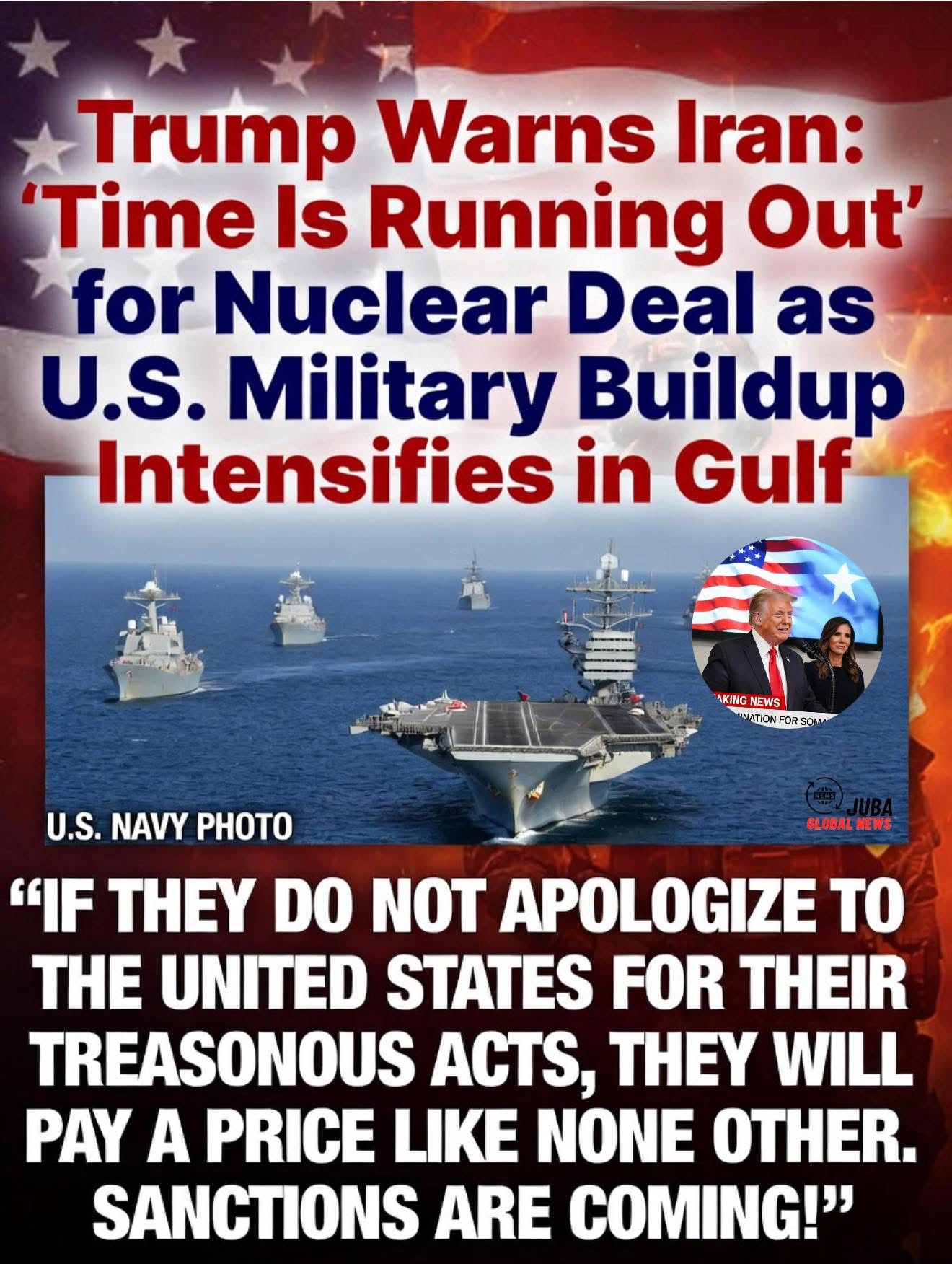
President Donald Trump has issued a stark warning to Iran, declaring that “time is running out” for the Islamic Republic to negotiate a new nuclear deal or face severe consequences, including the potential for military action far more devastating than previous U.S. strikes. This development, unfolding on January 28–29, 2026, marks a sharp escalation in U.S.-Iran tensions amid a significant American military buildup in the Persian Gulf region.
The Warning from the White House
In a lengthy post on Truth Social, President Trump urged Iran to “quickly ‘Come to the Table’” and negotiate “a fair and equitable deal — NO NUCLEAR WEAPONS — one that is good for all parties.” He emphasized that “time is running out, it is truly of the essence!”
Referencing a prior U.S. operation, Trump warned that any refusal to comply would lead to an attack “far worse” than the one Iran previously experienced. The president highlighted the deployment of a “massive armada” of U.S. naval forces heading toward the region, led by the USS Abraham Lincoln aircraft carrier strike group. He described these forces as “ready, willing, and able to rapidly fulfill [their] mission, with speed and violence, if necessary,” drawing a comparison to past U.S. naval operations, including those involving Venezuela.
This rhetoric represents a shift in focus from earlier statements tied to Iran’s domestic protests to a direct emphasis on preventing Tehran from acquiring nuclear weapons. Trump’s message revives his long-standing “maximum pressure” approach from his first term, when he withdrew the U.S. from the 2015 Joint Comprehensive Plan of Action (JCPOA) in 2018. That multilateral agreement, negotiated under President Obama, limited Iran’s nuclear activities in exchange for sanctions relief. Since the U.S. exit, Iran has significantly advanced its uranium enrichment program, installing advanced centrifuges and enriching uranium to near-weapons-grade levels, according to International Atomic Energy Agency (IAEA) reports.
Context of the Current Crisis
The latest confrontation builds on events from late 2025 and early 2026. In December 2025, widespread protests erupted across Iran over severe economic collapse, hyperinflation, and a plummeting rial. These demonstrations quickly evolved into calls for regime change, prompting a brutal crackdown by Iranian security forces that resulted in hundreds of deaths and arrests.
Initially, Trump’s administration framed potential U.S. intervention around protecting protesters, warning that harm to demonstrators could trigger military responses. However, by late January 2026, the narrative pivoted toward Iran’s nuclear ambitions. This change coincided with intelligence assessments suggesting Tehran might be accelerating efforts to rebuild or expand its nuclear infrastructure following the U.S.-Israeli strikes in June 2025.
That earlier operation, dubbed “Operation Midnight Hammer,” targeted key Iranian nuclear facilities at Fordow, Natanz, and Isfahan between June 13–24, 2025. Conducted jointly with Israel, it involved bunker-busting bombs and significantly degraded Iran’s enrichment capabilities—at least temporarily. Trump has repeatedly referenced this strike as proof of U.S. resolve, warning that any future action would be even more destructive.
The current military buildup is the largest U.S. deployment in the Middle East since those 2025 strikes. Assets include:
- The USS Abraham Lincoln carrier strike group,
- Additional warships and support vessels,
- Patriot and THAAD missile defense systems,
- F-15E Strike Eagle fighter jets.
These deployments serve both defensive and offensive purposes, aimed at deterring Iranian retaliation while positioning forces for potential preemptive or responsive strikes. U.S. Central Command (CENTCOM) has announced upcoming readiness exercises, further heightening regional alertness.
Iran’s Defiant Response
Tehran has rejected the threats outright, vowing a forceful and immediate counterstrike if attacked. Foreign Minister Abbas Araghchi stated that Iran’s armed forces are prepared “with their fingers on the trigger” to “immediately and powerfully respond” to any aggression by land, air, or sea. He referenced lessons from the 2025 “12-Day War” (the period encompassing Operation Midnight Hammer), asserting that Iran could now respond “even more strongly, rapidly, and profoundly.”
Other Iranian officials echoed this stance. Ali Shamkhani, an adviser to Supreme Leader Ayatollah Ali Khamenei, warned that any U.S. military action—even a “limited strike”—would be treated as the start of all-out war, with responses targeting “the heart of Tel Aviv” and supporters of the aggressor. Iran’s UN mission declared readiness for dialogue based on “mutual respect,” but insisted it would “defend itself and respond like never before” if pushed.
Despite the bellicose tone, some Iranian statements left a narrow door open for talks. Araghchi welcomed a “mutually beneficial, fair and equitable NUCLEAR DEAL — on equal footing, and free from coercion, threats, and intimidation,” mirroring Trump’s phrasing while insisting on no pressure or intimidation. However, no formal negotiations are currently underway, with exchanges limited to indirect messages.
Broader Implications and Regional Reactions
The standoff has sent shockwaves through global markets and alliances. Oil prices have surged due to fears of disruption in the Strait of Hormuz, a critical chokepoint for global energy supplies. Gulf states, including Saudi Arabia and the UAE, have quietly urged de-escalation while bolstering their own defenses.
European allies, including the UK under Prime Minister Keir Starmer, have expressed support for preventing Iran from acquiring nuclear weapons but emphasized diplomacy over confrontation. The shift risks isolating the U.S. if allies perceive the approach as overly aggressive.
Analysts warn of several scenarios:
- A negotiated breakthrough, though unlikely given mutual distrust.
- Limited U.S. strikes on nuclear or military targets to degrade capabilities further.
- Escalation into broader conflict, potentially involving Iranian proxies (Hezbollah, Houthis, Iraqi militias) attacking U.S. interests or allies.
- Unintended consequences, such as regime instability in Iran or a regional arms race.
As of January 29, 2026, the situation remains fluid and highly volatile. President Trump’s warning underscores a high-stakes gamble: use overwhelming military presence to force concessions without necessarily launching strikes. Yet with both sides digging in, the risk of miscalculation looms large in one of the world’s most combustible regions.
The coming days will test whether diplomacy can prevail or if the rhetoric of “time running out” will lead to the very confrontation both sides claim to want to avoid.
