Trump Insists US Must Shape Iran’s Next Leader After Khamenei’s Assassination
By: Juba Global News Network | JubaGlobal.comMarch 6, 2026 – 04:12 AM EST Update In a series of high-profile interviews and public statements on March 5–6,
By: Juba Global News Network | JubaGlobal.comMarch 6, 2026 – 04:12 AM EST Update
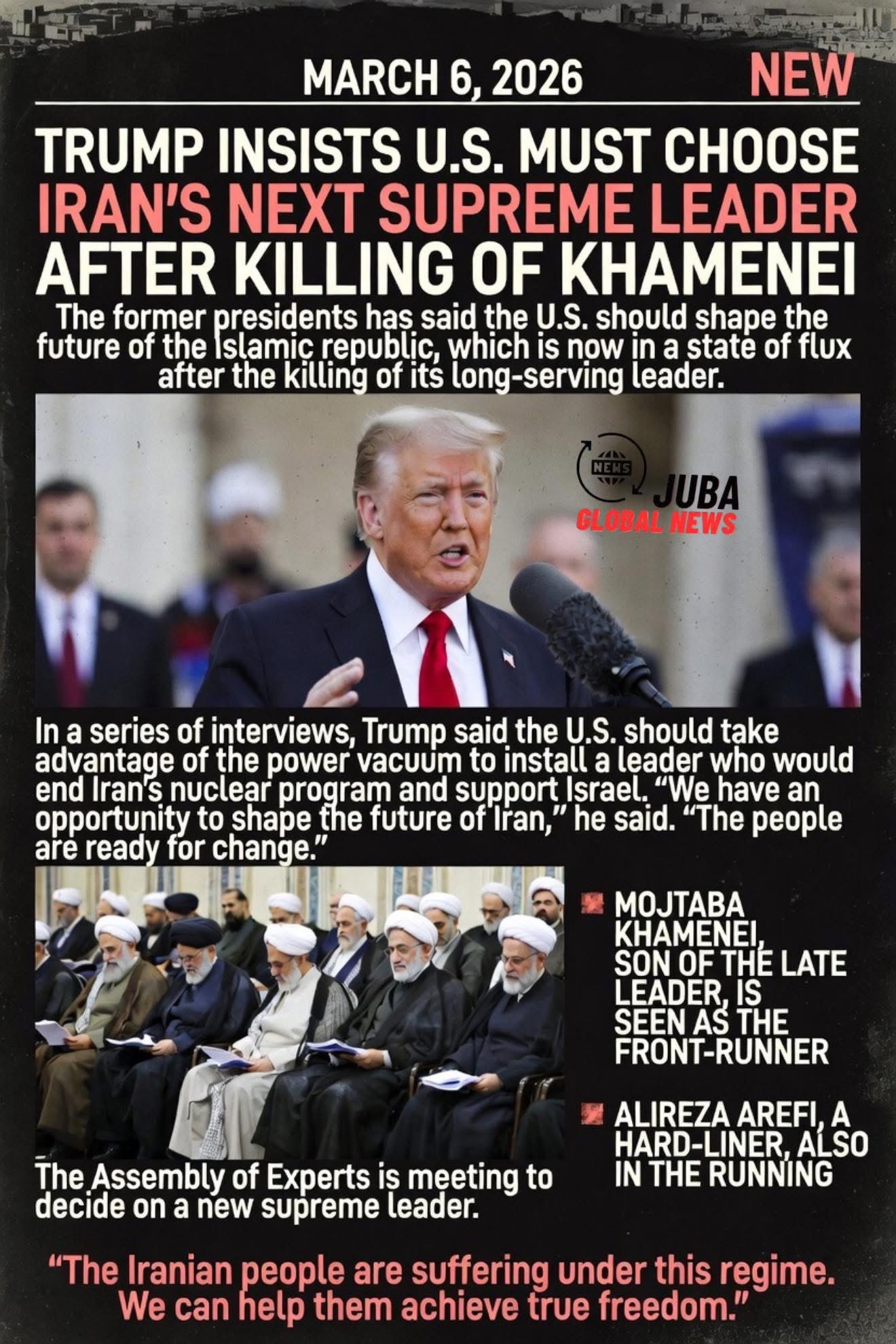
In a series of high-profile interviews and public statements on March 5–6, 2026, President Donald Trump has dramatically escalated the political dimensions of the US-Israel-Iran war by declaring that the United States “must have a role” in determining who becomes Iran’s next Supreme Leader following the targeted killing of Ayatollah Ali Khamenei in the conflict’s opening strikes. Trump explicitly labeled certain potential successors as “unacceptable,” most notably Mojtaba Khamenei—the late Supreme Leader’s son and long-rumored heir—calling him a “lightweight” unfit to lead.
The remarks mark a sharp departure from traditional US rhetoric on regime change and internal Iranian succession, injecting Washington directly into Tehran’s opaque clerical power structure at the height of active warfare.
The Assassination and Power Vacuum
Ayatollah Ali Khamenei, Iran’s Supreme Leader since 1989, was killed in the early hours of February 28, 2026, during the initial wave of coordinated US-Israeli airstrikes (Operation Epic Fury / Operation Roaring Lion). Multiple reports confirm a precision strike on a secure residence or command bunker in Tehran eliminated Khamenei, several senior IRGC commanders, and members of his immediate family. The strike decapitated the highest level of political and religious authority in the Islamic Republic, creating an unprecedented leadership crisis.
Under Iran’s constitution, the Assembly of Experts is tasked with selecting a new Supreme Leader. However, the ongoing bombardment, communication disruptions, security fears, and internal factional maneuvering have delayed any formal convening. An interim leadership council—reportedly including senior clerics such as Ali Reza Arafi (head of the Seminary of Qom) and other conservative figures—has assumed temporary oversight of state and religious affairs, but no permanent successor has been named as of March 6.
Trump’s Explicit Intervention
In a Fox News interview late March 5 and follow-up comments to Reuters and other outlets, Trump framed US involvement in Iran’s succession as both inevitable and necessary:
- “We’re not going to let some lightweight take over. Mojtaba? No way. He’s not acceptable. We have to have a role in choosing who comes next—someone who understands the new reality.”
- “Iran’s going to need strong leadership that doesn’t threaten the world with nukes and missiles. We’ve already taken out the old guy who caused all the problems. Now we make sure the next one is acceptable to the United States and our allies.”
- “If they pick the wrong person, we’ll keep hitting until they get the message. Simple.”
Trump also reiterated offers of “total immunity” to IRGC and Basij members who defect or refrain from fighting, signaling an attempt to fracture loyalty within the security apparatus and accelerate regime collapse or transformation.
The comments build on earlier statements in which Trump urged Iranian Kurds and other opposition groups to act, positioning the US as actively shaping post-Khamenei Iran rather than merely responding to events.
Potential Successors and US Red Lines
While the Assembly of Experts has not met, names frequently discussed in Iranian and regional media include:
- Mojtaba Khamenei (son of the late leader): Long viewed as the frontrunner before the war due to his behind-the-scenes influence and conservative credentials. Trump’s direct rejection appears aimed at blocking dynastic succession.
- Alireza Arafi or other senior Qom clerics: More establishment figures who could represent continuity.
- Ebrahim Raisi (former president, presumed dead or incapacitated in early strikes): No longer viable.
- Military-clerical hybrids or compromise candidates: Some analysts speculate the IRGC may push for a figure with strong security ties to maintain control amid wartime conditions.
Trump’s public veto of Mojtaba has been interpreted in Tehran as an attempt to delegitimize any Assembly decision that favors the Khamenei family, potentially deepening internal divisions between hardliners, pragmatists, and military factions.
Reactions in Iran and Internationally
Iranian state media denounced Trump’s statements as “blatant interference in sovereign religious affairs” and proof of American designs for regime change. Interim spokespeople vowed that succession would remain an internal Iranian process “free from foreign dictation.” Hardline outlets framed the comments as further justification for continued missile retaliation against Israel and US regional assets.
Internationally, reactions are mixed:
- Allies (Israel, Gulf states) have remained largely silent or offered tacit support, viewing any weakening of Iran’s clerical-military axis as strategically beneficial.
- European capitals and the UN expressed concern over escalation rhetoric and the precedent of a sitting US president publicly dictating terms for another nation’s supreme religious office.
- Russia and China condemned the statements as violations of sovereignty, with Moscow warning against attempts to “impose puppet leadership.”
Strategic Implications in a Widening War
Trump’s insistence on a US role in choosing Iran’s next leader reframes the conflict’s objectives beyond military degradation (nuclear sites, missiles, navy) toward explicit political engineering. It risks:
- Hardening Iranian resistance by unifying factions around national/religious sovereignty.
- Complicating any future diplomatic off-ramp, as Tehran now faces not only battlefield losses but existential threats to its ideological core.
- Encouraging opportunistic defections or uprisings—but also raising fears of chaotic fragmentation if the regime implodes without a clear successor.
As airstrikes pound Tehran for the 11th+ wave, Iranian missiles target Tel Aviv, and Kurdish groups weigh Trump’s encouragement, the war’s political endgame has become as explosive as its military dimension.
Juba Global News Network will continue tracking developments from Reuters, The New York Times, Al Jazeera, BBC, Axios, and regional sources. The situation remains highly volatile—consult verified outlets for real-time updates. Stay informed and safe.