

Trump Declares ‘War Has Been Won’ with Iran as US Pushes 15-Point Peace Plan
By Juba Global News Network | JubaGlobal.comMarch 25, 2026 In a bold and characteristically confident statement from the Oval Office, President Donald Trum
By Juba Global News Network | JubaGlobal.comMarch 25, 2026
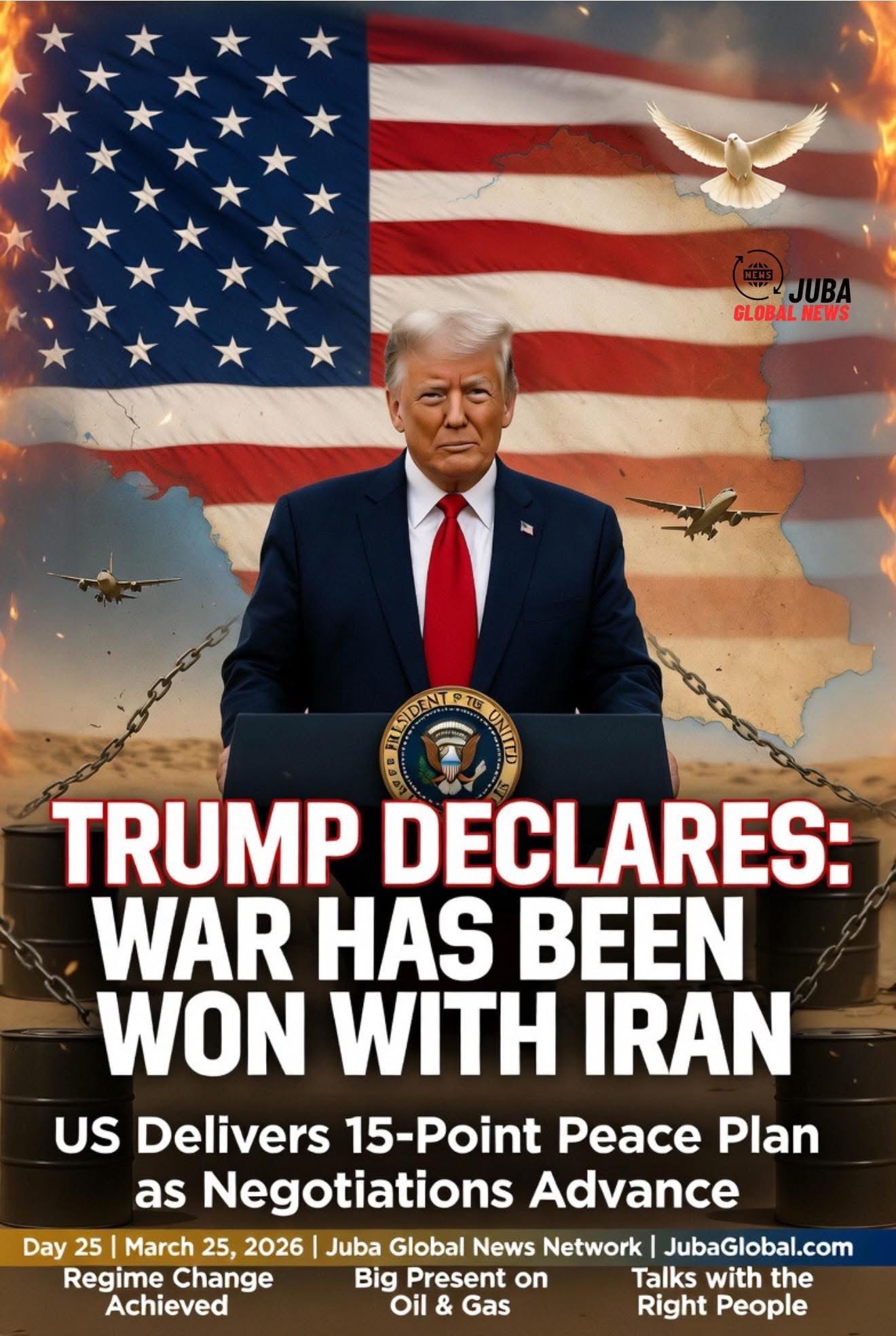
In a bold and characteristically confident statement from the Oval Office, President Donald Trump declared on Tuesday that the United States has effectively “won” the war against Iran, even as military operations continue and a detailed 15-point peace proposal has been transmitted to Iranian intermediaries. The announcement comes on day 25 of the US-Israel military campaign against Iran, which began on February 28, 2026, with massive coordinated strikes under Operation Epic Fury.3
Speaking to reporters, Trump asserted: “We’ve won this war. This war has been won.” He added that the only parties interested in prolonging the conflict are elements of the “fake news” media. The president claimed the US has achieved a form of regime change in Tehran, with new leadership emerging in the wake of strikes that targeted high-level Iranian figures, including the reported death of Supreme Leader Ali Khamenei earlier in the campaign.1
The 15-Point Peace Plan: Core Demands
According to multiple reports, the Trump administration has sent a comprehensive 15-point plan to Iran via intermediaries, including Pakistan. The document outlines conditions for a potential ceasefire and long-term settlement. Key elements reportedly include:
- Complete dismantlement of Iran’s three main nuclear sites and a permanent end to all uranium enrichment on Iranian soil.
- Verification mechanisms to ensure Iran never develops a nuclear weapon — described by Trump as “number one, number two, and number three” on the list.
- Cessation of support for proxy groups such as Hezbollah, Hamas, and the Houthis.
- Opening of the Strait of Hormuz to unrestricted international shipping and energy flows.
- Release of any remaining hostages or detained foreigners.
- Significant reductions in Iran’s ballistic missile arsenal and long-range strike capabilities.
- Economic and sanctions relief tied to verifiable compliance.
- Additional security guarantees and regional de-escalation measures involving Gulf states and Israel.15
Trump described receiving a “very big present” from the new Iranian leadership regarding oil and gas cooperation, raising hopes that energy markets could stabilize if the plan gains traction. He emphasized that negotiations are happening “right now” with “the right people” in Iran, naming envoys including Steve Witkoff and Jared Kushner as involved in back-channel contacts.18
Contrasting Signals from Tehran
Iranian officials have sharply rejected Trump’s narrative. Iran’s military and parliament speaker Mohammad Bagher Ghalibaf dismissed claims of productive negotiations as “psychological warfare” and “fake news.” Tehran continues to launch missile and drone barrages against Israeli cities and has threatened further escalation if US or Israeli strikes target energy infrastructure.24
Despite the denials, reports indicate indirect communications may be occurring through third parties. Iran maintains that any talks must respect its sovereignty and that the US and Israel bear responsibility for initiating the conflict.
Military Context: Strikes Continue Amid Diplomacy
Even as diplomatic overtures advance, the battlefield remains active:
- Israeli forces have conducted repeated airstrikes on targets in Tehran and other Iranian cities.
- Iran has responded with waves of ballistic missiles targeting Tel Aviv and other Israeli population centers, causing damage and casualties.
- The US has paused planned strikes on Iranian power plants for a five-day period to allow space for negotiations.
- The Pentagon is preparing to deploy over 1,000 paratroopers and additional forces to the Middle East to reinforce positions and support potential enforcement of any agreement.2
The war, now in its fourth week, has already caused significant disruption. The partial closure of the Strait of Hormuz has driven up global oil prices, triggered energy austerity measures in Asia, and raised fears of broader economic fallout. Dozens of attacks on shipping in the Persian Gulf have been reported.
Background: How the Conflict Escalated
Tensions boiled over after months of indirect nuclear talks. In late February 2026, President Trump, in coordination with Israeli Prime Minister Benjamin Netanyahu, authorized large-scale strikes aimed at neutralizing Iran’s nuclear program, missile capabilities, and leadership structures. Trump framed the operation as necessary to eliminate threats to the US, Israel, and the region, citing Iran’s support for terrorism, “Death to America” rhetoric, and alleged pursuit of nuclear weapons.7
The initial wave of nearly 900 strikes in a single day marked one of the largest US military operations in the Middle East since the 2003 Iraq invasion. Iranian retaliation included missile attacks on Israel and attempts to disrupt Gulf shipping.
Reactions and Global Implications
- Israel continues intense operations, signaling no immediate let-up until core threats are eliminated.
- Gulf states are monitoring developments closely, with some reportedly considering deeper involvement while others urge an immediate ceasefire to protect energy exports.
- China and several international actors have called for swift de-escalation to prevent a global economic meltdown.
- Markets remain volatile, with oil prices swinging on every rumor of progress or setback in talks.
Critics argue Trump’s optimistic declarations risk undermining diplomatic credibility if fighting continues unabated. Supporters view his approach as classic “maximum pressure” combined with deal-making — a strategy that previously brought Iran to the negotiating table.
What Comes Next?
The coming days will be critical. Iran’s response to the 15-point plan, delivered through intermediaries, could determine whether a temporary ceasefire takes hold or whether the conflict enters a more protracted phase. Trump has indicated flexibility on timelines but warned that failure to reach an agreement would mean continued “bombing our little hearts out.”
As the US readies additional troop deployments and Israel maintains pressure on multiple fronts, the world watches to see if bold rhetoric can translate into a lasting resolution — or if the 2026 Iran War will drag on, with far-reaching consequences for the Middle East and beyond.
Juba Global News Network will continue to monitor developments closely. For live updates, visit JubaGlobal.com.
This in-depth report provides comprehensive context, verified developments, and balanced perspectives on one of the most consequential stories of 2026. Stay informed with Juba Global News Network.
