

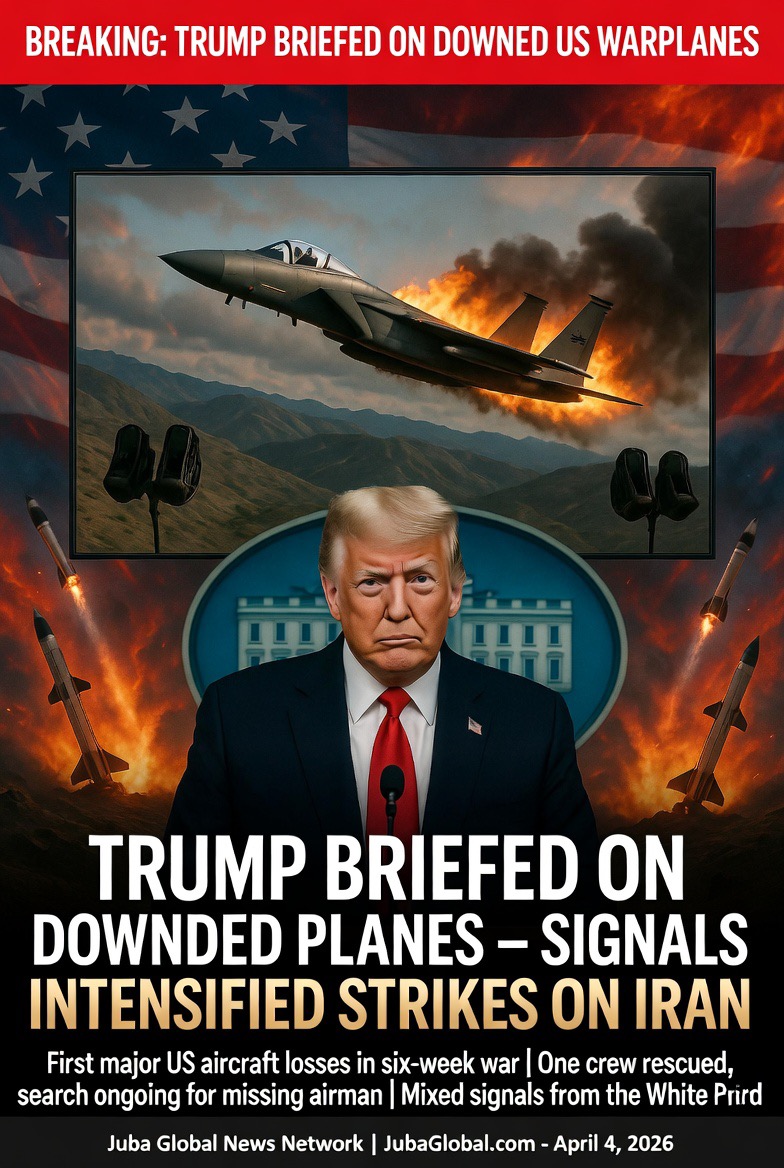
Trump Briefed on Downed Planes While Signaling Intensified Strikes on Iran
By Juba Global News Network | JubaGlobal.com April 4, 2026 President Donald Trump was briefed Friday on the downing of two US military aircraft by Iranian
By Juba Global News Network | JubaGlobal.com
April 4, 2026
President Donald Trump was briefed Friday on the downing of two US military aircraft by Iranian forces, an incident that marks the first confirmed loss of manned American warplanes in the six-week-old conflict. Despite the setback, the President has sent mixed signals, acknowledging the losses while maintaining a hardline stance and hinting at even more aggressive military action against Iran in the coming days.
White House Press Secretary Karoline Leavitt confirmed that President Trump received a detailed briefing on the incidents involving an F-15E Strike Eagle and a second combat aircraft. One crew member from the F-15E has been successfully rescued, while search-and-rescue operations continue for the second airman, whose status remains unknown.
In his first public comments following the briefing, Trump told NBC News that the downing of the US jet “would not affect any negotiations with Iran.” He described the situation bluntly, stating, “This is war. It is war,” and emphasized that the incident would not derail ongoing diplomatic efforts if Iran meets key US demands, including ending nuclear enrichment and reopening the Strait of Hormuz to international shipping.
However, the President has also signaled that intensified strikes could be imminent. In recent days, Trump has spoken of hitting Iran “extremely hard” over the next two to three weeks, even as he previously suggested that major operations might wind down soon. This apparent contradiction has raised questions about the administration’s strategy as the conflict enters what many analysts describe as a critical phase.
Mixed Messages from the White House
Trump’s communications have shown a blend of defiance and openness to talks. In a Truth Social post on Friday, he floated the idea of the United States “keeping the oil” in Iran, a remark that drew sharp criticism from opponents who called it “tone deaf” while American service members were still missing or at risk.
During the NBC interview, Trump declined to comment directly on the ongoing search-and-rescue mission but reiterated that America remains “unstoppable” and that Iranian air defenses have been largely neutralized. Earlier in the week, he claimed that Iran “is really no longer a threat” after 32 days of operations, only for Iranian forces to demonstrate renewed capability by downing the US aircraft.
These conflicting signals come as global oil prices continue to surge due to disruptions in the Strait of Hormuz, where Iran maintains significant influence. The President has given conflicting messages on the timeline for reopening the vital waterway, at times suggesting swift resolution through military pressure and at others hinting at possible negotiations.
Context of the Aircraft Losses
The downings occurred amid intensified US-Israeli airstrikes on Iranian infrastructure, including nuclear sites, missile facilities, and key bridges. Iranian state media and military officials celebrated the events as a major defensive victory, broadcasting footage and offering rewards for information leading to the capture of any downed pilots.
US officials have verified the loss of the F-15E Strike Eagle over southwestern Iran, confirming that both crew members ejected. One was rescued promptly by US forces. Details on the second aircraft remain less clear, with some reports mentioning possible involvement of an A-10 or another platform near the Persian Gulf region.
Military analysts note that while the US maintains overall air superiority, these incidents highlight remaining pockets of Iranian air defense capability, particularly in southern and southwestern provinces. The losses have prompted heightened caution in ongoing operations and raised concerns about the risks to American personnel.
Domestic and International Reactions
In Washington, the incidents have sparked partisan debate. Some Democratic lawmakers have accused the administration of putting US troops in “grave risk” through its approach to the conflict. Republican supporters, meanwhile, back the President’s tough posture, arguing that any sign of weakness would only embolden Iran.
Internationally, the events have heightened tensions across the Gulf region. Allies hosting US bases have increased security measures, while global markets reacted with volatility to the news. Humanitarian groups continue to warn of the growing civilian impact inside Iran and the broader regional fallout.
Iranian leadership, under the reported new Supreme Leader Mojtaba Khamenei, has used the shoot-downs for domestic propaganda, portraying them as proof of resilience despite weeks of heavy bombardment. Tehran continues to reject US demands and maintains its control over shipping routes in the Strait of Hormuz.
Strategic Outlook
The briefing and subsequent statements from President Trump come at a pivotal moment. With the war now stretching into its sixth week, questions persist about the endgame. The administration has spoken of degrading Iran’s nuclear and missile programs to the point where the country no longer poses a serious threat. Yet the downing of US aircraft and continued Iranian counterstrikes suggest that full victory remains elusive.
Analysts suggest the coming weeks will be decisive. If Trump follows through on threats of intensified strikes, the conflict could deepen further, with risks of wider regional involvement. Conversely, if diplomatic channels open and Iran shows willingness to compromise on enrichment and the Hormuz strait, a de-escalation path might emerge.
For now, the White House insists the mission continues on track. Search-and-rescue efforts for the missing crew member remain a top priority, with US forces operating under challenging conditions.
As developments unfold, the world watches to see whether the President’s mix of negotiation hints and strike warnings will bring the conflict closer to resolution or push it into a more dangerous phase.
